
MAPPING PM2.5 POLLUTION ZONES IN NIGERIA USING HIERARCHICAL CLUSTERING
DOI:
https://doi.org/10.33003/fjs-2025-0912-4150Keywords:
Agglomerative Hierarchical Cluster, Air Pollution, Air Quality Index, Nigeria, PM2.5Abstract
The persistent challenges in Nigeria's air-quality monitoring network have limited large-scale spatial assessments of particulate matter. This study conducts a national-scale clustering analysis of PM2.5 using agglomerative hierarchical clustering which does not require a pre-specified number of clusters and shows hierarchical linkages across monitoring sites. Ward's method was applied to daily PM2.5 data from 15 monitoring stations over the period from 2019 to 2023, using Euclidean distance to assess the similarity measure. Three distinct clusters were identified: High Pollution Regions (HPR) with an average PM2.5 concentration of 61.7 µg m⁻³, Medium Pollution Regions (MPR) at 46.7 µg m⁻³, and Low Pollution Regions (LPR) at 36.0 µg m⁻³. The 2019 haze episode produced peak concentrations of 197.7 µg m⁻³ in HPR, leading to a hazardous Air Quality Index (AQI) of 273. Cluster distributions demonstrated a significant correlation with land-use characteristics. HPR stations were primarily situated in industrial zones, MPR in densely built urban corridors, and LPR in coastal peri-urban regions. The resulting novel spatial stratification offers substantial evidence for developing targeted and regionally adaptive air quality management strategies across Nigeria.
References
Abayomi, O., Olayemi, T. E., & Ogungbade, T. (2021). Environmental pollution and its ecological consequences on the Niger Delta: A review of the literature. African Journal of Environment and Natural Science Research, 4, 27-42.
Abuh, P. O., & John, J. A. (2023). Geographic Analysis of Traffic Congestion in FCT-Abuja, Nigeria. Journal of Sustainability and Environmental Management, 2(1), 26-32.
Abulude, F. O., Oyetunde, J. G., & Feyisetan, A. O. (2024). Air Pollution in Nigeria: A Review of Causes, Effects, and Mitigation Strategies. Continental Journal of Applied Sciences, 19, 1-23.
Adeleye, M. A., Connor, S. E., & Haberle, S. G. (2021). A quantitative synthesis of Holocene vegetation change in Nigeria (Western Africa). The Holocene, 31(11-12), 1681-1689.
Almsatar, T. (2020). Environmental issues of biomass-burning in sub-Saharan African countries. In Biomass burning in sub-Saharan Africa: Chemical issues and action outreach (pp. 1-14). Dordrecht: Springer Netherlands.
Ameh, E. B. (2024). An Assessment of Supply Chain Resilience Capabilities in Nigeria's Downstream Oil and Gas Sector (Doctoral dissertation, Royal Roads University (Canada).
Arunachalam, G. (2024). A Human Health Risk Assessment (HHRA) associated with gaseous pollutants in the ambient environment at Coimbatore City's High Traffic Road.
Azizan, N. A., Othman, A. S., Meramat, A. A., Amin, S. N. S. M., & Azid, A. (2023). A framework to spatially cluster air quality monitoring stations in Peninsular Malaysia using the hybrid clustering method. Malaysian Journal of Fundamental and Applied Sciences, 19(5), 804-816.
Behr, A. S., Völkenrath, M., & Kockmann, N. (2023). Ontology extension with NLP-based concept extraction for domain experts in catalytic sciences. Knowledge and Information Systems, 65(12), 5503-5522.
Benabed, A., & Boulbair, A. (2022). PM10, PM2. 5, PM1, and PM0. 1 resuspension due to human walking. Air Quality, Atmosphere & Health, 15(9), 1547-1556.
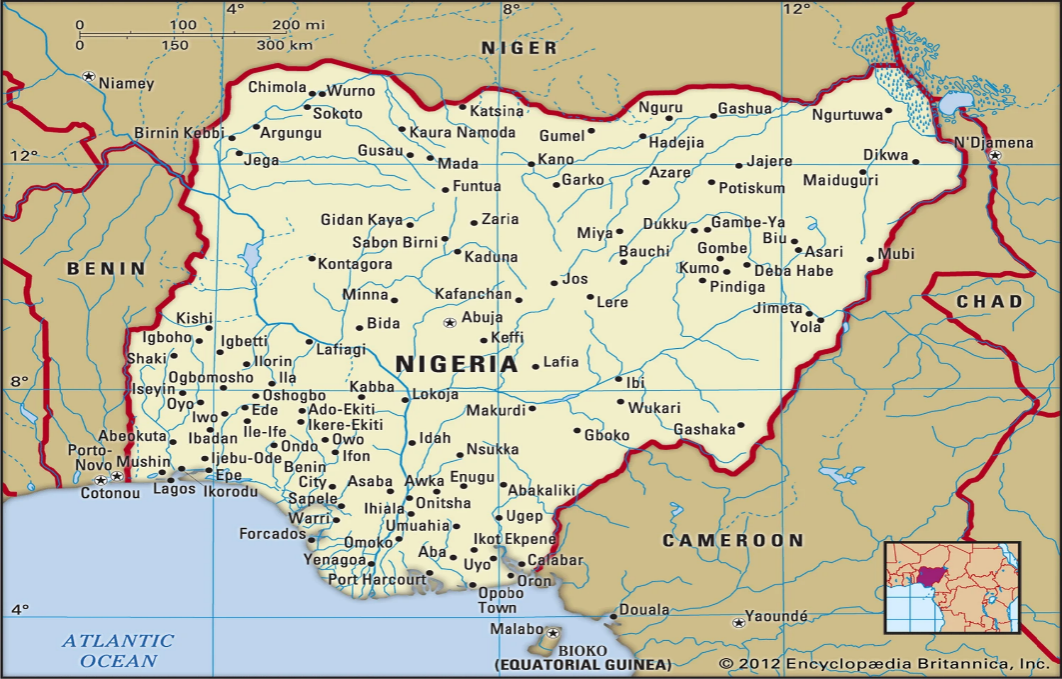
Britannica, T. Editors of Encyclopaedia (2025). List of cities and towns in Nigeria. Encyclopedia Britannica. https://www.britannica.com/topic/list-of-cities-and-towns-in-Nigeria-2042462. Accessed 23rd October, 2025
Busolo, W. S., & Njabira, V. I. (2022). Air Quality. In The Palgrave Handbook of Urban Development Planning in Africa (pp. 327-372). Cham: Springer International Publishing.
Chukwu, T. M. (2023). Assessment of air quality in urban settings in Nigeria: a comparison of perceptual indicators, causes and management in Abuja and Enugu (Doctoral dissertation, University of Surrey).
El-Araby, I. E., Moawed, S. A., Hassan, F. A., & Gouda, H. F. (2023). A combined approach of multiple correspondence analysis and hierarchical cluster analysis for profiling relationships among categorical risk predictors: a bluetongue case study. Slovenian Veterinary Research/Slovenski Veterinarski Zbornik, 60.
Elechi, F. A., Etea, E. A., & Mbanusi, E. C. (2023). Governance, security and economic cooperation in the southeast geo-political zone, Nigeria. South east Journal of Political Science, 9(1).
Evans, M. J., et al. (2022). A network of field-calibrated low-cost sensor measurements of PM2.5 in West Africa. ACS Earth and Space Chemistry,6(4), 1048-1062. https://doi.org/10.1021/acsearthspacechem.1c00391
Ezeh, G. C., Obioh, I. B., Asubiojo, O., Abiye, O. E., & Onyeuwaoma, N. D. (2019). A study of PM2. 5–10 pollution at three functional receptor sites in a sub-Saharan African megacity. Aerosol Science and Engineering, 3(3), 65-74.
Fu, D., Song, Z., Zhang, X., Wu, Y., Duan, M., Pu, W., ... & Xia, X. (2020). Similarities and Differences in the Temporal Variability of PM2. 5 and AOD between Urban and Rural Stations in Beijing. Remote Sensing, 12(7), 1193.
Garcia, A., Santa-Helena, E., De Falco, A., de Paula Ribeiro, J., Gioda, A., & Gioda, C. R. (2023). Toxicological effects of fine particulate matter (PM2. 5): health risks and associated systemic injuries—systematic review. Water, Air, & Soil Pollution, 234(6), 346.
Glenn, B. E., Espira, L. M., Larson, M. C., & Larson, P. S. (2022). Ambient air pollution and non-communicable respiratory illness in sub-Saharan Africa: a systematic review of the literature. Environmental Health, 21(1), 40.
Horn, S. A., & Dasgupta, P. K. (2024). The Air Quality Index (AQI) in historical and analytical perspective a tutorial review. Talanta, 267, 125260.
Ifie, I., Igwebuike, C. G., Imasuen, P., Akalamudo, W., Oghenebrorhie, O., Akpodiete, J. O., & Eze, U. A. (2022). Assessment of aflatoxin and heavy metals levels in maize and poultry feeds from Delta State, Nigeria. International Journal of Environmental Science and Technology, 19(12), 12551-12560.
Jin, X., Fiore, A. M., Civerolo, K., Bi, J., Liu, Y., Van Donkelaar, A., ... & Kinney, P. L. (2019). Comparison of multiple PM2. 5 exposure products for estimating health benefits of emission controls over New York State, USA. Environmental Research Letters, 14(8), 084023.
Khomenko, S., Cirach, M., Pereira-Barboza, E., Mueller, N., Barrera-Gómez, J., Rojas-Rueda, D., ... & Nieuwenhuijsen, M. (2021). Premature mortality due to air pollution in European cities: a health impact assessment. The Lancet Planetary Health, 5(3), e121-e134.
Kodiya, M. A., Modu, M. A., Ishaq, K., Yusuf, Z., Wakili, A. Z., Dayyabu, N., ... & Babangida, M. U. (2025). Environmental pollution in Nigeria: Unlocking integrated strategies for environmental sustainability. African Journal of Environmental Sciences and Renewable Energy, 18(1), 30-50.
Léon, J. F., Akpo, A. B., Bedou, M., Djossou, J., Bodjrenou, M., Yoboué, V., & Liousse, C. (2021). PM 2.5 surface concentrations in southern West African urban areas based on sun photometer and satellite observations. Atmospheric Chemistry and Physics, 21(3), 1815-1834.
Magi, B. I., Cupini, C., Francis, J., Green, M., & Hauser, C. (2020). Evaluation of PM2. 5 measured in an urban setting using a low-cost optical particle counter and a Federal Equivalent Method Beta Attenuation Monitor. Aerosol Science and Technology, 54(2), 147-159.
Maldonado-Salguero, P., Bueso-Sánchez, M. C., Molina-García, Á., & Sánchez-Lozano, J. M. (2022). Spatio-temporal dynamic clustering modeling for solar irradiance resource assessment. Renewable Energy, 200, 344-359.
Manisalidis, I., Stavropoulou, E., Stavropoulos, A., & Bezirtzoglou, E. (2020). Environmental and health impacts of air pollution: a review. Frontiers in public health, 8, 14.
Meo, S. A., Salih, M. A., Alkhalifah, J. M., Alsomali, A. H., & Almushawah, A. A. (2024). Environmental pollutants particulate matter (PM2. 5, PM10), Carbon Monoxide (CO), Nitrogen dioxide (NO2), Sulfur dioxide (SO2), and Ozone (O3) impact on lung functions. Journal of King Saud University-Science, 36(7), 103280.
Mitchell, L., & Bala, I. (2024). Thematic exploration of educational research after the COVID pandemic through topic modelling. Journal of Applied Learning & Teaching, 7(1), 26-34.
Mohd Shafi’i, M. S., & Juahir, H. (2024). Assessment of spatial air quality on the East Coast of Peninsular Malaysia utilizing environmetric techniques. Environmental Monitoring and Assessment, 196(7), 640.
Nnadi, V. E., Udokporo, E. L., & Okolo, O. J. (2022). Petroleum production activities and depletion of biodiversity: A case of oil spillage in the Niger Delta. In Handbook of Environmentally Conscious Manufacturing (pp. 95-111). Cham: Springer International Publishing.
Ogwu, M. C., Imarhiagbe, O., Ikhajiagbe, B., & Osawaru, M. E. (2024). Toward understanding the impacts of air pollution. In Sustainable Strategies for Air Pollution Mitigation: Development, Economics, and Technologies (pp. 3-43). Cham: Springer Nature Switzerland.
Oluwakoya, A. O. (2024). A comprehensive assessment of transportation emissions in Nigeria: Trends, drivers, and impacts. Proceedings of the Nigerian Academy of Science, 16(1s), 61-71.
Omokaro, G. O., Efeni, O. S., Adeyanju, O. I., Obomejero, J., & Akpotu, E. (2025). Oil spillage in the Niger Delta: impacts, institutional failures, and policy reforms. Academia Environmental Sciences and Sustainability, 2(3).
Paparrizos, J., Yang, F., & Li, H. (2024). Bridging the gap: A decade review of time-series clustering methods. arXiv preprint arXiv:2412.20582.
Raheja, G., Sabi, K., Sonla, H., Gbedjangni, E. K., McFarlane, C. M., Hodoli, C. G., & Westervelt, D. M. (2022). A network of field-calibrated low-cost sensor measurements of PM2. 5 in Lomé, Togo, over one to two years. ACS Earth and Space Chemistry, 6(4), 1011-1021.
Rahman, E. A., Hamzah, F. M., Latif, M. T., & Dominick, D. (2022). Assessment of PM2. 5 patterns in Malaysia using the clustering method. Aerosol and Air Quality Research, 22(1), 210161.
Singh, S., Kulshrestha, M. J., Rani, N., Kumar, K., Sharma, C., & Aswal, D. K. (2023). An overview of vehicular emission standards. Mapan, 38(1), 241-263.
Sooktawee, S., Kanchanasuta, S., & Bunplod, N. (2023). Assessment of 24-h moving average PM2. 5 concentrations in Bangkok, Thailand against WHO guidelines. Sustainable Environment Research, 33(1), 3.
Sufiyan, I., Mohammed, K. D., Bello, I. E., & Zaharadeen, I. (2020). Impact of harmattan season on human health in Keffi, Nasarawa State, Nigeria. Matrix Science Medica, 4(2), 44-50.
Ukpong, I. G., Balcombe, K. G., Fraser, I. M., & Areal, F. J. (2019). Preferences for mitigation of the negative impacts of the oil and gas industry in the Niger Delta region of Nigeria. Environmental and Resource Economics, 74(2), 811-843.
US EPA. (2024). Final updates to the Air Quality Index (AQI) for particulate matter. EPA Fact Sheet. Retrieved October 20, 2025, from https://www.epa.gov/system/files/documents/2024-02/pm-naaqs-air-quality-index-fact-sheet.pdf
Wambebe, N. M., & Duan, X. (2020). Air quality levels and health risk assessment of particulate matters in Abuja municipal area, Nigeria. Atmosphere, 11(8), 817.
World Health Organization. (2021). WHO global air quality guidelines: particulate matter (PM2.5 and PM10), ozone, nitrogen dioxide, sulfur dioxide and carbon monoxide. World Health Organization.
World Health Organization. (2022). Setting global research priorities for urban health. World Health Organization.
Xu, J., Xu, M., Zhao, Y., Wang, S., Tao, M., & Wang, Y. (2021). Spatial-temporal distribution and evolutionary characteristics of water environment sudden pollution incidents in China from 2006 to 2018. Science of the Total Environment, 801, 149677.
Downloads
Published
Issue
Section
Categories
License
Copyright (c) 2025 Emmanuel Yohanna, Dr. Jasini Waida, Emmanuel Yusuf Yila

This work is licensed under a Creative Commons Attribution 4.0 International License.


