The Impact of Temperature Variation on the Dielectric Properties of Prepared Stable Nanofluids and Methyl Ester
DOI:
https://doi.org/10.33003/fjs-2026-1015-4091Keywords:
Insulation, Nanofluids, Relative Permittivity, ViscosityAbstract
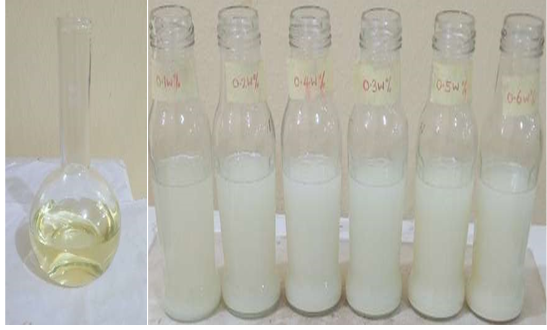
Vegetable oils are considered a replacement for mineral oil in that cooling and insulation of power equipment. This could be related to its environmental friendliness and abundance in Nigeria. Palm kernel (from vegetable) oil and titanium oxide (TiO2) nanoparticles were combined to prepare a stable nanofluid. However, the TiO2 is functionalized with oleic acid as a surfactant to enhance the stability of the fluid. Modified TiO2 nanoparticles were also characterized by Fourier Transform Infrared (FTIR) spectroscopy to ascertain their functional group. The impact of temperature variation on the dielectric properties of the prepared stable nanofluid samples at 0.1 to 0.6wt% of particles and methyl ester (obtained from palm kernel) was studied. The sample prepared at 0.6wt% has the highest suspension of 0.22g/l. Hence, the parameters used in the samples to be measured were relative permittivity, dielectric loss factor and viscosity. All samples' relative permittivity and dielectric loss factor were assessed using the Rohde & Schwarz HM8118 programmable inductive capacitive reactance (LCR) bridge within a frequency range of 20 to 200kHz. At the same time, viscosity was determined using the RVDV-1 Brookfield digital viscometer. From the FTIR results obtained, the peak at 650 per cm is fall within the range of Titania. The viscosity measurement showed that the activation energy of the samples increases with temperature by dissociating the molecules which disallows a fast rise in particle charge mobility contained in the fluids. And also, the increase in temperature resulted in the gradual increase in dielectric properties of prepared samples.
Downloads
Published
Issue
Section
Categories
License
Copyright (c) 2026 Muhammad Ya'u Muhammad, Abdelghaffar Amoka Abdelmalik, Yusuf Musa Abubakar, Balarabe Abubakar Ibrahim

This work is licensed under a Creative Commons Attribution 4.0 International License.