
Optimizing Irrigation Regimes and Intervals for Improved Water Productivity and Yield of Cucumber (Cucumis Sativus) in a Tropical Agroecological Zone
DOI:
https://doi.org/10.33003/fjs-2026-1016-3821Keywords:
Cucumis Sativus, Deficit Irrigation, Water Use Efficiency, Drip Irrigation, Tropical Agriculture, Evapotranspiration, Fruit QualityAbstract
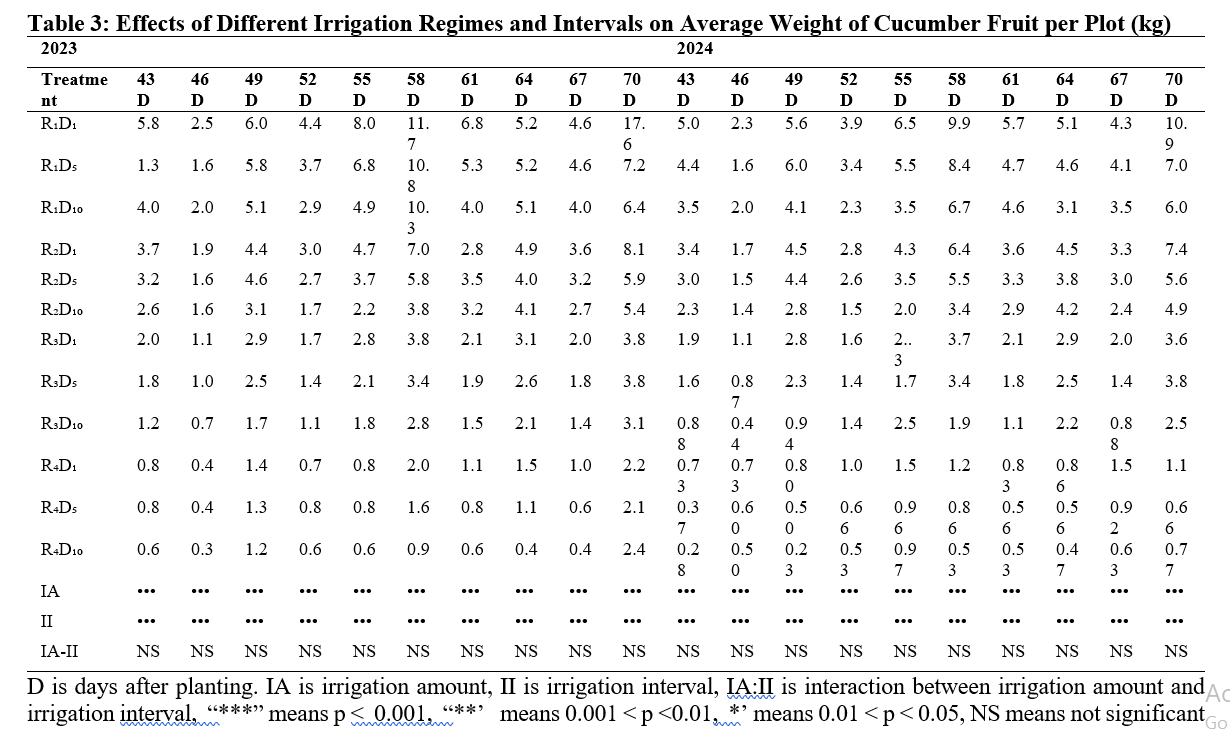
This study evaluated the effects of four irrigation levels (R1: 100% ETc; R2: 75% ETc; R3: 50% ETc; R4: 25% ETc) and three irrigation intervals (D1: daily; D5: 5-day; D10: 10-day) on cucumber yield, fruit quality, and water productivity under tropical greenhouse conditions in southeastern Nigeria. A randomized complete block design (RCBD) with a 4×3 factorial arrangement and three replications was implemented over two growing seasons (2023–2024). Crop evapotranspiration (ETc) was calculated using the FAO Penman-Monteith equation, with water applied via calibrated drip irrigation. Key results revealed that both irrigation amount (IA) and interval (II) significantly (p < 0.001) influenced all parameters. Maximum fruit yield (151 t/ha in 2023; 123.1 t/ha in 2024), fruit weight (17.6 kg/plot), length (36.1 cm), and diameter (5.99 cm) occurred under full irrigation with daily application (R1D1). Yield declined progressively with reduced IA and extended II, with R4D10 yielding only 16.3 t/ha (2023) and 11.5 t/ha (2024). Water productivity (WP) peaked at 73 kg/m³ (R1D1, 2023) and 43.1 kg/m³ (R2D1, 2024), while irrigation water productivity (IWP) reached 81 kg/m³ (R1D1, 2023). Crucially, R2D1 (75% ETc daily) maintained competitive yields (92 t/ha in 2023; 87.1 t/ha in 2024) and high WP/IWP, indicating potential for significant water savings with minimal yield penalty. Interactions between IA and II were nonsignificant for yield, WP, and IWP but significant for fruit dimensions over time (p < 0.001).
References
Adeleye, O. A., Ayeni, L. S., and Olatunji, A. T. (2021). Evaluation of irrigation scheduling for optimal yield and water productivity in cucumber (Cucumis sativus L.). Journal of Agronomy and Crop Science, 207(3), 551–561. https://doi.org/10.1111/jac.12498
Adeboye, A. O., Akintoye, H. A., and Aladesanmi, O. T. (2022). Water use efficiency and growth response of cucumber under regulated deficit irrigation in southwest Nigeria. African Journal of Agricultural Research, 17(1), 1–10.
Ahmed, F. E. M., Abd El-Mageed, T. A., and Awad, Y. M. (2021). Enhancing water productivity and fruit quality of cucumber via deficit irrigation strategies. Horticultural Plant Journal, 7(3), 150–158.
Ahmed, M., Hussain, S., and Hammad, H. M. (2020). Deficit irrigation strategies for water-scarce regions: Review and implications. Agricultural Water Management, 238, 106238. https://doi.org/10.1016/j.agwat.2020.106238
Ahmed, A., Oyebode, M.A., Igbadun, H.E. and Oiganji,E. (2020). Assessment of Tomato Farmers Irrigation Practices in Pampaida Millennium Villge Ikara Local Government Area, Kaduna State, Nigeria. FUDMA Journal of Sciences (FJS), 4(2), 499-509. https://doi.org/10.33003/fjs-2020-0402-232
Akhoundnejad, Y., Ashrafzadeh, A., and Gohari, A. (2019). Response of cucumber yield and quality to different irrigation levels under drip irrigation. Iranian Journal of Horticultural Science, 50(2), 185–195.
Ajayi, A. O. and Olasantan, F. O. (2022). Influence of irrigation and planting date on growth and yield of cucumber. Nigerian Journal of Horticultural Science, 27(1), 56–66.
Allen, R.G., Pereira, L.S., Raes, D and Smith M. (1998). Crops evapotranspirtation: guideline for computing crop water requirements. FAO irrigation and Drainage Paper 56, FAO, Rome, 300 (9), DO5109.
Ali M.H. and Talukder M.S.U (2008). Increasing water productivity in crop production – A synthesis. Agricultural Water Management, 95, 1201 – 1213.
Chukwuka, K. S., Ajayi, A. O., and Adegbite, K. A. (2019). Effect of irrigation interval on the growth and yield of cucumber (Cucumis sativus) in derived savannah zone of Nigeria. Nigerian Agricultural Journal, 50(1), 135–141.
El-Mageed, T. A., Semida, W. M., and Rady, M. M. (2023). Deficit irrigation strategies to enhance fruit quality and water productivity in cucurbits: A review. Irrigation Science, 41, 117–134.
Farre, I., and Faci, J. M. (2009). Deficit irrigation in maize for reducing water use. Agricultural Water Management, 96(3), 508–514.
Fereres, E., and Soriano, M. A. (2007). Deficit irrigation for reducing agricultural water use. Journal of Experimental Botany, 58(2), 147–159.
Geerts, S., and Raes, D. (2009). Deficit irrigation as an on-farm strategy to maximize crop water productivity in dry areas. Agricultural Water Management, 96(9), 1275–1284.
Hasanuzzaman, M., Bhuyan, M. H. M. B., and Al Mahmud, J. (2022). Water stress in vegetables: A review on physiological responses and management. Horticulturae, 8(9), 826. https://doi.org/10.3390/horticulturae8090826
Hassan, M. M., Baset Mia, M. A., and Rahman, M. S. (2021). Effects of irrigation interval and mulching on growth and yield of cucumber. Journal of Horticultural Research, 29(2), 23–30.
Howell T.A. (2001). Enhancing Water use efficiency in irrigated agriculture. Agron. J., 93 (2), 281 – 287.
Ibrahim, R. Y., Fajoye, M. O., and Usman, A. B. (2023). Irrigation scheduling and water management for cucumber cultivation in northern Nigeria. Nigerian Journal of Horticultural Science, 28(1), 102–110.
Igbadun, H. E., Ramalan, A. A., and Oiganji, E. (2012). Effects of regulated deficit irrigation and mulch on yield, water use and crop water productivity of onion in Samaru, Nigeria. Agricultural Water Management, 109, 162–169.
Jensen, C. R., Battilani, A. & Plauborg, F. (2020). Deficit irrigation based on drought tolerance and root signalling in potatoes. Agricultural Water Management, 222, 13–24.
Kadayifci, A., Tuylu, G. I., Ucar, Y. & Cakmak, B. (2020). Crop water stress index for watermelon. Agricultural Water Management, 36(1), 105–112.
Kassaye, A. & Solomon, K. (2021). Effect of deficit irrigation on yield and water productivity of cucumber in Ethiopia. International Journal of Agricultural Research, 16(2), 47–53.
Kharrou, M. H., Er-Raki, S., Chehbouni, A. & Duchemin, B. (2011). Water use efficiency and yield of olive trees under different irrigation regimes. Agricultural Water Management, 98(10), 1489–1496.
Musa, Y. M., Sani, B. M. & Adamu, M. (2022). Comparative analysis of drip and sprinkler irrigation systems for cucumber production in dry regions of Nigeria. Irrigation Science and Technology, 9(1), 11–22.
NIMET (Nigerian Meteorological Agency). (2023). 2023 Seasonal Climate Prediction for Nigeria. Abuja, Nigeria.
Olaoye, M. O., Ojo, F. T. & Adebisi, A. O. (2022). Evaluation of water productivity under different irrigation schedules in humid tropical vegetables. Tropical Agriculture, 99(2), 120–129.
Oyinlola, E. Y., Adeyemi, O. A. & Balogun, K. S. (2020). Water use efficiency and yield response of cucumber under varying irrigation intervals in Nigeria. African Journal of Plant Science, 14(8), 355–363.
Palanisami, K., Kumar, D. S. & Ramalingam, K. (2021). Improving water productivity through deficit irrigation: A study on cucumber. Water Resources Management, 35(3), 1015–1028.
Qiu, R. & T. Du (2013). Response of evapotranspiration and yield to planting density of solar greenhouse grown tomato in Northwest China. Agricultural Water Management, 130, 44 – 51.
Rafiee, M. & Nazari, M. (2022). Improving crop water productivity through optimized irrigation scheduling in open field cucumber production. Water Resources Management, 36(4), 1191–1205
Wang, F., Kang, S., Du, T., Li, F. & Qiu, R. (2011). Determination of comprehensive quality index for tomato and its response to different irrigation treatments. Agricultural Water Management, 98 (8), 1228-1238.
Wang, Z. and Liu, Z., Zhang, Z. & Liu, X. (2009). Subsurface drip irrigation scheduling for cucumber (cucumis sativus). Grown in solar greenhouse based on 20cm standard pan evapotranspiration in Northeast China. Scientia Horticulture, 123 (1), 51-57.
Zhang, T., Wang, J. & Li, S. (2023). Interactive effects of irrigation frequency and amount on cucumber yield and water productivity. Agricultural Water Management, 281, 108305. https://doi.org/10.1016/j.agwat.2023.108305
Zhao, Y., Liu, Y. & Shen, Y. (2020). Deficit irrigation strategies for water-saving agriculture: A global review. Agronomy, 10(12), 1929. https://doi.org/10.3390/agronomy10121929
Zwart, S. J. & Bastiaanssen, W. G. M. (2004). Review of measured crop water productivity values for irrigated wheat, rice, cotton, and maize. Agricultural Water Management, 69(2), 115–133.
Downloads
Published
Issue
Section
Categories
License
Copyright (c) 2026 Donatus Okwudiri Igbojionu, Valentine Ngozi Ekejiuba, Juliet Nnennaya Igbojionu; Patience C. Ezema; Helen Sampson, Cabrine Ifeoma Chiemeka

This work is licensed under a Creative Commons Attribution 4.0 International License.


