
Factors Influencing the use of Information and Communication Technologies (ICTs) on the Livelihood of Maize Farmers in Taraba State, Nigeria
DOI:
https://doi.org/10.33003/fjs-2026-1011-5494Keywords:
Factors, awareness, ICT, Maize, FarmersAbstract
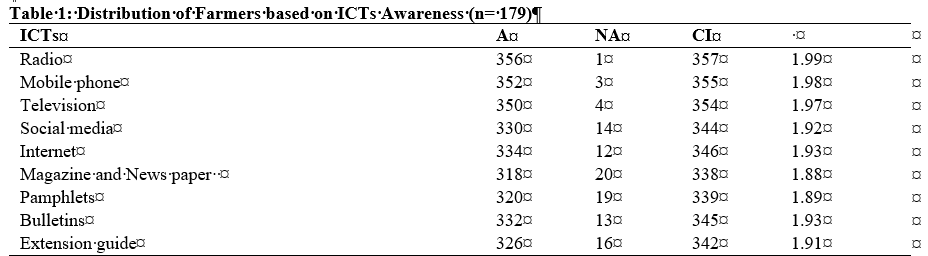
This study investigated factors affecting the use of information and communication technologies (ICTs) on the livelihood of maize farmers in Taraba State, Nigeria. Utilizing a multistage sampling method and Slovin’s formula, data were collected through primary sources and analyzed with descriptive and inferential statistics. Key findings revealed that most maize farmers were male (85%), female (15%). Majority were between 40-49 years old (67%), who were in their productive years. 84% were married and have larger household sizes, with 61% having six or more children. Educationally, 59% have tertiary education, 15% have primary education. Regarding farming experience, 43% had 16 years, and 78% cultivate 5 hectares of land. Institutionally, 52% of farmers were not members of cooperative societies, and 86% lack access to extension services. In terms of ICT access, 75% have access to ICTs, though only 14% have extension contact. On credit access, 84% of farmers find it inadequate. Income levels vary, with 52% earning over N1,000,000 annually. Awareness was determined using a confrontational index with benchmarks 1.50 means score, percentage and ranked. The result showed that farmers were aware of all the ICT components and uses them. The study concluded that socio-economic and institutional factors significantly influence ICT use among maize farmers. It was recommended that sex, household size, level of education, farming experience, farm size, cooperative membership, extension visit, access to ICTs, access to credit for ICTs were found to influence the use of ICTs by maize farmers and should be strengthened.
References
Adejoh, S. O., Edoka, M. H., & Shaibu, U. M. (2016) Comparative Analysis of the Determinants of Mass Media Usage by Urban and Rural Farmers in Kogi State. Nigeria. Journal of Agriculture Extension, Economics and Sociology, 14(3): 1-12, 2026; JAEES.30078. ISSN:2320-7027 SCIENCEDOMAIN international www.sciencedomain,org.
Agwu, A. E., Uche-Mba, U. C., & Akinnagbe, O. M. (2018). Use of information and communication technologies among researchers, extension workers and farmers in Abia and Enugu states: Implications for a national agricultural extension policy on ICTs. Journal of Agricultural Extension.12(11): 22-25.
Akeweta, J. N. Tata, L. A. & James, A. N. (2018). Information needs of farmers in Song Local Government area, Adamawa State, Nigeria. Journal of Agriculture, Food security and Sustainable environment, 1(1): 11.
Alfieri, L., Burek, P., Dutra, E., Krzeminski, B., Muraro, D., Thielen, J., & Pappenberger, F. (2015). GloFAS – global ensemble streamflow forecasting and flood early warning. Hydrology and Earth System Sciences, 17(3): 1161-1175. Online and Available at: https://doi.org/10.5194/hess-17-1161-2013.
Ariola, M. (2006) Principles and methods of research Ed. Publisher Rex bookstore, in. 2006 ISBN:97124583,9789712345487, pp 112-113.
Bekele, A., & Guadie, T. (2020). Multiple linear regression analysis on factors affecting maize production in Bench-Shako Zone: In case of Mizan-Aman District, Southwest Ethiopia. Journal of Advances in Bioscience and Bioengineering, 8: 24-30.
Food and Agriculture Organization (FAO, 2015). The State of Food and Agriculture. Social Protection and Agriculture: Breaking the Cycle of Rural Poverty. Food and Agriculture Organization of the United Nations, Rome, 2015.
Garandi, D. I., Tanko, H. S., Bukar, H. A., Bashir, A., Dasin, M. S., Chukwu, P. I., Gabul, P., & Wesley, P. (2026). Indigenous knowledge on land evaluation and soil fertility management among rural farmers in Mubi North Local Government Area, Adamawa State, Nigeria. FUDMA Journal of Sciences (FJS), 9(12): 356 – 362. Retrieved from DOI: https://doi.org/10.33003/fjs-2025-0912-4286
Gichangi, A., Birachi, E., Wambua, S., Kavoi, J., Karanja, D., Muriithi, F., & Mutua, M. (2019). Factors Influencing Smallholder Farmers’ Inputs Use in Major Bean Production Corridors in Kenya. Journal of Agriculture and Food Science, 17(1): 136-147.
Ibitola, O. R., Fasakin, I. J., Popoola, O. O., & Olajide, O. O. (2019). Determinants of maize farmers’ productivity among smallholder farmers in Oyo State, Nigeria. Greener Journal of Agricultural Sciences, 9(2): 189-198.
Ibrahim, M. K., Adejoh, S. O., & Edoka, M. H. (2019). Sources and uses of agricultural information among rural farmers in Ijumu Local Government Area of Kogi State, Nigeria. Proceedings of the 43rd annual conference of the agricultural society of Nigeria (ASN), held on the 20th–23rd October 2009, at Abuja, Nigeria. pp. 558 -561.
Kaduna, H., Yusuf, H. A., & Yusuf, H. O. (2024). An analysis of technological factors influencing the use of information and communication technologies (ICTs) by maize farmers in Taraba State, Nigeria. Journal of Agricultural Economics, Extension and Science. 10(1): 80-91.
Macire, K., Robert, O., & Christopher, C. (2016). Factors affecting the use of ICTs on agricultural input information by farmers in developing countries, School of Computing and Informatics, University of Nairobi, Nairobi Kenya.
Mani, J. R., Issah, F. O., Abdussalam, Z., & Damisa, M. A. (2022). National factors influencing farmer participation in maize production in Kaduna State, Nigeria, Journal of agriculture and environment,18(1): 1-11 ISSN: 1595-465X (Print) 2695-236X (Online)
Omotayo, O. M. (2015). ICT and Agricultural Extension. Emerging issues in transferring agricultural technology in developing countries. In: Adedoyin SF (ed), Agricultural Extension in Nigeria. Ilorin: Agricultural Extension Society of Nigeria.pp.145-157.
Organization for Economic Cooperation and Development. (OECD (2011). The OECD’S Project on Harmful Tax Practices. https://www.oecd.org/countries/tanzania/49755272.pdf ISBN: 978-951-724-993-5 (printed), ISBN: 978-951-724-994-2 (pdf), ISSN: 1235-7618. REPORT 2012:2 Country Proposed reference: Caldecott J, Valjas A, Killian B and Lounela. Table 5 Total MFA disbursements to Tanzania, 1991-2001.
Raktim, R. L. & Nivedita, D. (2019). Application of Information and Communication Technology (ICT) in Farm Management Department of Agric Economics and FM, Assam Agricultural University (AAU), in Jorhat District of India.
Ryan, T. (2013). Sample Size Determination and Power. John Wiley and Sons.
Tanko, Y. (2019). Determining the efficiency of rice production in the Kadawa rice cluster of Kano State, Nigeria. Journal of Economic Information, 6(4), 5-10.
Taraba Agricultural Development Programs (TADP, 2019). The impact of Taraba State agricultural programs TADP on rural farmers in Taraba State Nigeria.
Umar, M. M. (2015). Extension Communication. In: Perspectives on Mass Communication Issues: A Book of Reading 1 (Ed.) Malam, M. N. and M. B. Ali). Gidan Dabino Publishers, Kano, Nigeria, pp116-130 United Nations Economic for Latin America and the Carribbean (ECLAC), Food and Agricultural Organization (FAO), and Inter-American Institute for Cooperation on Agriculture (IICA) (2012). ICTs and the new challenges for Agricultural and rural development. The outlook for Agriculture and Rural Development in the Americas; A perspective on Latin America and the Caribbean, 115-139.
Yamane, T. (1967). Statistics: Introductory analysis, 2nd Edition, New York: Harper and Row
Yekini, O. T., Ladigbolu T. A., Adeniyi, R. T., & Adebisi, G. L. (2019), Benefits Derived from the Use of Information and Communication Technologies among Rural Farmers in Northeast Nigeria, Journal of Agricultural Extension. ISSN (e): 24086851; ISSN (Print); 1119944X. https://dx.doi.org/10.4314/jae.v23i3.10
Downloads
Published
Issue
Section
Categories
License
Copyright (c) 2026 Hwanvyon Kaduna, Zando Bala Agyo, Irimiya Akhenhunyo

This work is licensed under a Creative Commons Attribution 4.0 International License.


