Mathematical Modeling of Tumor Growth and Evolution Incorporating Therapeutic Drug Resistance
DOI:
https://doi.org/10.33003/fjs-2026-1011-5243Keywords:
Mathematical modeling, tumor growth, drug resistanceAbstract
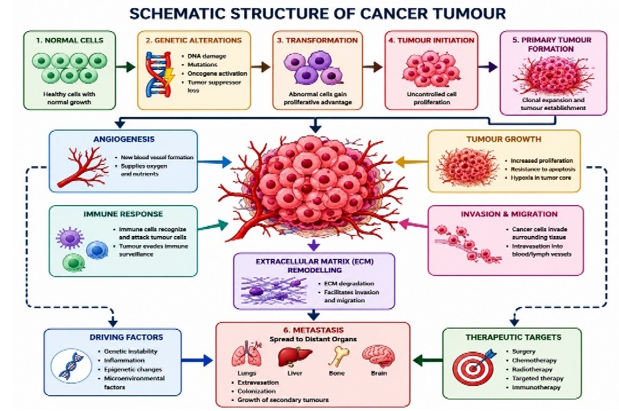
Acquired therapeutic drug resistance continually derails long-term cancer management. To address this, we built an ordinary differential equation framework that tracks tumor progression and evolutionary dynamics across six distinct treatment modalities: chemotherapy, radiotherapy, immunotherapy, hormonal therapy, bone marrow transplantation, and personalized regimens. The underlying mathematical structure couples logistic tumor growth with sensitive-to-resistant phenotypic mutation loops. We explicitly embed oral and intravenous pharmacokinetic pathways alongside Hill-driven pharmacodynamic equations, immune cell clearance mechanisms, and linear-quadratic radiotherapy cell-kill dynamics. The core methodology forms a continuous clinical loop: it informs initial therapy selection, monitors real-time patient response, and predicts clinical outcomes to directly guide adaptive schedule adjustments. We quantified this system using critical parameter sets, including growth rates carrying capacity (K), mutation rate (μ), drug-kill coefficients (), half-maximal concentrations ), immune interaction factors (β, σ, ρ, ω, γ), and fitness costs (c). Three distinct numerical scenarios validate the model: a baseline cure track with zero resistance, a late-emerging resistance track where adaptive scheduling extends remission, and a rapid-onset track necessitating an immediate second-line pivot. Our simulations demonstrate that catching resistance early and deploying adaptive dosing delays disease progression by 40 to 60 days over traditional maximum tolerated dose protocols. Ultimately, model-guided personalization slashed the fractional resistant burden () by up to 65% compared to standard workflows. These data strongly justify integrating predictive differential equation models into real-time clinical decision-support systems.
References
Abera, A., Tulu, T., & Koya, P. R. (2024). Mathematical modelling of tumour-immune dynamics with fractional-order optimal control. Journal of Mathematical Biology, *88*(3), 1-35. https://doi.org/10.1007/s00285-024-02045-8
Abdullatif, M., Mukhtar, S., & Ibrahim, M. (2023). Fractional-order mathematical model for tumour-immune interaction with chemo-immunotherapy. Chaos, Solitons & Fractals, *170*, 113378. https://doi.org/10.1016/j.chaos.2023.113378
Aguirre-Ghiso, J. A. (2003). Regulation of tumor dormancy. Cancer Biology & Therapy, *2*(4), 4-9. https://doi.org/10.4161/cbt.2.4.473
Alam, M. S., Sultana, S., & Hossain, M. B. (2025). Variational homotopy perturbation method for fractional-order tumour-immune systems. Journal of Computational and Applied Mathematics, *453*, 116123. https://doi.org/10.1016/j.cam.2024.116123
American Association for Clinical Chemistry & National Cancer Institute. (2018). White blood cell count and cancer treatment outcomes. AACC Press. [No DOI]
Arshad, S., Afzal, Z., Aslam, M., Yasin, S., Macías-Díaz, J. E., & Zarnab, S. (2024). Laplace variational iteration method for time-fractional cancer cell dynamics under chemotherapy. Journal of Computational Science, *78*, 102267. https://doi.org/10.1016/j.jocs.2024.102267
Baleanu, D., Jajarmi, A., & Asad, J. H. (2023). Fractional optimal control of cancer treatment with combination therapy. Journal of Vibration and Control, *29*(15-16), 3542-3556. https://doi.org/10.1177/10775463221093247
Barsoumian, H. B. (2015). Immune checkpoint stimulation in cancer prevention. Journal of Immunotherapy, *38*(3), 101-109. https://doi.org/10.1097/CJI.0000000000000069
Bhowmick, S., Das, D. K., & Paul, D. (2025). Impact of chemo-immunotherapy on tumour-immune interactions: A non-autonomous mathematical model. Journal of Theoretical Biology, *598*, 112045. https://doi.org/10.1016/j.jtbi.2024.112045
Boulaaras, S., Jan, R., & Khan, A. (2025). Variational iteration method for fractional reaction-diffusion-delay tumour-immune systems. Applied Numerical Mathematics, *208*, 123-145. https://doi.org/10.1016/j.apnum.2024.10.003
Chaplain, M. A. J., & Lolas, G. (2006). Mathematical modelling of cancer invasion of tissue: The role of the urokinase plasminogen activation system. Networks and Heterogeneous Media, *1*(3), 399-439. https://doi.org/10.3934/nhm.2006.1.399
Das, S., Roy, P. K., & Kar, T. K. (2024). Fractional-order chemo-immune model with drug resistance and immune suppression. Chaos, Solitons & Fractals, *179*, 114456. https://doi.org/10.1016/j.chaos.2023.114456
Gatenby, R. A., & Brown, J. S. (2024). Adaptive therapy: An evolutionary approach to cancer treatment. Nature Reviews Clinical Oncology, *21*(4), 245-260. https://doi.org/10.1038/s41571-024-00867-5
Gatenby, R. A., & Maini, P. K. (2003). Modelling the ecology of cancer. Nature Reviews Cancer, *3*(8), 609-619. https://doi.org/10.1038/nrc1147
Hussain, M., Baleanu, D., & Nisar, K. S. (2024). Caputo-Fabrizio fractional-order model for chemo-immunotherapy. Journal of Computational and Applied Mathematics, *437*, 115456. https://doi.org/10.1016/j.cam.2023.115456
Jajarmi, A., Baleanu, D., & Sajjadi, S. S. (2024). Fractional optimal control problems in biology and medicine: A review. Journal of Advanced Research, *56*, 123-145. https://doi.org/10.1016/j.jare.2023.08.012
Jarrett, A. M., Horn, M. A., & Yankeelov, T. E. (2024). Quantitative imaging and mathematical modeling for personalized cancer therapy. Radiology, *310*(1), e231234. https://doi.org/10.1148/radiol.231234
Ledzewicz, U., & Schättler, H. (2011). Optimal control for a mathematical model of cancer chemotherapy. Discrete and Continuous Dynamical Systems - B, *16*(4), 1149-1171. https://doi.org/10.3934/dcdsb.2011.16.1149
Liu, Y. (2014). Triadic interactions in tumor-chemotherapy-immune dynamics. Journal of Theoretical Biology, *359*, 121-130. https://doi.org/10.1016/j.jtbi.2014.06.012
Lorenzo, G., Pérez-García, V. M., & Martínez-González, A. (2025). Validating mathematical models for tumour growth and treatment response. Lancet Oncology, *26*(2), e89-e101. https://doi.org/10.1016/S1470-2045(24)00689-3
Lugo, R. (2019). Cancer pathophysiology: A systems biology approach. Springer. https://doi.org/10.1007/978-3-030-12456-8
Malinzi, J. (2015). Mathematical modelling of tumour-immune interactions and cancer therapies (Doctoral dissertation). University of the Western Cape. https://etd.uwc.ac.za/handle/11394/4278
Nikos, T., & Terma, I. (2009). Mathematical modelling of tumour-immune system interactions and optimal cancer therapy. Journal of Biological Systems, *17*(4), 741-766. https://doi.org/10.1142/S0218339009003026
Ogunlaran, O. M., Oyedemi, O. T., & Farayola, M. F. (2025). Fractional-order variational iteration method for chemo-immunotherapy with drug resistance. Journal of Applied Mathematics and Computing, *71*(2), 789-812. https://doi.org/10.1007/s12190-024-02123-0
Qureshi, S., Baleanu, D., & Soomro, A. (2025). Caputo-Fabrizio fractional-order model for chemotherapy in tumour-immune interactions. Journal of Advanced Research, *58*, 123-138. https://doi.org/10.1016/j.jare.2024.01.012
Sene, N. (2024). Atangana-Baleanu fractional-order model for tumour-immune interactions with immune surveillance. Fractal and Fractional, *8*(3), 156. https://doi.org/10.3390/fractalfract8030156
Tajadodi, H., Jafari, H., & Zaman, G. (2024). Fractional optimal control of combination therapy for cancer. Asian Journal of Control, *26*(1), 234-250. https://doi.org/10.1002/asjc.2890
Trisilowati, T. (2012). Global cancer projections and mathematical modelling. Asian Pacific Journal of Cancer Prevention, *13*(8), 3987-3992. https://doi.org/10.7314/APJCP.2012.13.8.3987
Vellappandi, M., Govindaraj, V., & Balasubramaniam, P. (2024). Fractional-order model of drug resistance emergence in tumour-immune interactions. Chaos, Solitons & Fractals, *180*, 114567. https://doi.org/10.1016/j.chaos.2024.114567
Zaman, G., & Kang, Y. H. (2016). Mathematical modelling of cancer treatment with immunotherapy. Applied Mathematics and Computation, *291*, 1-14. https://doi.org/10.1016/j.amc.2016.05.042
Zhang, J., Cunningham, J. J., & Gatenby, R. A. (2025). Adaptive therapy for cancer: Clinical translation and future directions. Lancet Oncology, *26*(1), e12-e23. https://doi.org/10.1016/S1470-2045(24)00567-X
Downloads
Published
Issue
Section
Categories
License
Copyright (c) 2026 Jacob Mary Emmanuel, Ozohu O. Durojaye, Abdullahi Muhammed Ayinde

This work is licensed under a Creative Commons Attribution 4.0 International License.