
Evaluation of the Effects of Bacillus Species Co-culture on some Quality Characteristics of Fermented African Locust Beans (Iru)
DOI:
https://doi.org/10.33003/Keywords:
African locust beans, Iru fermentation, Bacillus subtilis, Bacillus licheniformis, Coculture, AcceptabilityAbstract
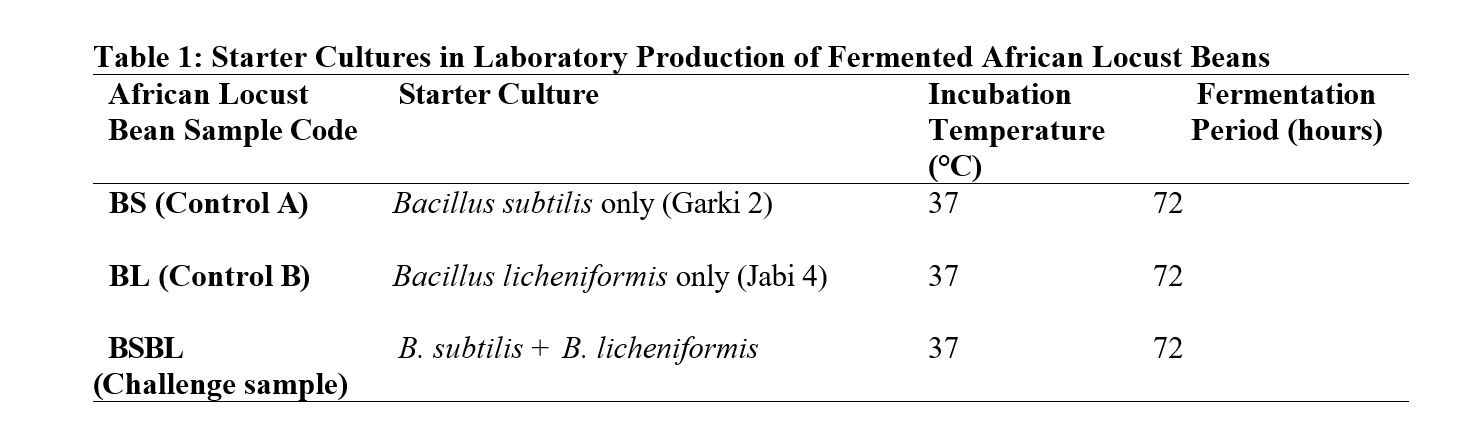
Fermentation of African locust beans (Parkia biglobosa) is primarily facilitated by Bacillus species, producing a condiment known by various names across Nigeria (Iru in South-Western Nigeria). This work studied the potential of two starter cultures and their coculture for the fermentation of African locust bean (Parkia biglobosa) to produce Iru. Single cultures of Bacillus subtilis (BS) and Bacillus licheniformis (BL) and their coculture (BSBL) were used as starter cultures for fermentation at 37oC for 72h. Fermenting African locust beans were analyzed for microbial counts and pH during fermentation while proximate analysis and sensory evaluation were carried out following fermentation.. Counts increased from initial inoculum sizes of 0.5 McFarland standard (1.5x10⁸ Cfu/g) where sample BL showed the highest count at 24h (11.3log10 Cfu/g) and at 72h (15.1log10 Cfu/g). Sample BSBL had the lowest counts at 24h (10.4log10 Cfu/g) and at 72h (14.3log10 Cfu/g). Proximate analysis showed significant differences (P< 0.05) with sample BS having the highest crude protein (8.8%) and moisture (69.4%) contents while sample BL yielded highest ash content (0.8%).Statistical analysis showed significant differences in results of sensory evaluation (P< 0.05) with coculture fermented Iru receiving the highest ratings for aroma, taste, colour, and overall acceptability whereas products fermented with single cultures were less preferred. Findings suggest that single cultures of B.subtilis and B.licheniformis enhance the nutritional quality of Iru, while their coculture produce a more acceptable product. Further studies are recommended to assess safety characteristics with a view to promoting industrial applications to enhance consistency in quality and safety.
References
Achi, O.K. (2005). The upgrading of traditional fermented foods through Biotechnology. African journal of Biotechnology ,4(5),375-380 .
Adebayo-Tayo, B. C., Onilude, A. A., & Ogunjobi, A. A. (2008) Comparative effect of Bacillus subtilis and Bacillus licheniformis on the fermentation of African locust bean (Parkia biglobosa) seeds. Africa Journal of Biotechnology, 7(14), 2590–2596.
Adesanya, B. J., Faasema, J., & Acham, I. O. (2021). effect of bacillus subtilis concentration and fermentation time on the quality of african locust bean condiment. Bacterial Empire, 4(2), e96.
https://doi.org/10.36547/be.96.
Ajiboye, A. & Hammed, B. (2020). Antimicrobial activity of the crude extracts of Parkia biglobosa (Jacq) seeds on selected clinical isolates. 18(2). https://doi.org/10.4314/br.v18i2.2.
Bogueva, D., & Danova, S. (2024). Comparing precision fermentation and traditional fermentations: Consumer views. In Consumer perceptions and food (pp. 563–588). Springer.
Bungenstock, L., Abdulmawjood, A., & Reich, F. (2020). Evaluation of antibacterial properties of lactic acid bacteria from traditionally and industrially produced fermented sausages from Germany.
Cairo, J.,Gherman ,I.,Day, A., & Cook, P.E. (2022). Bacillus Cytotoxicus -A potentially virulent food -associated microbe. Journal of Applied microbiology 132,31-40.10.1111/Jam 15214,
Carroll, M., Wiedmann L., M., & Kovac, J. (2020). Proposal of a Taxonomic Nomenclature for the Bacillus cereus Group Which Reconciles Genomic Definitions of Bacterial Species with Clinical and Industrial Phenotypes.
Chai L., Lu ,Z.M., Zhang,X.J., Li,Q., Wang,S.T., Shen,C.H., Shi ,J.S., &Xu ,Z.H.,(2021) Cooperation within the microbial consortia of fermented grains and pit mud drives organic acid synthesis in strong – flavor Baijiu production. Food research international ,147,110449. https;//doi.org/10.1016/j.foodres.2021.110449.
Das, K., Choudhary, R., & Thompson-Witrick, K. A. (2019). Effects of new technology on the current manufacturing process of yogurt-to increase the overall marketability of yogurt. Lebensmittel-Wissenschaft & Technologie, (Food Science and Technology.), 108, 69–80. https://doi.org/10.1016/j.lwt.2019.03.05.
Diawara, B., Sawadogo, L., Kabore´, I.Z., 1992. Contribution a` 204 L.I.I. Ouoba et al. / International Journal of Food Microbiology 90 (2004) 197–205 l’e´tude des proce´de´s traditionnels de fabrication du ‘‘soumbala’’ au Burkina Faso, aspects biochimiques, microbiologiques et technologiques. Sciences et Techniques 20, 5 – 14.
Eboma, R. N., Ogidi, C. O., & Akinyele, B. J. (2020). Bioactive compounds and antimicrobial activity of extracts from fermented African locust bean (Parkia biglobosa) against pathogenic microorganisms. North African Journal of Food and Nutrition Research, 4(8), 343–350.
Famuwagun, A. A. & Taiwo, K. A. (2023). Drying characteristics, nutritional and anti-nutritional properties of locust bean seed. Cogent Food & Agriculture. https://www.tandfonline.com/doi/full/10.1080/23311932.2023.2202276.
Felix, A. E., & Francis, A. K. (2019). Effect of traditional fermentation process on the nutrient and anti- nutrient content of maize and African locust beans. Journal of Food Science and Nutrition Research, 2(2), 65–75.
Okolie, P. I., Okolie, E. C., Ogundimu, S. A., Agboola, K. A., & Ojinnaka, M. C. (2022). effects of bacillus amyloliquefaciens culture concentrations on microbial load, physicochemical and sensory properties of “iru”-type condiment from african yam bean (Sphenostylis stenocarp) SEEDS. Food and Environment Safety Journal, 21(1).
Pedrazzani, C., Viscusi, P., Fuso, A., & Caligiani, A. (2024). Development of a protocol for fractionating and characterising fibres from lignocellulosic food Anderson, B. & Grant, R. (1993). G93-1168.
Tamang, J. P., Cotter, P. D., Endo, A., Han, N. S., Kort, R., Liu, S. Q., Mayo, B., Westerik, N., & Hutkins, R. (2020). Fermented foods in a global age: East meets West. Comprehensive Reviews in Food Science and Food Safety, 19(1), 184–217.
Tersoo-Abiem, E. M., Sule, S., Iwuamadi, I., & Awulu, E. O. (2021). Quality Evaluation of Dried Fermented Locust Bean and Soybean Condiments. European Journal of Agriculture and Food Sciences, 3(2), 63–67. https://doi.org/10.24018/ejfood.2021.3.2.261.
Zhao, M., Yu, J.,Liu,Q., Ma,Xu,J, Yu,D.(, September ,2022) Co fermentation of Bacillus and Bacillus licheniformis and its application in the feeding of Koi. Aquaculture research ,53(3) Doi:10.1111/are ,16077.
Zhang, C., Zhang, J., & Liu, D. (2021). Biochemical changes and microbial community dynamics during spontaneous fermentation of Zhacai, a traditional pickled mustard tuber from China. International Journal of Food Microbiology.
Atfaoui, K., Ettoui, A., Fadil, M., Asmaa, O., Inekach, S., Ouhssine, M., & Zarrouk, A., (2021). Controlled fermentation of food industrial wastes to develop a bioorganic fertilizer by using experimental design methodology. Journal of the Saudi society of agricultural sciences, 20(8), 544-552.
Toor, B., Kataria, A., Kaur, A., & Sharma, S., (2022). Advances in food fermentation. In food Processing and preservation Technology (pp. 203-244). Apple Academic Press.
Sanya, E. A., Ahouansou, R. H., Bagan, G., Vianou, A., & Hounhouigan, D. J. (2013). Effects of some pretreatments of African locust bean seeds (Parkia biglobosa) on delivered efficiency of a devised dehuller. Research Journal of Recent Sciences.
Downloads
Published
Issue
Section
Categories
License
Copyright (c) 2026 OLUWAYEMISI ESTHER MARQUIS, SAKINA BELLO

This work is licensed under a Creative Commons Attribution 4.0 International License.


