
Spatiotemporal Assessment of Environmental Noise Exposure and Associated Health Effects around Religious Centers in Abeokuta, Nigeria
DOI:
https://doi.org/10.33003/fjs-2026-1010-5114Keywords:
Environmental Noise Pollution, Religious Centers, Noise Exposure, Public Health, Urban Environmental ManagementAbstract
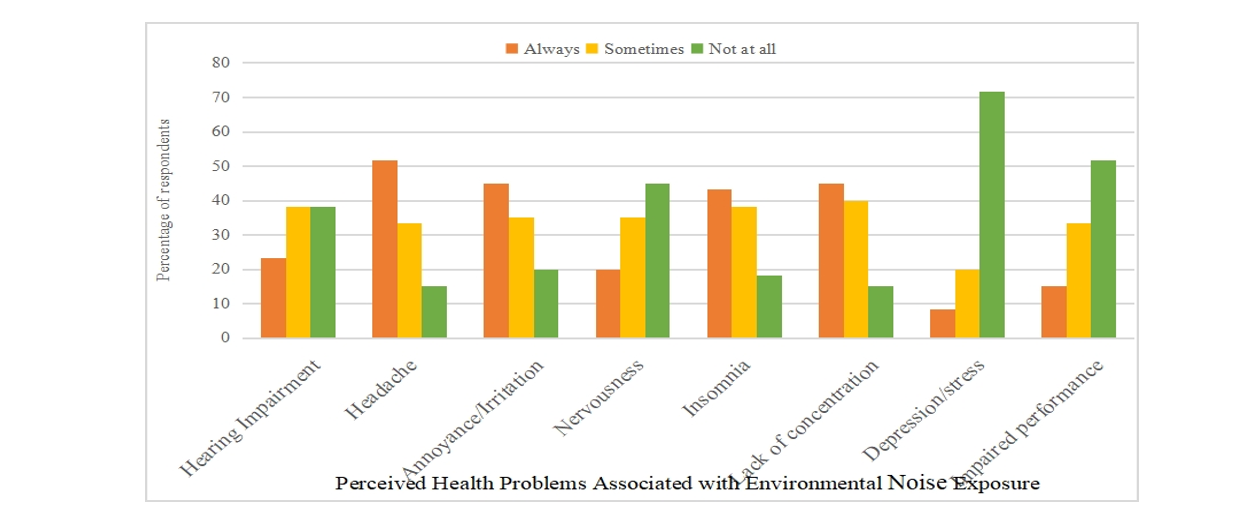
Environmental noise pollution from religious activities has emerged as a pressing environmental health concern in rapidly urbanizing Nigerian cities. This study assessed noise levels from selected churches and mosques in Abeokuta and examined the associated health effects among nearby residents. A cross‑sectional design combining environmental noise monitoring and questionnaire surveys was adopted. Twenty religious centers (15 churches, 5 mosques) were sampled, and 200 residents participated. Noise levels were measured with a calibrated sound level meter during morning, afternoon, and evening/night periods. Data were analyzed using descriptive statistics, independent samples t‑test, one‑way ANOVA, and Pearson correlation. Mean environmental noise across all centers was 85.48 ± 9.03 dB (A), exceeding World Health Organization and NESREA residential limits. Churches recorded significantly higher noise levels than mosques (t = 4.62, p = .001). Noise intensity varied across time, with evening/night worship activities producing the highest levels, F (2, 57) = 8.47, p = .002. Commonly reported health complaints included headache (51.7%), annoyance (45.0%), insomnia (43.3%), and lack of concentration (45.0%). Correlation analysis revealed strong positive associations between noise exposure and headache (r = .71, p < .01) as well as sleep disturbance (r = .64, p < .01).
The findings demonstrate that religious noise constitutes a significant environmental health challenge in Abeokuta. Stricter enforcement of noise regulations and adoption of sustainable control measures are recommended to protect residential communities from adverse health impacts.
References
Ayanugo, A. O., Ogaji, D., & Agbapuonwu, N. E. (2024). Association of Church-House noise pollution on mental health of individuals living in proximity in Owerri, Imo State. International Journal of Public Health, Pharmacy and Pharmacology, 9(3), 12–22.
Basner, M., Babisch, W., Davis, A., Brink, M., Clark, C., Janssen, S., & Stansfeld, S. (2014). Auditory and non-auditory effects of noise on health. The Lancet, 383(9925), 1325–1332.
Chen, X., Liu, M., Zuo, L., Wu, X., Chen, M., Li, X., An, T., Chen, L., Xu, W., Peng, S., Chen, H., Liang, X., & Hao, G. (2023). Environmental noise exposure and health outcomes: An umbrella review of systematic reviews and meta-analyses. European Journal of Public Health, 33(4), 725–731.
Eseroghene, A. (2019). Noise levels and frequency response from religious houses in Portharcourt City Local Government Area. International Journal of Environmental Protection and Policy, 7(1), 24–31. https://doi.org/10.11648/j.ijepp.20190701.14
Evans, G. W., & Cohen, S. (1987). Environmental stress. In D. Stokols & I. Altman (Eds.), Handbook of environmental psychology (Vol. 1, pp. 571–610). New York: Wiley.
Halperin, D. (2014). Environmental noise and sleep disturbances: A threat to health? Sleep Science, 7, 209–212. https://doi.org/10.1016/j.slsci.2014.11.003
Hahad, O., Kuntic, M., Al-Kindi, S., Gilan, D., Petrowski, K., Daiber, A., & Münzel, T. (2025). Noise and mental health: Evidence, mechanisms, and consequences. Journal of Exposure Science & Environmental Epidemiology, 35, 16–23.
Hahad, O., Prochaska, J. H., Daiber, A., & Muenzel, T. (2019). Environmental noise-induced effects on stress hormones, oxidative stress, and vascular dysfunction: Key factors in the relationship between cerebrocardiovascular and psychological disorders. Oxidative Medicine and Cellular Longevity, 2019, Article 4623109.
Hammer, M. S., Swinburn, T. K., & Neitzel, R. L. (2014). Environmental noise pollution in the United States: Developing an effective public health response. Environmental Health Perspectives, 122(2), 115–119.
Ikibe, S., & Adekogbe, O. S. (2020). Exposure to excessive sound volume: A major challenge in the South-Western Nigeria church auditoria. Advances in Research, 21(10), 54–65.
Kango, A., Abdullah, S., Thahir, M., Fata, A., & Kamaruzzaman, K. (2025). The Toa dilemma: Responses to the public use of loudspeakers in Indonesian local tradition. Religió: Jurnal Studi Agama-Agama, 15(1). https://doi.org/10.15642/religio.v15i1.3311
Lu, D., & Kwan, M. (2025). Influence pathways of noise exposure on people’s negative emotions and health across different activity contexts: A neural network-based double machine learning approach. Health & Place, 93, 103455. https://doi.org/10.1016/j.healthplace.2025.103455
Münzel, T., Molitor, M., Kuntic, M., Hahad, O., Röösli, M., Engelmann, N., Basner, M., Daiber, A., & Sørensen, M. (2024). Transportation noise pollution and cardiovascular health. Circulation Research, 134(9).
Münzel, T., Sørensen, M., Schmidt, F., Schmidt, E., Steven, S., Kröller-Schön, S., & Daiber, A. (2018). The adverse effects of environmental noise exposure on oxidative stress and cardiovascular risk. Antioxidants & Redox Signaling, 28, 873–908. https://doi.org/10.1089/ars.2017.7118
National Environmental Standards and Regulations Enforcement Agency. (2009). National environmental (noise standards and control) regulations 2009. Nigeria.
Sackey, L., Abugre, J., Fei-Baffoe, B., Amuah, E., & Amoako, R. (2024). Assessment of noise levels of churches in the Kpone Katamanso Municipal Assembly in Ghana. The Scientific World Journal, 2024, Article 6674297. https://doi.org/10.1155/2024/6674297
Sakthivel, R., Kamalakannan, L., Shanmugam, R., & Venugopal, V. (2025). Nonauditory impacts of industrial noise exposures: A case study from a steel manufacturing industry. Safety and Health at Work, 16, 243–248. https://doi.org/10.1016/j.shaw.2025.01.004
Silva, L., & Cabral, R. (2011). Noise exposure levels of priests and worshippers in Protestant churches. International Journal of Occupational Safety and Ergonomics, 17, 79–86. https://doi.org/10.1080/10803548.2011.11076872
Udeh, N. U., Amah, V. E., & Amadi, R. C. (2023). Spatial distribution of noise from religious houses in Rumu-Okwachi community, Rivers State, Nigeria. Advances in Research, 24(4), 47–58.
World Health Organization. (2015, March 10). 1.1 billion people are at risk of hearing loss.
Zaman, M., Muslim, M., & Jehangir, A. (2022). Environmental noise-induced cardiovascular, metabolic and mental health disorders: A brief review. Environmental Science and Pollution Research, 29, 76485–76500. https://doi.org/10.1007/s11356-022-22351-y
Downloads
Published
Issue
Section
Categories
License
Copyright (c) 2026 Wole Odubanjo, Oduwole Odubanjo, Funmilola Odubanjo, Mohammed Sanni

This work is licensed under a Creative Commons Attribution 4.0 International License.


