
ALLELOPATHIC EFFECTS OF Tithonia diversifolia N-BUTANOLIC SUB-FRACTIONS ON WEED SUPPRESSION, GERMINATION, AND CYTOTOXICITY IN TWO COWPEA VARIETIES
DOI:
https://doi.org/10.33003/fjs-2026-1005-4989Keywords:
allelopathy, weed suppression, Vigna unguiculata, germination inhibition, cytotoxicity, bioherbicideAbstract
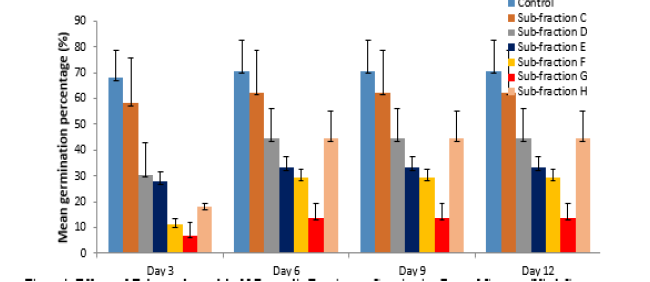
The search for sustainable alternatives to synthetic herbicides has intensified interest in plant-derived allelochemicals for weed management. This study evaluated the effects of Tithonia diversifolia n-butanolic sub-fractions on weed suppression indices, germination, seedling growth, and cytotoxicity in two varieties of Vigna unguiculata (Vital-5 and K-28). Germination was significantly reduced in all treated groups compared to the control, with sub-fraction G exhibiting the strongest inhibitory effect, particularly in Vital-5, while K-28 showed relatively higher tolerance. Seedling growth responses revealed consistent inhibition of radicle elongation across treatments, whereas some sub-fractions (E and H) stimulated plumule growth in K-28, suggesting a hormetic response. All sub-fractions demonstrated measurable weed suppression, with G showing the highest suppression and E exhibiting the greatest weed suppression efficiency. Cytological analyses revealed pronounced mitotic abnormalities, including micronuclei formation, chromosomal fragmentation, spindle disruption, and complete mitotic arrest, indicating strong cytotoxic and effects. Overall, the findings highlight the significant allelopathic and bioherbicidal potential of T. diversifolia n-butanolic sub-fractions. However, the observed phytotoxicity to cowpea underscores the need for optimization to achieve selective weed control in sustainable agricultural systems.
References
Ajao, A. A., & Moteetee, A. N. (2017). Tithonia diversifolia (Hemsl) A. Gray.(Asteraceae: Heliantheae), an invasive plant of significant ethnopharmacological importance: A review. South African Journal of Botany, 113, 396-403.
Cheng, F., & Cheng, Z. (2015). Research progress on the use of plant allelopathy in agriculture and the physiological and ecological mechanisms of allelopathy. Frontiers in plant science, 6, 160714.
Dayan, F. E., Cantrell, C. L., & Duke, S. O. (2009). Natural products in crop protection. Bioorganic & Medicinal Chemistry, 17(12), 4022–4034.
Ghenabzia, I., Hemmami, H., Ben Amor, I., Zeghoud, S., & Ben Seghir, R. (2023). Different methods of extraction of bioactive compounds and their effect on biological activity: A review. International Journal of Secondary Metabolite, 10(4), 469–494.
Inderjit, & Duke, S. O. (2003). Ecophysiological aspects of allelopathy. Planta, 217(4), 529–539.
Kabir, D. (2024). Assessment of Phytochemicals Content, Antioxidant and Antibacterial Effects of Some Selected Nigerian Medicinal Plants. Journal of Applied Science and Environmental Studies, 7(3), 181-198.
Lalchandani, D. S., Chenkual, L., & Porwal, P. K. (2025). Stability of herbal formulations: emerging trends and techniques. Formulating Pharma‐, Nutra‐, and Cosmeceutical Products from Herbal Substances: Dosage Forms and Delivery Systems, 195-217.
Latif, S., Chiapusio, G., & Weston, L. A. (2017). Allelopathy and the role of allelochemicals in plant defence. In Advances in botanical research (Vol. 82, pp. 19-54). Academic Press.
Leme, D. M., & Marin-Morales, M. A. (2009). Allium cepa test in environmental monitoring: A review on its application. Mutation Research, 682(1), 71–81.
Nicuță, D., Grosu, L., Patriciu, O. I., Voicu, R. E., & Alexa, I. C. (2025). The Allium cepa model: a review of its application as a cytogenetic tool for evaluating the biosafety potential of plant extracts. Methods and Protocols, 8(4), 88.
Olabode, O. S., Sola, O., Akanbi, W. B., Adesina, G. O., & Babajide, P. A. (2007). Evaluation of Tithonia diversifolia (Hemsl.) A. Gray for soil improvement. World Journal of Agricultural Sciences, 3(4), 503–507.
Peiris, S., Fernando, D. T. K., Senadeera, S. P. N. N., & Ranaweera, C. B. (2023). Phytochemical Screening for Medicinal Plants: Guide for Extraction Method.
Scavo, A., Restuccia, A., & Mauromicale, G. (2018). Allelopathy: principles and basic aspects for agroecosystem control. In Sustainable agriculture reviews 28: ecology for agriculture (pp. 47-101).
Siemieniuk, A., Rudnicka, M., Jemioła, G., & Małkowski, E. (2025). Hormesis as a Particular Type of Plant Stress Response. Plants, 14(24), 3815.
Sun, S., Yu, Y., Jo, Y., Han, J. H., Xue, Y., Cho, M., Bae, S.-J., Ryu, D., Park, W., Ha, K.-T., & Zhuang, S. (2025). Impact of extraction techniques on phytochemical composition and bioactivity of natural product mixtures. Frontiers in Pharmacology, 16, 1615338.
Yadav, T., Nisha, K. C., Chopra, N. K., Yadav, M. R., Kumar, R., Rathore, D. K., ... & Singh, M. (2017). Weed management in cowpea-A review. International Journal of Current Microbiology and Applied Sciences, 6(2), 1373-1385.
Zaky, A. A., Akram, M. U., Rybak, K., Witrowa-Rajchert, D., & Nowacka, M. (2024). Bioactive compounds from plants and by-products: Novel extraction methods, applications, and limitations. AIMS Molecular Science, 11(2), 150–188.
Downloads
Published
Issue
Section
Categories
License
Copyright (c) 2026 AbdulAziz Ayinla, Wasiu O Opadokun, AbdulRasheed O Koiki, Umar B Olayinka, Amudalat R. Lawal, Lukman B. AbdulRauf, AbdulAzeez Balogun, AbdulToyyeeb Bello, Isiaka Kareem, Fatimoh T Ridwan,, Ganiyat T Abdulkareem, Zainab N Abubakar, Khadijah Mohammed, Asiaw Abdulganiy

This work is licensed under a Creative Commons Attribution 4.0 International License.


