
OPTIMIZATION OF DIETARY ENERGY DENSITY FOR BROILER CHICKENS DURING THE COLD DRY SEASON OF JOS, PLATEAU STATE, NIGERIA
DOI:
https://doi.org/10.33003/fjs-2026-1006-4976Keywords:
Broiler, Metabolizable energy, Feed, Diets, Growth performanceAbstract
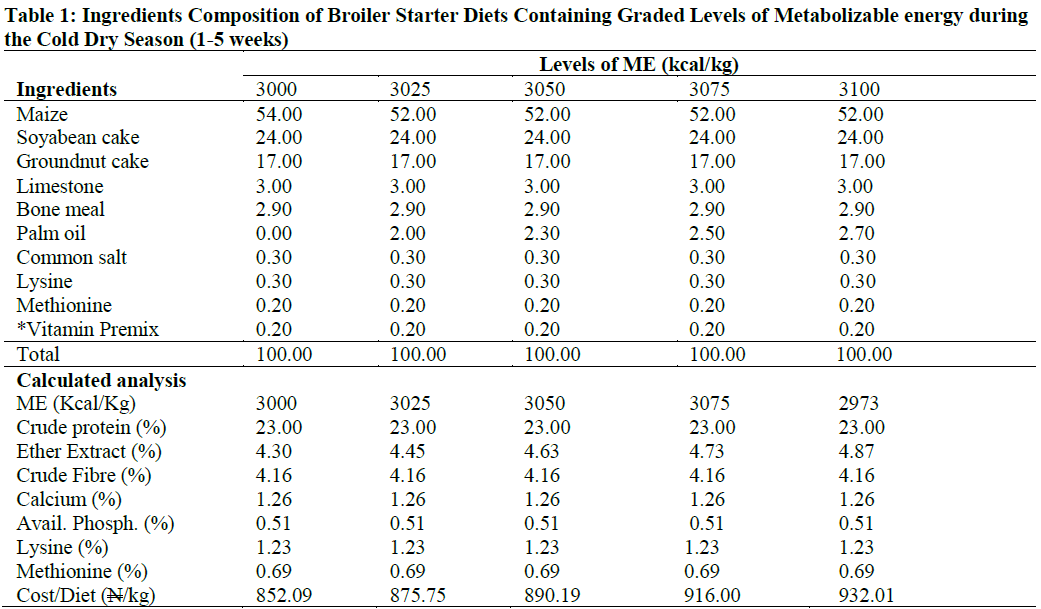
This study evaluated the optimization of dietary energy density for broiler chickens during the cold dry season of Jos, Plateau State, Nigeria. A total of 210 Arbor Acre day-old broiler chicks were assigned to five dietary treatments in a completely randomized design with three replicates of fourteen birds each. Starter diets contained 3000, 3025, 3050, 3075 and 3100 kcal/kg ME in diets T1 to T5 respectively, with 23% CP in all diets. Finisher diets contained 3200, 3225, 3250, 3275, and 3300 kcal/kg ME in diets T1 to T5 respectively with 20% CP in all diets. Feed and water were provided ad libitum, growth indices and villi morphometry were evaluated. During the starter phase, birds fed 3075 kcal/kg ME achieved the highest (P<0.05) final body weight (1080.17 g/bird) and daily weight gain (1036.97 g/bird/day), with the best (P<0.05) FCR (1.40). Feed intake decreased from 1520.22 g/bird/day at 3000 kcal/kg to about 1450 g/bird/day at higher energy levels, while the lowest feed cost per kilogram gain (₦1280.40) was recorded at 3075 kcal/kg. During the finisher phase, birds fed 3275 kcal/kg ME recorded the highest final body weight (2750.38 g/bird) and best FCR (1.81), while the lowest feed cost per kilogram gain (₦1965.13) occurred at 3250 kcal/kg. Villus height increased from 980.32 µm at 3200 kcal/kg to 1180.46 µm at 3275 kcal/kg, with villus height-to-crypt depth ratio improving from 4.65 to 5.30. Mortality was 0.00% across treatments.
References
Adejumo, I. O., Ologhobo, A. D. and Adejumo, D. O. (2017). Environmental influences on nutrient requirements and performance of broiler chickens. Nigerian Journal of Animal Production, 44(2): 45–56.
Attia, Y. A., Hassan, R. A. and Abou-Kassem, D. (2013). Influence of dietary energy and protein levels on growth performance, carcass traits, and blood metabolites of broiler chicks. Poultry Science, 92(5): 1248–1257.
Awad., W.A, Kurt, G., Stefan, A. and Josef, B. (2009). Effects of dietary inclusion of probiotic and synbiotic on growth performance, organ weights, and intestinal histomorphology of broiler chickens. Poultry Science, 88(1): 49–56.
Classen, H.L. (2017). Diet energy and feed intake in poultry. In: Margaret C. Walsh & Michael R. Bedford (Eds.), Poultry Nutrition (pp. 285–300). Nottingham University Press, Nottingham, UK.
Dozier, W.A., Alfred, Corzo., Michael, T. K., Paul, B. T. and Susan, L. B. (2006). Dietary apparent metabolizable energy and amino acid density effects on growth and carcass traits of heavy broilers. Journal of Applied Poultry Research, 15(4): 499–507.
Federal College of Forestry (FCF). (2019). Meteorological data report for Jos, Plateau State. Federal College of Forestry Press.
Food and Agriculture Organization (FAO). (2005). Poultry production and the environment: A review. FAO Animal Production and Health Division.
Hussein, E.O., Youssef, A. A., Abdallah, S. A. and Ahmed, E. E. (2017). Effect of dietary energy levels on growth performance, nutrient digestibility and economic efficiency of broiler chickens. Brazilian Journal of Poultry Science, 19(3): 325–332.
Idachaba, C.U. (2026). Optimization of metabolizable energy levels for broiler chickens during the cold dry season in Jos Plateau, Nigeria. Unpublished research manuscript / experimental dataset.
Leeson, S. and Summers, J. D. (2005). Commercial Poultry Nutrition (3rd ed.). Guelph, Canada: University Books.
Montagne, L., Jean-René, P. and Dominique, J. H. (2003). A review of interactions between dietary fibre and the intestinal mucosa, and their consequences on digestive health in young monogastric animals. Animal Feed Science and Technology, 108(1–4): 95–117.
Noblet, J., Jean-van, M. and Jean, D. (2003). Utilization of metabolizable energy in monogastric animals and its application to feed evaluation systems. Journal of Applied Poultry Research, 12(3): 425–435.
NRC (National Research Council). (1994). Nutrient Requirements of Poultry (9th rev. ed.). Washington, DC: National Academies Press. https://doi.org/10.17226/2114.
Uni, Z., Eyal, T., Orna, G. and Dov, S. (2003). Morphological, molecular, and functional changes in the chicken small intestine during the pre- and post-hatch periods. Journal of Nutrition, 133(1): 215–220.
SAS Institute. (2008). SAS/STAT user’s guide (Version 9.2). SAS Institute Inc.
Steel, R. G. D., Torrie, J. H. and Dickey, D. A. (1997). Principles and procedures of statistics: A biometrical approach (3rd ed.). McGraw-Hill.
Waldroup, P. W. and Fritts, C. A. (1990). Nutritional strategies to improve feed efficiency in broiler production. Poultry Science Symposium Series, 23: 12–21.
Xu, X.R., Hu., C.H. and Xia, M.S. (2003). Effects of dietary fructooligosaccharide on digestive enzyme activities, intestinal microflora and morphology of male broilers. Poultry Science, 82(6): 1030–1036.
Zhai, W., Peebles, E.D., Kim, S.W., Corzo, A. and Kidd, M.T. (2013). Effects of dietary metabolizable energy and crude protein levels on growth performance and carcass traits of broilers. Poultry Science, 92(12): 3215–3223.
Downloads
Published
Issue
Section
Categories
License
Copyright (c) 2026 Collins Udagbene Idachaba, Adebayo Kunle Adeniyi, Akinsola Michael Oludayo, Mary Foluke Oladipo, Peter Nandur Kurdor, Idris Abdullahi, Aliyu Garba Zungum

This work is licensed under a Creative Commons Attribution 4.0 International License.


