
Predictive Modelling of Compressive Strength of Rice Husk Ash Stabilized Clay Burnt Bricks
DOI:
https://doi.org/10.33003/fjs-2026-1011-4935Keywords:
Rice husk ash, Clay bricks, Compressive strength, Regression modelling, Soil stabilizationAbstract
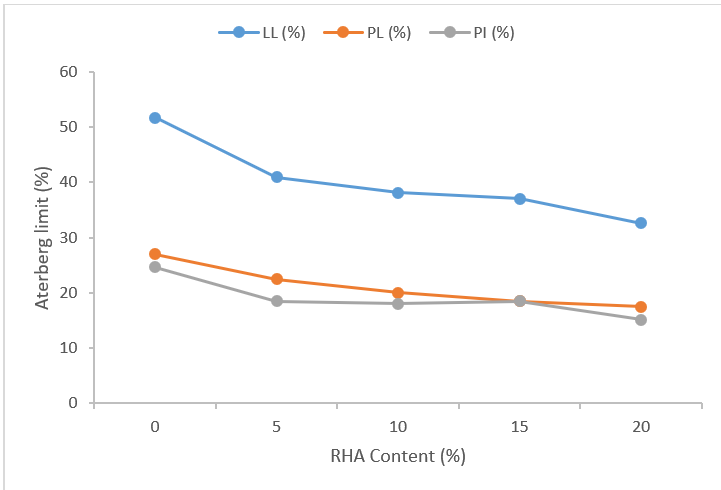
This study investigates the predictive modelling of compressive strength of rice husk ash (RHA) stabilized clay burnt bricks using consistency limit and compaction properties. Natural clay soil was first characterized through index property tests and chemical composition analysis as conducted to assess its suitability for brick production. Rice husk ash was incorporated into the clay at varying proportions (0–20%) to evaluate its influence on the clay consistency, compaction behavior, and the compressive strength of burnt bricks. Laboratory results showed that RHA addition significantly reduced the Atterberg limits, indicating decreased plasticity and improved workability. Compaction tests revealed an increase in optimum moisture content with RHA content, while maximum dry density slightly increased at low RHA levels and decreased at higher levels due to the lightweight nature of the ash. Compressive strength improved with RHA addition up to an optimum content of 5%, beyond which strength declined. Bricks containing up to 15% RHA met the minimum strength requirement of 3.5 MPa specified in NIS 87:2004. A multilinear regression model was developed using plasticity index, optimum moisture content, and maximum dry density, showing good predictive performance (R² = 0.84) with close agreement between measured and predicted values. The study demonstrates that moderate RHA incorporation can enhance brick strength while promoting sustainable utilization of agricultural waste.
References
Agbede, O. (2011). Effect of rice husk ash (RHA) on the properties of Ibaji burnt clay bricks. American Journal of Scientific and Industrial Research. https://doi.org/10.5251/AJSIR.2011.2.4.674.677
Alyami, M., Nassar, R., Khan, M., Hammad, A., Alabduljabbar, H., Nawaz, R., Fawad, M., & Gamil, Y. (2024). Estimating Compressive Strength of Concrete Containing Rice Husk Ash Using Interpretable Machine Learning-based Models. Case Studies in Construction Materials. https://doi.org/10.1016/j.cscm.2024.e02901.
Amin, M., Ahmad, W., Khan, K., & Deifalla, A. (2023). Optimizing compressive strength prediction models for rice husk ash concrete with evolutionary machine intelligence techniques. Case Studies in Construction Materials. https://doi.org/10.1016/j.cscm.2023.e02102.
Amin, M., Iftikhar, B., Khan, K., Javed, M., AbuArab, A., & Rehman, M. (2023). Prediction model for rice husk ash concrete using AI approach: Boosting and bagging algorithms. Structures. https://doi.org/10.1016/j.istruc.2023.02.080.
Aslam, F., Elkotb, M., Iqtidar, A., Khan, M., Javed, M., Usanova, K., Khan, M., Alamri, S., & Musarat, M. (2021). Compressive strength prediction of rice husk ash using multiphysics genetic expression programming. Ain Shams Engineering Journal. https://doi.org/10.1016/j.asej.2021.09.020.
BS 1377 (1990). Methods of tests for Soils for Civil Engineering purposes. London, British Standards Institutions.
Ganasen, N., Krishnaraj, L., Onyelowe, K., Alaneme, G., & Otu, O. (2023). Soft computing techniques for predicting the properties of raw rice husk concrete bricks using regression-based machine learning approaches. Scientific Reports, 13. https://doi.org/10.1038/s41598-023-41848-1.
Iftikhar, B., Alih, S., Vafaei, M., Elkotb, M., Shutaywi, M., Javed, M., Deebani, W., Khan, M., & Aslam, F. (2022). Predictive modeling of compressive strength of sustainable rice husk ash concrete: Ensemble learner optimization and comparison. Journal of Cleaner Production. https://doi.org/10.1016/j.jclepro.2022.131285.
Iqtidar, A., Khan, N., Kashif-Ur-Rehman, S., Javed, M., Aslam, F., Alyousef, R., Alabduljabbar, H., & Mosavi, A. (2021). Prediction of Compressive Strength of Rice Husk Ash Concrete through Different Machine Learning Processes. Crystals. https://doi.org/10.3390/cryst11040352.
Janbuala, S., Kitthawee, U., Aermbua, M., & Laoratanakul, P. (2013). Effect of Rice Husk Ash to Mechanical Properties of Clay Bricks. Advanced Materials Research, 770, 50–53. https://doi.org/10.4028/www.scientific.net/amr.770.50
Jwaida, Z. (2025). Utilizing agricultural wastes for fired bricks: A machine learning approach to compressive strength and water absorption predictions. Cleaner Engineering and Technology. https://doi.org/10.1016/j.clet.2025.101109.
Kashem, A., Karim, R., Pobithra, D., Datta, S., & Alharthai, M. (2024). Compressive strength prediction of sustainable concrete incorporating rice husk ash (RHA) using hybrid machine learning algorithms and parametric analyses. Case Studies in Construction Materials. https://doi.org/10.1016/j.cscm.2024.e03030.
Li, Q., & Song, Z. (2022). Prediction of compressive strength of rice husk ash concrete based on stacking ensemble learning model. Journal of Cleaner Production. https://doi.org/10.1016/j.jclepro.2022.135279.
Obianyo, I., Anosike-Francis, E., Ihekweme, G., Geng, Y., Jin, R., Onwualu, A., & Soboyejo, A. (2020). Multivariate regression models for predicting the compressive strength of bone ash stabilized lateritic soil for sustainable building. Construction and Building Materials. https://doi.org/10.1016/j.conbuildmat.2020.120677.
Raji, M., Falola, B., Enikuomehin, J., Oyelade, A., Abiodun, Y., Olaniyi, Y., Olagunju, O., Anyaegbuna, K., Abdulkareem, M., & Fapohunda, C. (2024). Prediction of compressive strength of nano silica and micro silica from rice husk ash using multivariate regression models. AI in Civil Engineering, 3. https://doi.org/10.1007/s43503-024-00043-5.
Ranathunga, R., Sampath, K., & Ranathunga, A. (2023). Prediction of Geotechnical Properties of Rice Husk Ash-Stabilized Soil Systems. 2023 Moratuwa Engineering Research Conference (MERCon), 240-245. https://doi.org/10.1109/mercon60487.2023.10355529.
Downloads
Published
Issue
Section
Categories
License
Copyright (c) 2026 Benjamin Kuma Jechira, Joel Godwin, Luqman Ugbede Aliyu

This work is licensed under a Creative Commons Attribution 4.0 International License.


