
DIURNAL VARIATION OF CELLULAR RADIOFREQUENCY POWER DENSITY FROM SHORT-RANGE FIELD MEASUREMENTS IN TROPICAL PROPAGATION ENVIRONMENTS
DOI:
https://doi.org/10.33003/fjs-2026-1004-4859Keywords:
Diurnal variation, RF power density, Radiofrequency propagation, Base Transceiver Station (BTS), Tropical atmospheric effects, Wireless network reliabilityAbstract
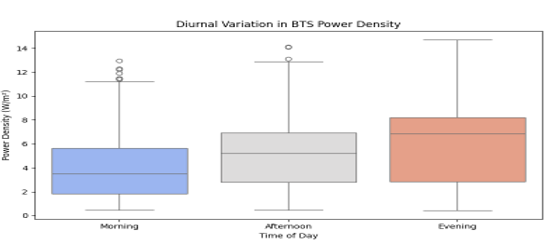
Reliable cellular network performance depends on stable radio frequency (RF) signal propagation under varying environmental and temporal conditions. Although distance and meteorological influences on signal behaviour are well documented, few field-based studies have quantified short-range diurnal variation in broadband aggregate RF power density around base transceiver station (BTS) infrastructure, particularly in tropical urban environments. This study investigates diurnal variation in broadband RF power density around three operational BTS sites within a 2.5-3 km radius. Field measurements were obtained using a calibrated Trifield TF2 RF meter, which records broadband aggregate RF exposure, while meteorological data were sourced from the Nigeria Meteorological Agency (NiMet). Measurements were collected across morning, afternoon, and evening time blocks over twenty-eight consecutive days. Results show a clear diurnal pattern, with mean power density highest in the evening (6.00 W/m²), followed by afternoon (5.37 W/m²), and lowest in the morning (4.08 W/m²). One-way ANOVA indicated statistically significant differences (p < 0.001), with a moderate effect size (η² ≈ 0.06), and Tukey HSD testing confirmed differences between time blocks. Correlation analysis showed weak associations between power density and distance (r = -0.121), temperature (r = 0.14), and relative humidity (r = -0.142), indicating small practical effect, despite statistical significance. Regression analysis identified distance as the dominant predictor (R² = 0.015), with only marginal improvement when meteorological variables were included (R² = 0.038). These results provide short-range tropical field evidence of diurnal variability in broadband RF power density, where atmospheric effects remain secondary to distance-dependent attenuation.
References
Adediji, A. T., Dada, J. B., & Ajewole, M. O. (2019) Diurnal, seasonal and annual variation of microwave radio refractivity gradient over Akure, South West Nigeria. Physical Science International Journal, 23(4), 1-11.
Ale, F., Ayegba, A., Agboola, O., & Olatunji, P. J. (2024) Effects of some weather variables on the signal strength of Maloney FM radio, Nasarawa State, Nigeria. Heliyon. doi: 10.1016/j.heliyon.2024.e25978.
Amajama, J., Ibrahim, A. T., & Akwagiobe, J. U. (2023) Influence of Atmospheric Temperature on the Signal Strength of Mobile Phone Communication. Communication in Physical Sciences, 9(4), 717-737.
Bakare, B. I., Nwakpang, F. M. & Desire, A. E. (2019) Propagation Analysis of Radio Frequency (RF) Signal of Love FM Transmitter in Port Harcourt, Nigeria. IOSR Journal of Electronics and Communication Engineering (IOSR-JECE), 14(2), 5-12.
Diton, G. & Odu, O. J. (2025) Weather Components and Network Signal Strength: An analysis of Yenagoa, Bayelsa State. International Journal of Engineering and Modern Technology (IJEMT), 11(5). IIARD Journals
Goldsmith, A. (2005). Wireless Communications. Cambridge University Press.
Iloke, J., Ukoette J. E., & Igwe E. (2022) Tropospheric Influence on Ultra-High Frequency (UHF) Radio Waves. Asian Journal of Research and Reviews in Physics, 6 (3), 48 - 57. https://doi.org/10.9734/ajr2p/2022/v6i3121.
International Telecommunication Union (1998). Handbook – The Ionosphere and its effects on radio wave propagation. International Telecommunication Union.
International Telecommunication Union (2005). ITU R P.838 3: Specific attenuation model for rain for use in prediction methods. International Telecommunication Union.
International Telecommunication Union (2017). ITU R P.530 17: Propagation data and prediction methods required for the design of terrestrial line of sight systems. International Telecommunication Union.
International Telecommunication Union (2019). ITU R P.676 12: Attenuation by atmospheric gases. International Telecommunication Union.
Iwuji, P. C. and Onuabuchi, V. C. (2018) Investigation of Diurnal Variation of Signal Strength Generated by FM Transmitter. European Scientific Journal, 14(18), 235-246. URL:http://dx.doi.org/10.19044/esj.2018.v14n18p235.
Matthews, V.O., Idiake, S.U., Noma-Osaghae, E. and Nwukor, F. (2018) Comparative Analysis of the Effect of Distance on Signal Strength using Selected Communication Media. International Journal of Advances in Scientific Research and Engineering, 4(8), 82 - 91. https://doi.org/10.31695/IJASRE.2018.32833.
Mehina, A., & Čavlina, I. (2023). Signal Propagation. Nauka i Tehnologija, 11(1), 47–54. https://doi.org/10.58952/nit20231101047
Molisch, A. F. (2012). Wireless Communications (2nd ed.). Wiley.
Odesanya, I., Olukanmi S. E. & Risi I. (2025). Impact of Atmospheric Variables, Radio Resource Control and Call Drop on Radio Frequency Signals Attenuation in Wireless Communication Networks. Journal of Sciences, Computing and Applied Engineering Research (JSCAER), 1(1), 28-33. https://jcaes.net.
Ohworho, A. E., & Ossai, C. C. (2023). Path loss measurements for wireless communication in South West Nigeria. FUW Trends in Science and Technology Journal, 8(2), 337 - 340. www.ftstjournal.com.
Ohworho, A. E., Vwavware, J. O. & Abriku, E. O. (2026) Empirical assessment of FM radio signal strength variations with distance and weather conditions in Warri, Nigeria. FUDMA Journal of Science,10(1), 194 - 202.
Omotoso, E. T., & Olajide-Owoyomi, F. (2025). Diurnal and Seasonal Variability of Radio Refractivity Over Coastal Nigeria. In Proceedings of the 8th URSI-NG Annual Conference (pp. 264–275). Atlantis Press. https://doi.org/10.2991/978-94-6463-644-4_26.
Onuorah, L. O., Agbo, G. A., & Okoh, D. (2020) Variation of Meteorological Parameters and their Influence on Tropospheric Surface Radio Refractivity in Minna and Yola, Nigeria. Journal of Space Science and Technology, 9(2).
Parsons, J. D. (2000). The Mobile Radio Propagation Channel (2nd ed.). Wiley.
Poddar, H., Gold, D., Lee, D., Zhang, N., Sridharan, G., Asplund, H. & Shafi, M. (2025) Overview of 3GPP Release 19 study on Channel modelling enhancements to TR 38.901 for 6G. IEEE Vehicular Technology Magazine (VTM), 2025, 1-9.
Rappaport, T. S. (2002). Wireless Communications: Principles and Practice (2nd ed.). Prentice Hall.
Saunders, R. S., & Aragón Zavala, A. (2007). Antennas and Propagation for Wireless Communication Systems (2nd ed.). Wiley.
Sedara, S. O. (2023). Field strength intensity measurement of a Radio station for frequency and coverage range inferences and human exposure index. Discovery, 59. (discoveryjournals.org) doi: https://doi.org/10.54905/disssi.v59i333.e108d1352
Sharma, A. K. & More, C. T. (2017) Diurnal variation of VLF radio wave signal strength at 19.8 and 24 kHz received at Khatav India (16o46’N, 75o53’E). Journal of space science and technology, 6(2), 1-12.
Suleman, K. O. Olawuyi, A. S., Joseph, O., Ogunmola, O. L., Alagbe, G. A., Azeez, S. O., Suleiman, S. B., Adegbaye, A. L., Ahmed, K., & Sunmonu, L. A. (2025) Investigation of Diurnal and seasonal variation of radio refractivity and field strength over Ogbomoso, South Western Nigeria. Proceedings of 8th URSI-NG Annual Conference, Advances in Physics Research 12. https://doi.org/10.2991/978-94-6463-644-4_7.
Downloads
Published
Issue
Section
Categories
License
Copyright (c) 2026 Akpevwe Ejiro Ohworho, Onoriode Ezekiel Abriku, Zhimwang Timothy Jangfa, Isaac Ikechukwu Iwebunor, Emmanuel Akinna Osiyai

This work is licensed under a Creative Commons Attribution 4.0 International License.


