
TOWARDS SUSTAINABLE AND RISK-RESILIENT PROCUREMENT IN PUBLIC BUILDING PROJECTS: EVIDENCE FROM RIVERS STATE, NIGERIA
DOI:
https://doi.org/10.33003/fjs-2026-1006-4857Keywords:
Sustainable procurement, Risk Management, Public building projects, Construction projects, Projects life-cycleAbstract
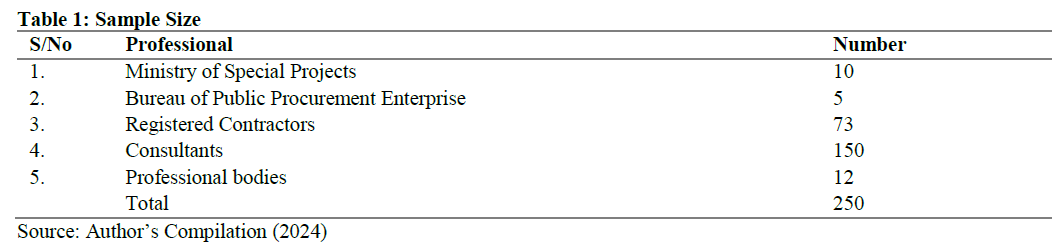
Public building projects in Nigeria continue to experience cost overruns, delays, and inefficiencies due to weak procurement systems and inadequate risk management. Although sustainable procurement is increasingly promoted as a strategy for improving project performance, its integration with risk management in Nigeria’s public construction sector remains insufficiently understood. This study addresses this gap by examining sustainable procurement practices and associated risk management strategies in public building projects in Rivers State. A quantitative approach was adopted using structured questionnaires administered to 250 stakeholders, with data analysed using descriptive statistics. Findings reveal high awareness of sustainable procurement (75.2%), but inconsistent implementation, with 67.4% of respondents indicating that such practices are only occasionally applied. Procurement decisions remain largely cost-driven, as environmental (98.3%) and economic (93.4%) considerations are prioritised over social sustainability (78.5%). Risk management is mainly driven by detailed risk assessment (60.2%) and contractor prequalification (26.5%), yet financial risks (63.5%) persist as the most critical challenge, alongside supplier-related and regulatory risks. While 74.0% of respondents perceive sustainable procurement as effective, 53.0% remain uncertain about its capacity to consistently reduce project risks. The study demonstrates a disconnect between awareness and practical application, limiting the risk-mitigation potential of sustainable procurement. It contributes empirical evidence from a developing-country context and highlights the need for integrated policy frameworks, life-cycle costing, and strengthened institutional capacity to achieve sustainable and risk-resilient public project delivery.
References
Adeleke, A. Q., Bahaudin, A. Y., & Kamaruddeen, A. M. (2020). Project risk management practices and critical success factors affecting performance of Nigerian construction projects. International Journal of Construction Project Management, 12(3), 45–59.
Adeleke, A. Q., Bahaudin, A. Y., & Kamaruddeen, A. M. (2020). The influence of organizational external factors on construction risk management performance in Nigeria. Journal of Construction Engineering and Management, 146(4), 04020029.
Ademola, O., Akinola, A., & Bello, F. (2022). Sustainable procurement implementation challenges in the Nigerian construction industry. Journal of Construction Economics and Management, 8(2), 45–58.
Agyekum, K., Kissi, E., Baiden, B. K., & Adinyira, E. (2020). Sustainable public procurement practices in developing countries: A systematic review. Journal of Public Procurement, 20(3), 237–260.
Aigbavboa, C., & Thwala, W. D. (2020). Sustainable construction and social value creation in developing countries. Journal of Construction Project Management, 12(3), 42–57.
Aje, I. O., & Alake, O. (2020). Sustainable procurement risk practices in Nigerian public sector construction projects. Journal of Sustainable Built Environment, 6(2), 45–61.
Aje, I., Olatunji, O., & Alake, O. (2020). Sustainability and cost-effectiveness in Nigerian public procurement. Journal of Built Environment Studies, 14(2), 90–104.
Alhazmi, T., & McCaffer, R. (2000). Project procurement system selection model. Journal of Construction Engineering and Management, 126(3), 176–184.
Ameh, O. J., & Odusami, K. T. (2002). Risk management in the Nigerian construction industry: A survey of current practices. The Professional Builder, 3(1), 1–10.
Ameyaw, E. E., & Chan, A. P. C. (2016). Identifying public–private partnership risks in Ghana. Journal of Infrastructure Systems, 22(3), 04016010.
Chapman, C., & Ward, S. (2003). Project risk management: Processes, techniques and insights (2nd ed.). John Wiley & Sons.
Dada, M. O., & Jagboro, G. O. (2007). An evaluation of the impact of risk factors on project cost in Nigeria. Asian Journal of Business and Management Sciences, 3(6), 29–35.
Hillson, D. (2009). Managing risk in projects: The risk breakdown structure. PMI Publications.
Laryea, S., & Hughes, W. (2011). Risk and price in construction tenders. Journal of Construction Management and Economics, 29(8), 781–794.
Loosemore, M., Raftery, J., Reilly, C., & Higgon, D. (2006). Risk management in projects (2nd ed.). Routledge.
Love, P. E. D., Edwards, D. J., & Irani, Z. (2021). Forensic project management: An exploratory examination of procurement and risk. IEEE Transactions on Engineering Management, 68(3), 1–13.
Meehan, J., & Bryde, D. (2011). Sustainable procurement practice. Business Strategy and the Environment, 20(2), 94–106. https://doi.org/10.1002/bse.678
Mensah, S., & Ameyaw, C. (2012). Sustainable procurement: The challenges of practice. International Journal of Construction Supply Chain Management, 2(2), 87–104.
Mhetre, K., Konnur, B. A., & Landage, A. B. (2016). Risk identification techniques for construction projects. International Journal of Scientific Engineering and Technology, 5(2), 41–47.
Molenaar, K. R., & Songer, A. D. (2011). Model for public sector design-build project selection. Journal of Construction Engineering and Management, 127(6), 467–479.
Nnadi, E. O., & Ugwu, O. O. (2014). Risk management in Nigerian construction projects. Journal of Construction in Developing Countries, 19(1), 1–20.
Ofori, G. (2015). Nature of the construction industry and its development over four decades. Journal of Construction Studies, 30(3), 77–91.
Ojo, S. O., Adeyemi, A. Y., & Fagbenle, O. I. (2006). The influence of procurement methods on project performance in Nigeria. Journal of Construction Procurement, 12(2), 15–27.
Onyema, C. (2001). Public procurement and accountability in Nigeria. African Journal of Public Administration, 6(1), 45–58.
Oyedele, L. (2019).Barriers to sustainable construction in developing countries. Journal of Building Research, 12(1), 33–47.
Ozorhon, B., & Karahan, U. (2017). Critical success factors for sustainable project management. Journal of Cleaner Production, 158, 217–229.
Public Procurement Act. (2007). Federal Republic of Nigeria Official Gazette.
Udom, E., & Joseph, P. (2021). Professional competence and sustainable procurement practices. International Journal of Project Procurement Management, 14(3), 215–230.
UNECA. (2020). Sustainable public procurement in Africa: Opportunities and challenges. Addis Ababa: UNECA.
United Nations Environment Programme (UNEP). (2016). Global review of sustainable procurement. UNEP.
Walker, H., & Brammer, S. (2009). Sustainable procurement in the United Kingdom public sector. Supply Chain Management: An International Journal, 14(2), 128–137. https://doi.org/10.1108/13598540910941993
Walker, H., & Brammer, S. (2019). Global review of sustainable public procurement. International Journal of Operations and Production Management, 39(4), 63–81.
Wenzhe, T., Qiang, M., & Duffield, C. (2007). Risk management in construction projects. Journal of Construction Engineering and Management, 133(12), 944–956. https://doi.org/10.1061/(ASCE)0733-9364(2007)133:12(944)
Downloads
Published
Issue
Section
Categories
License
Copyright (c) 2026 Omolola Oluronke Odunjo, Dorcas Oluwaseyi Adeoye, Mutiu Adewale Oloyede, Ridwanullahi Abiodun Akewusola

This work is licensed under a Creative Commons Attribution 4.0 International License.


