
INTEGRATIVE IN SILICO ANALYSIS OF COMMERCIAL SOAP INGREDIENTS FROM NIGERIAN MARKETS PREDICTS POTENTIAL MODULATORS OF HUMAN MELANOGENESIS PATHWAYS
DOI:
https://doi.org/10.33003/fjs-2026-1003-4734Keywords:
Bioinformatics, Melanogenesis, Soap ingredients, Skin pigmentation, Computational toxicologyAbstract
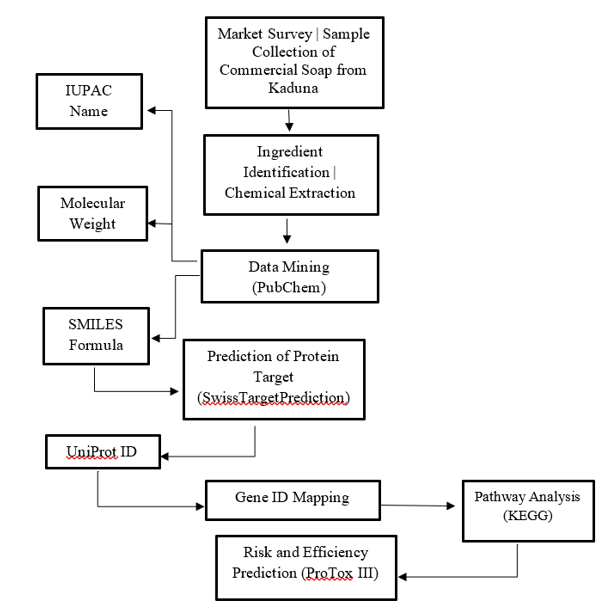
Commercial soaps widely sold in African markets contain diverse chemical ingredients that may interact with biological pathways in the skin. However, the potential molecular effects of these compounds on melanogenesis and skin physiology remain insufficiently explored, particularly in populations with darker skin types where melanin provides critical photoprotection. This study applied an integrative bioinformatics approach to evaluate the chemical composition of commonly used soaps sold in Kaduna markets and predict their interactions with proteins involved in pigmentation regulation and skin signaling pathways. Fifteen commercial soap products, including locally manufactured and imported brands, were surveyed. Ingredient profiling identified 43 unique compounds, including surfactants, fatty acids, fragrances, preservatives, pigments, and conditioning agents. Chemical structures retrieved from PubChem were subjected to target prediction using SwissTargetPrediction. Sixteen compounds generated predicted protein targets (probability ≥0.1), yielding 375 potential human protein interactions associated with enzymes, receptors, kinases, and oxidoreductases involved in skin biology. KEGG pathway enrichment revealed significant associations with melanogenesis, tyrosine metabolism, MAPK signaling, PI3K–Akt signaling, and Wnt signaling pathways, which are critical for melanocyte regulation, pigment synthesis, and cellular stress responses. ProTox-3.0 toxicity profiling classified most compounds in Classes IV–VI (harmful to non-toxic), though several ingredients showed potential irritation or sensitization alerts. As a purely computational study without in vitro validation, these predictions require experimental confirmation. Overall, this work demonstrates the utility of computational toxicology and systems bioinformatics for cosmetic ingredient evaluation and offers preliminary insights into how soap constituents may influence pigmentation-related pathways and skin health in darker skin populations.
References
Ando, H., Watabe, H., Valencia, J. C., Yasumoto, K. I., Furumura, M., Funasaka, Y., Oka, M., Ichihashi, M., & Hearing, V. J. (2004). Fatty acids regulate pigmentation via proteasomal degradation of tyrosinase: A new aspect of ubiquitin-proteasome function. Journal of Biological Chemistry, 279(15), 15427–15433. https://doi.org/10.1074/jbc.M313701200
Banerjee, P., Kemmler, E., Dunkel, M., & Preissner, R. (2024). ProTox 3.0: a webserver for the prediction of toxicity of chemicals. Nucleic Acids Research, 52(W1), W513–W520. https://doi.org/10.1093/nar/gkae303
Benn, E. K. T., Alexis, A., Mohamed, N., Wang, Y. H., Khan, I. A., & Liu, B. (2016). Skin Bleaching and Dermatologic Health of African and Afro-Caribbean Populations in the US: New Directions for Methodologically Rigorous, Multidisciplinary, and Culturally Sensitive Research. Dermatology and Therapy, 6(4), 453–459. https://doi.org/10.1007/s13555-016-0154-1
Bino, S. Del, Duval, C., & Bernerd, F. (2018). Clinical and Biological Characterization of Skin Pigmentation Diversity and Its Consequences on UV Impact. International Journal of Molecular Sciences, 19(9). https://doi.org/10.3390/ijms19092668
Brar, G., Dhaliwal, A., Brar, A. S., Sreedevi, M., Ahmadi, Y., Irfan, M., Golbari, R., Zumárraga, D., Yateem, D., Lysak, Y., & Abarca-Pineda, Y. A. (2025). A Comprehensive Review of the Role of UV Radiation in Photoaging Processes Between Different Types of Skin. Cureus, 17(3), e81109. https://doi.org/10.7759/cureus.81109
D’Mello, S. A. N., Finlay, G. J., Baguley, B. C., & Askarian-Amiri, M. E. (2016). Signaling Pathways in Melanogenesis. International Journal of Molecular Sciences, 17(7), 1–18. https://doi.org/10.3390/ijms17071144
Hida, T., Kamiya, T., Kawakami, A., Ogino, J., Sohma, H., Uhara, H., & Jimbow, K. (2020). Elucidation of Melanogenesis Cascade for Identifying Pathophysiology and Therapeutic Approach of Pigmentary Disorders and Melanoma. International Journal of Molecular Sciences, 21(17), 1–23. https://doi.org/10.3390/ijms21176129
Kim, T., Kang, J. K., & Hyun, C. G. (2023). 6-Methylcoumarin Promotes Melanogenesis through the PKA/CREB, MAPK, AKT/PI3K, and GSK3β/β-Catenin Signaling Pathways. Molecules, 28(11). https://doi.org/10.3390/molecules28114551
Kunatsa, Y., & Katerere, D. R. (2021). Checklist of African Soapy Saponin-Rich Plants for Possible Use in Communities’ Response to Global Pandemics. Plants (Basel, Switzerland), 10(5), 842. https://doi.org/10.3390/plants10050842
Lee, D. K., Won, K. J., Kim, D. Y., Kim, Y. Y., & Lee, H. M. (2023). Chemical Composition and Skin-Whitening Activities of Siegesbeckia glabrescens Makino Flower Absolute in Melanocytes. Plants, 12(23). https://doi.org/10.3390/plants12233930
Lee, Y., Song, H.-Y., & Byun, E.-B. (2025). Anti-melanogenic effects of hydroxyethyl chrysin through the inhibition of tyrosinase activity: In vitro and in silico approaches. Heliyon, 11(2), e41718. https://doi.org/10.1016/j.heliyon.2025.e41718
Mazri, R., Ouassaf, M., Zekri, A., Khan, S. U., Rengasamy, K. R. R., & Alhatlani, B. Y. (2025). In Silico Network Pharmacology, Molecular Docking, and Molecular Dynamics Analysis of Rosemary-Derived Compounds as Potential HSP90 Inhibitors for Cancer Therapy. Current Issues in Molecular Biology, 47(10), 1–23. https://doi.org/10.3390/cimb47100860
Olajuyigbe, O. O., Adeoye-Isijola, M. O., & Adedayo, O. (2017). A comparison of the antibacterial activity of some African black soaps and medicated soaps commonly used for the treatment of bacteria-infected wound. Journal of Medicinal Plants for Economic Development, 1(1), 1–8. https://doi.org/10.4102/jomped.v1i1.20
Pillaiyar, T., Manickam, M., & Namasivayam, V. (2017). Skin whitening agents: medicinal chemistry perspective of tyrosinase inhibitors. Journal of Enzyme Inhibition and Medicinal Chemistry, 32(1), 403–425. https://doi.org/10.1080/14756366.2016.1256882
Pollock, S., Taylor, S., Oyerinde, O., Nurmohamed, S., Dlova, N., Sarkar, R., Galadari, H., Manela-Azulay, M., Chung, H. S., Handog, E., & Kourosh, A. S. (2021). The dark side of skin lightening: An international collaboration and review of a public health issue affecting dermatology. International Journal of Women’s Dermatology, 7(2), 158–164. https://doi.org/10.1016/j.ijwd.2020.09.006
Solano, F. (2020). Photoprotection and Skin Pigmentation: Melanin-Related Molecules and Some Other New Agents Obtained from Natural Sources. Molecules (Basel, Switzerland), 25(7), 1–18. https://doi.org/10.3390/molecules25071537
Wang, F., Ma, W., Fan, D., Hu, J., An, X., & Wang, Z. (2024). The biochemistry of melanogenesis: an insight into the function and mechanism of melanogenesis-related proteins. Frontiers in Molecular Biosciences, 11(August), 1–15. https://doi.org/10.3389/fmolb.2024.1440187
Xu, Y., Liang, X., Kim, H. M., & Hyun, C. G. (2025). In Vitro and In Silico Studies of Maculosin as a Melanogenesis and Tyrosinase Inhibitor. Molecules, 30(4). https://doi.org/10.3390/molecules30040860
Zamudio Díaz, D. F., Busch, L., Kröger, M., Klein, A. L., Lohan, S. B., Mewes, K. R., Vierkotten, L., Witzel, C., Rohn, S., & Meinke, M. C. (2024). Significance of melanin distribution in the epidermis for the protective effect against UV light. Scientific Reports, 14(1), 3488. https://doi.org/10.1038/s41598-024-53941-0
Zheng, Z. (2025). Application of Big Biological Data Analysis Techniques in Molecular Biology. Proceedings of the 2025 5th International Conference on Bioinformatics and Intelligent Computing, January 2025, 236–241. https://doi.org/10.1145/3724979.3725017
Zolghadri, S., Beygi, M., Mohammad, T. F., Alijanianzadeh, M., Pillaiyar, T., Garcia-Molina, P., Garcia-Canovas, F., Munoz-Munoz, J., & Saboury, A. A. (2023). Targeting tyrosinase in hyperpigmentation: Current status, limitations and future promises. Biochemical Pharmacology, 212, 115574. https://doi.org/10.1016/j.bcp.2023.115574
Downloads
Published
Issue
Section
Categories
License
Copyright (c) 2026 Stephen A. James, Maryam Lawal

This work is licensed under a Creative Commons Attribution 4.0 International License.


