
DISCRIMINATING SOYBEAN VARIETIES VIA MINERAL COMPOSITION, PHYTOCHEMICAL PROFILING AND DNA QUALITY ANALYSIS
DOI:
https://doi.org/10.33003/fjs-2026-1002-4665Keywords:
Discriminating, Mineral, Phytochemical, Profiling, Dna Quality, SoybeanAbstract
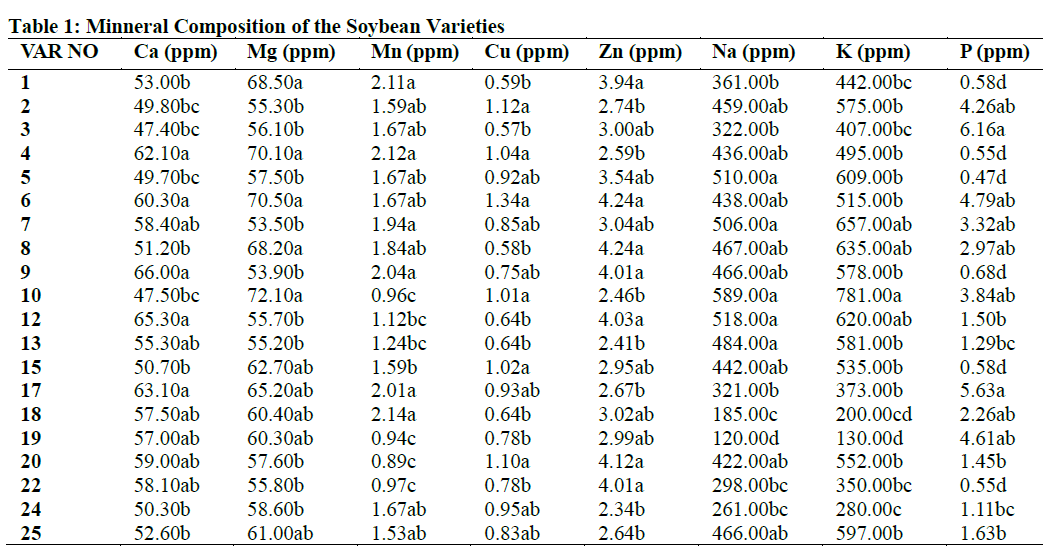
Soybean (Glycine max (L.) Merrill) is a globally important legume valued for its nutritional and industrial applications. This study evaluated twenty soybean varieties for mineral composition, phytochemical profiling, and DNA quality to provide an integrated assessment of their nutritional, biochemical, and molecular attributes. The germplasm was sourced from the International Institute of Tropical Agriculture (IITA), Ibadan, Nigeria. Genomic DNA was extracted using NIMR Kit I and sodium dodecyl sulfate (SDS) protocols, and quality was assessed via spectrophotometry and agarose gel electrophoresis.The mineral composition of the soybean varieties revealed varying levels of the mineral constituents such as calcium (47.40 - 66.00ppm), magnesium (53.50 -72.10ppm), manganese (0.89 - 2.14ppm), copper (0.57 - 1.34ppm), zinc (2.34 - 4.24ppm), sodium (120.00 - 589.00ppm), potassium (130.00 - 781.00ppm) and phosphorous (0.47 - 6.16ppm). The phytochemical composition of the soybean varieties revealed varying levels of Phytate (25.54 to 33.78 mg/g), Saponin (2.05 to 3.60mg/g), Tannin (0.05 to 0.23mg/g) and Oxalate (0.90 to 2.79mg/g). DNA quality for NIMR Kit I ranged from 1.709–2.261 (A260/A280) and 1.173–2.304 (A260/A230), while SDS extracted DNA ranged from 1.694–2.097 (A260/A280) and 1.734–2.598 (A260/A230), indicating the presence of contaminants in some samples. Overall, DNA quality based on A260/A280 ratios was higher for the SDS protocol compared to NIMR Kit I, suggesting it as the preferable method for downstream molecular applications, although further purification may be required for some of the samples.
References
Abdullah, M., Ali, S., Khan, S. and Raza, S. (2021). "Evaluation of DNA extraction methods for soybean: A comparison of kits and SDS-based approaches for genetic analysis." Journal of Plant Molecular Biology, 48(2), 239-249. https://doi.org/10.1016/j.jplasmol.2021.07.006.
Aboul-Maaty, N. A.-F. and Oraby, H. A.-S. (2019). Extraction of high-quality genomic DNA from different plant orders applying a modified CTAB-based method. Bulletin of the National Research Centre, 43(1), Article 25. https://doi.org/10.1186/s42269-019-0066-1
Amiteye, S. (2021). Basic concepts and methodologies of DNA marker systems in plant molecular breeding. Heliyon, 7(10).
Aremu, M. O., and Olaleye, I. A. (2019). Mineral composition of selected soybean varieties and implications for health. Journal of Food Composition and Analysis, 87, 103385.
Bruce, K., Blackman, R. C., Bourlat, S. J., Hellström, M., Bakker, J., Bista, I. and Deiner, K. (2021). A practical guide to DNA-based methods for biodiversity assessment. Pensoft Advanced Books.
Chang, C., Yang, M., Wen, H. and Chern, J. (2002). Estimation of total flavonoid content in propolis by two complementary colorimetric methods. Journal of Food and Drug Analysis, 10(3), 178–182.
Chang, W. S., Lee, H. I. and Hungria, M. (2015). Soybean production in the Americas. Principles of plant-microbe interactions: Microbes for sustainable agriculture, 393-400.
Chikpah, S. K., Mensah, R. A., and Asiedu, P. (2020). Oxalate concentrations in legume varieties and calcium bioavailability. Journal of Nutritional Biochemistry, 30(7), 220-227.
Das, S., Sharangi, A. B., Egbuna, C., Jeevanandam, J., Ezzat, S. M., Adetunji, C. O. and Onyeike, P. C. (2020). Health benefits of isoflavones found exclusively of plants of the fabaceae family. Functional Foods and Nutraceuticals: Bioactive Components, Formulations and Innovations, 473-508.
Getaneh Zewudie, K. and Gemede, H. F. (2024). Assessment of nutritional, antinutritional, antioxidant and functional properties of different soybean varieties: Implications for soy milk development. Cogent Food & Agriculture, 10(1), 2380496. https://doi.org/10.1080/23311932.2024.2380496
Khan, K. H., Khan, M. A. and Mian, A. (2011). A study on the determination of oxalates in vegetables. Pakistan Journal of Agricultural Sciences, 48(3), 141-145.
Kim, I. S., Kim, C. H. and Yang, W. S. (2021). Physiologically active molecules and functional properties of soybeans in human health—A current perspective. International journal of molecular sciences, 22(8), 4054.
Kumar, S., and Singh, V. (2021). Phosphorus uptake and its genetic variability in soybean varieties. Journal of Plant Nutrition, 44(7), 1050-1061.
Mahajan, R., Sharma, S. and Singh, B. (2022). Optimization of DNA extraction methods for genomic studies in soybean. Biotechniques, 72(6), 292-299. https://doi.org/10.1016/j.biotech.2022.03.012
Marwal, A. and Gaur, R. K. (2020). Molecular markers: tool for genetic analysis. In Animal biotechnology (pp. 353-372). Academic Press.
Modi, A., Vergata, C., Zilli, C., Vischioni, C., Vai, S., Tagliazucchi, G. M. and Taccioli, C. (2021). Successful extraction of insect DNA from recent copal inclusions: limits and perspectives. Scientific Reports, 11(1), 6851.
Ncube, E., Mohale, K. and Nogemane, N. (2022). Metabolomics as a prospective tool for soybean (Glycine max) crop improvement. Current Issues in Molecular Biology, 44(9), 4181-4196.
Nwachukwu, I. D., Aluko, R. E., and Agboola, S. O. (2021). Phenolic content variation and antioxidant properties of soybean cultivars. Journal of Food Science, 86(3), 1330-1338.
Pereira, D. M., Valentão, P., Pereira, J. A. and Andrade, P. B. (2014). Tannins: Bioactivity and chemistry. Natural Product Research, 28(6), 528–534. https://doi.org/10.1080/14786419.2013.877768
Ramalingam, R., and Jegadeesh, M. (2022). Impact of flavonoid variation on antioxidant capacity in soybean varieties. Phytotherapy Research, 36(5), 2389-2398.
Rocchetti, G., Lucini, L., Corrado, G., Colla, G., Cardarelli, M., Pascale, S. D. and Rouphael, Y. (2020). Phytochemical profile, mineral content, and bioactive compounds in leaves of seed-propagated artichoke hybrid cultivars. Molecules, 25(17), 3795.
Sahrawat, K. L., Kumar, G. R. and Rao, J. K. (2002). Evaluation of triacid and dry ashing procedures for determining potassium, calcium, magnesium, iron, zinc, manganese, and copper in plant materials. Communications in Soil Science and Plant Analysis, 33(1–2), 95–102
Sangiovo, J. P., Carvalho, I. R., Pradebon, L. C., Loro, M. V., Port, E. D., Scarton, V. D. B. and Foleto, E. E. (2023). Selection of soybean lines based on a nutraceutical ideotype. REVISTA DE AGRICULTURA NEOTROPICAL, 10(3), e7356-e7356.
Semba, R. D., Ramsing, R., Rahman, N., Kraemer, K. and Bloem, M. W. (2021). Legumes as a sustainable source of protein in human diets. Global Food Security, 28, 100520.
Shahrajabian, M. H., Sun, W. and Cheng, Q. (2021). Bioactive Components and Chemical Constituents of Some Important Legumes in Traditional Medicine. Journal of Stress Physiology and Biochemistry, 17(4), 30-45.
Shunmugam, A., Kumar, P., and Devi, R. (2018). Impact of phytate on mineral availability and antioxidant activity in various soybean cultivars. Plant Foods for Human Nutrition, 73(1), 20-29.
Singleton, V. L., Orthofer, R. and Lamuela-Raventos, R. M. (1999). Analysis of total phenols and other oxidation substrates and antioxidants by means of folin-ciocalteu reagent. Methods in Enzymology, 299, 152–178. https://doi.org/10.1016/S0076-6879(99)99017-1
Sultana, B., Anwar, F. and Ashraf, M. (2007). Evaluation of antioxidant potential of different extracts of Moringa oleifera leaves. Food Chemistry, 104(4), 1106–1111. https://doi.org/10.1016/j.foodchem.2007.01.001
Tarar, Z. H., Ashraf, W., Asghar, S., Habib, F., Shah, S. A. H., Khaliq, A. and Sarfraz, S. (2022). A review on soil fertility and soybean yield improvement by managing micronutrients. Journal of Global Innovations in Agricultural Sciences, 10, 255-266.
Tian, H., Zhou, D., Zhang, S., and Li, J. (2018). A simple and rapid method for the determination of phytate in plant seeds. Journal of Food Science, 83(3), 718–724. https://doi.org/10.1111/1750-3841.14047
Ugwu, M. C., and Ndubuisi, A. C. (2019). Protein digestibility and tannin content across diverse soybean varieties. Food Chemistry, 285, 135-141.
Wilson, K. J., and Zhao, Y. (2015). Comparative analysis of trace minerals in soybean cultivars: Manganese, copper, and zinc. Plant Foods for Human Nutrition, 70(2), 156-161.
Xia, Y., Chen, F., Du, Y., Liu, C., Bu, G., Xin, Y. and Liu, B. (2019). A modified SDS-based DNA extraction method from raw soybean. Bioscience Reports, 39(2), BSR20182271. https://doi.org/10.1042/BSR20182271
Yusof, S., and Tan, S. (2020). Variation in sodium and potassium content among soybean genotypes. International Journal of Agriculture, 11(3), 225-230.
Zhao, Z., Zhang, Y., Li, X. and Liu, H. (2020). Evaluation of DNA quality from soybean seedling tissues using different extraction methods for molecular marker-assisted selection. Plant Molecular Biology Reporter, 38(2), 206–213. https://doi.org/10.1007/s11105-020-01290-w
Downloads
Published
Issue
Section
Categories
License
Copyright (c) 2026 O. F. Adewusi, O. M. Ologun, C. O. Adeniran

This work is licensed under a Creative Commons Attribution 4.0 International License.


