
ASSESSING THE RELATIONSHIP BETWEEN POPULATION DISPLACEMENT AND THE PREVALENCE OF PARASITIC INFECTIONS AMONG IDP HOST COMMUNITIES IN ADAMAWA, BORNO, AND YOBE STATES, NORTHEAST NIGERIA
DOI:
https://doi.org/10.33003/fjs-2026-1002-4602Keywords:
Displacement, Parasitic infections, Internally Displaced Persons, Northeast NigeriaAbstract
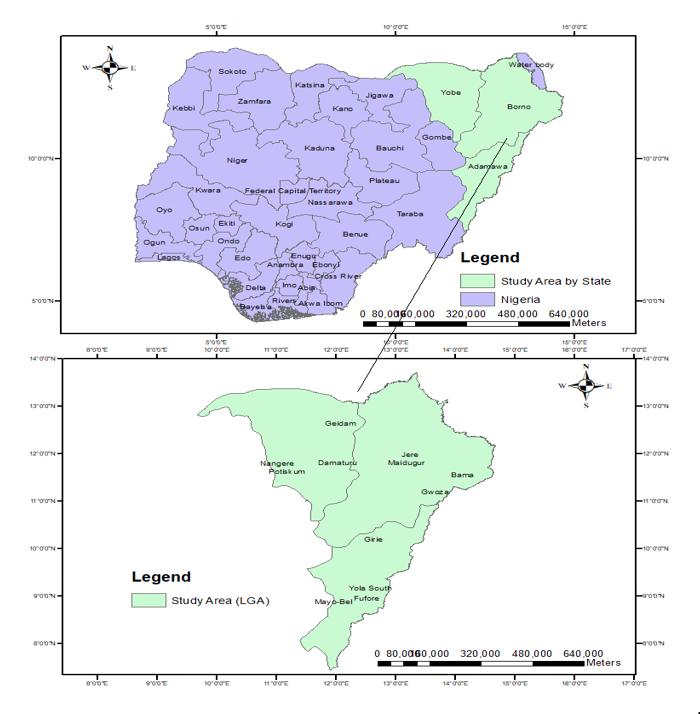
Armed conflicts in Northeast Nigeria, driven largely by Boko Haram and ISWAP insurgencies, have led to widespread population displacements, with millions of internally displaced persons (IDPs) settling in host communities. This study assessed the relationship between displacement rates and the prevalence of parasitic infections among IDP host communities in Adamawa, Borno, and Yobe States. A descriptive cross-sectional design was employed across 12 host communities, which had a combined population of 243,000, including 45,354 displaced persons. Structured questionnaires and laboratory investigations (stool, urine, and blood smears) were conducted among 1,094 participants. Data were analyzed using descriptive statistics and the Pearson correlation coefficient. Results revealed high displacement rates, ranging from 8.0% (Damare, Adamawa) to 28.0% (Dalori, Borno). The prevalence of parasitic infections ranged from 17.5% to 38.0%, with intestinal helminths as the most common. A strong positive correlation was found between displacement rate and parasitic prevalence (r = 0.81, p < 0.01), with the highest associations observed in Borno communities (Dalori r = 0.84, Bama r = 0.82). These findings suggest that increasing displacement intensity is significantly linked with higher parasitic burdens, largely due to overcrowding, poor sanitation, and inadequate health interventions. Integrated WASH, deworming, and malaria prevention programs are recommended to reduce morbidity in these vulnerable populations.
References
Abiye, M. A., Mengistie, Z., Teshome, F., & Asmare, G. (2022). Prevalence and associated factors of intestinal parasitic infections among patients attending Shahura Health Center, Northwest Ethiopia. BMC Infectious Diseases, 22(1), 1–9. https://doi.org/10.1186/s12879-021-07005-1
Abou-Zeid, A. H. A., Abkar, T. A., & Mohamed, R. O. (2012). Schistosomiasis and soil-transmitted helminths among an adult population in a war-affected area, Southern Kordofan state, Sudan. Parasites & Vectors, 5(133), 1–7. https://doi.org/10.1186/1756-3305-5-133
Abubakr, M. (2021). Population displacement and parasitic disease burden in conflict zones: Evidence from Sudan. Sudan Journal of Public Health, 16(2), 55–63.
Adebote, R. (2023). Impact of displacement and poor sanitation on soil-transmitted helminthiasis in conflict zones. Infectious Diseases Journal, 27(4), 301–314.
Adejuwon, J. O., & Jeje, L. K. (Eds.). (2018). Perspectives on Land Administration in Nigeria. Obafemi Awolowo University Press.
Adelakun, R. A., & Yakubu, I. (2021). Intestinal parasitic infections and risk factors among school children in rural Nigerian communities. Nigerian Journal of Parasitology, 42(1), 56–65.
Afolayan, O., Johnson, A., & Musa, Y. (2022). Burden of soil-transmitted helminths in internally displaced communities in Nigeria. African Health Sciences, 22(3), 211–221.
Ali, S., & Gambo, Y. (2023). Soil-transmitted helminthiasis and associated risk factors among rural households in Adamawa State, Nigeria. Journal of Tropical Parasitology, 49(2), 112–121.
Anyakora, C., Umeokonkwo, C. D., Abubakar, A., & Abah, R. O. (2025). Polyparasitism in internally displaced populations of Northeastern Nigeria: Implications for integrated control. Nigerian Journal of Infectious Diseases, 31(1), 44–57.
Davis, J., Jenkins, M., & Nwokocha, N. (2019). Water and sanitation challenges in conflict zones: A study from Northeastern Nigeria. Journal of Water, Sanitation and Hygiene for Development, 9(1), 12-25.
Federal Republic of Nigeria. (2015). Nigeria's Intended Nationally Determined Contribution. United Nations Framework Convention on Climate Change (UNFCCC). https://unfccc.int/sites/default/files/NDC/2022-06/Nigeria%27s%20INDC.pdf
IDMC. (2023). Global report on internal displacement. Internal Displacement Monitoring Centre.
Idris, I. (2016). Displacement, belonging, and land rights in Nigeria: The legacy of the Boko Haram conflict. K4D Helpdesk Report. Institute of Development Studies. https://assets.publishing.service.gov.uk/media/5c6c85a6e5274a72bc5d3dbe/Displacement_belonging_and_land_rights_in_Nigeria.pdf
Mwebaza, N. (2022). Prevalence and associated factors of intestinal parasitic infections among internally displaced persons living with HIV in Uganda. East African Health Research Journal, 6(2), 104–112.
Nwachukwu, E., & Omer, A. (2021). The impact of insurgency on the prevalence of parasitic infections: Evidence from Nigeria. International Journal of Infectious Diseases, 105, 560–572. https://doi.org/10.1016/j.ijid.2021.02.052
Okonkwo, E., & Oladimeji, A. (2023). Malaria transmission and control in Nigeria: A systematic review. African Journal of Malaria Research, 12(2), 144–157.
Shimawua, D., Abah, J., & Ebune, C. (2019). The sanitation challenges in Nigeria’s internally displaced persons camps. African Journal of Social and Behavioral Sciences, 9(2), 101–115.
Teklemariam, W. A., Hiko, D & Dheresa, M. (2022). Epidemiology of soil-transmitted helminthiasis and associated malnutrition among under-fives in conflict-affected areas in southern Ethiopia. BMC Infectious Diseases, 22(1), 1–11.
Thurston, A. (2018). Boko Haram: The History of an African Jihadist Movement. Princeton University Press.
UNHCR. (2022). UNHCR Report: Internally Displaced Persons in North-Eastern Nigeria. UNHCR Report.
United Nations Office for the Coordination of Humanitarian Affairs (OCHA), (2023). Humanitarian Needs Overview: Nigeria. United Nations Office for the Coordination of Humanitarian Affairs. https://reliefweb.int/attachments/ec229a3f-4f56-4c3a-95a4-61d4b1ec8453/Nigeria%20Humanitarian%20Needs%20Overview%202023.pdf
World Health Organization. (2021). World Malaria Report 2021. WHO. https://www.who.int/teams/global-malaria-programme/reports/world-malaria-report-2021
Downloads
Published
Issue
Section
Categories
License
Copyright (c) 2026 Emmanuel T. Pukuma M. S, Augustine L. M

This work is licensed under a Creative Commons Attribution 4.0 International License.


