
Evaluating the Validity of Constructing Balanced Incomplete Block Design using Galois Field Multiplication
DOI:
https://doi.org/10.33003/fjs-2025-0912-4496Keywords:
Galois field, Irreducible function, Multiplicative binary operation, Block Design, Prime factorAbstract
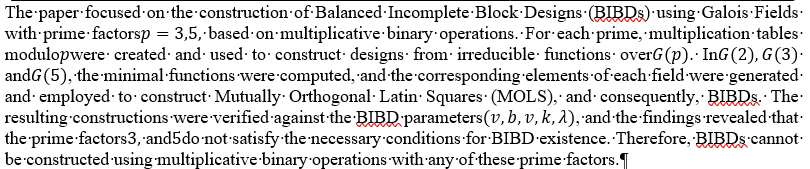
The paper focused on the construction of Balanced Incomplete Block Designs (BIBDs) using Galois Fields with prime factorsbased on multiplicative binary operations. For each prime, multiplication tables modulowere created and used to construct designs from irreducible functions over. Inand, the minimal functions were computed, and the corresponding elements of each field were generated and employed to construct Mutually Orthogonal Latin Squares (MOLS), and consequently, BIBDs. The resulting constructions were verified against the BIBD parameters, and the findings revealed that the prime factorsanddo not satisfy the necessary conditions for BIBD existence. Therefore, BIBDs cannot be constructed using multiplicative binary operations with any of these prime factors.
References
Akra, U. P., Akpan, S. S., Ugbe, T. A., and Ntekim, O. E. (2021). Finite Euclidean Geometry Approach for Constructing Balanced Incomplete Block Design (BIBD). Asian Journal of Probability and Statistics, 11(4), 47 – 59.
Akra, U. P., Bassey, E. E., Akpan, S. S., Etim, A. C., and Ntekim, O. E. (2025). Geometrical Approach for Construction of Balanced Incomplete Block Design. Jordan Journal of Mathematics and Statistics, 18 (2), 223-231.
Akra, U. P., Bassey, E. E., Umondak, U. J., Etim, A. C., Isaac, A. A., and Akpan, U. A. (2024). On the Selection of Optimal Balanced Incomplete Block Design Using Different Types of Designs. African Journal of Mathematics and Statistics Studies, 7(3), 179 – 189.
Akra, U. P., Isaac, A. A., Michael, I. T., Akpan, U. B., and Umondak, U. J. (2025). Concept of Isomorphisms and Automorphisms of a Balanced Incomplete Block Design. Scientia. Technology, Science and Society, 2(5), 118 – 124.
Akra, U. P., Ntekim, O. E., Robinson, G. S., and Etim, A. C. (2023). Evaluation of Some Algebraic Structures in Balanced Incomplete Block Design. African Journal of Mathematics and Statistics Studies, 6(4), 34 - 43.
Araujo, F. P., and Pardo, L. (2022). Existence and nonexistence results for BIBDs with given parameters via finite-field methods. Discrete Mathematics, 345(5), 112774.
Bailey, R. A. (2008). Design of comparative experiments. Cambridge: Cambridge University Press.
Beth, T., Jungnickel, D., and Lenz, H. (1999). Design theory (Vol. I, 2nd ed.). Cambridge: Cambridge University Press.
Bose, R. C. (1939). On the construction of balanced incomplete block designs. Annals of Eugenics, 9(4), 353–399.
Cochran, W. G., & Cox, G. M. (1957). Experimental designs (2nd ed.). New York: Wiley.
Colbourn, C. J., and Dinitz, J. H. (Eds.). (2007). Handbook of combinatorial designs (2nd ed.). Boca Raton: CRC Press.
Dinitz, J. H., and Stinson, D. R. (Eds.). (2024). The CRC handbook of combinatorial designs (3rd ed.). Boca Raton: CRC Press.
Federer, W. T. (1955). Experimental design: Theory and application. New York: Macmillan.
Hedayat, A. S., Sloane, N. J. A., and Stufken, J. (1999). Orthogonal arrays: Theory and applications. New York: Springer.
Ionin, Y. J., and Shrikhande, M. S. (2006). Combinatorics of symmetric designs. Cambridge: Cambridge University Press.
Isaac, A. A., Akra, U. P., and Akpan, S. S. (2025). On Whether a t – Steiner Quintuple System of Balanced Incomplete Block Design is a Group, Ring or Field Algebra. Fudma Journal of Sciences, 9(12), 246 – 251. https://doi.org/10.33003/fjs-2025-0912-4082.
Isaac, A. A., Akra, U. P., and Akpan, S. S. (2025). A New Procedure for Constructing N – Point D – Optimal Symmetric and Asymmetric Designs. African Journal of Mathematics and Statistics, 8(4), 150 – 161.
Janardan, M. (2018). Construction of Balanced Incomplete Block Design: An Application of Galois Field. Open Science Journal of Statistics and Application, 5(3), 32-39.
John, J. A., and Williams, E. R. (1995). Cyclic and computer-generated designs (2nd ed.). Boca Raton: CRC Press.
Kageyama, S., and Kubota, H. (2016). Evaluating robustness of balanced incomplete block designs under missing observations. Communications in Statistics Simulation and Computation, 45(8), 2733–2747.
Kang, S., and Jungnickel, D. (2021). On the classification of small balanced incomplete block designs via isomorphism testing. Journal of Combinatorial Designs, 29(9), 659–677.
Li, X., and Wang, X. (2023). Monte Carlo evaluation of efficiency and robustness of BIBDs under heteroscedastic errors. Statistical Papers, 64(2), 451–468.
Mukerjee, R., and Das, A. (2017). Robustness and efficiency of block designs: A review and new results. Journal of Statistical Planning and Inference, 187, 28–40.
Onyeka, C. E., and Akra, U. E. (2024). Construction and statistical evaluation of balanced incomplete block designs using Galois-field multiplication. African Journal of Mathematical and Statistical Sciences, 5(1), 33–47.
Pearce, S. C. (1984). The agricultural field experiment: A statistical examination of theory and practice. Chichester: Wiley.
Shrikhande, S. S., and Raghavarao, D. (1994). Balanced incomplete block designs: A historical survey and recent results. Journal of Statistical Planning and Inference, 42(1), 23–41.
Street, A. P. (2010). New constructions of BIBDs with prescribed automorphism groups. Designs, Codes and Cryptography, 56(1), 85–99.
Street, D. J., and Street, A. P. (1987). Combinatorics of experimental design. Oxford: Clarendon Press.
Downloads
Published
Issue
Section
Categories
License
Copyright (c) 2025 Muffat Akanimo J., Akra Ukeme P., Uto Nseobong P., Isaac Anthony A., Etim Andrew C., Akpan Uwem A.

This work is licensed under a Creative Commons Attribution 4.0 International License.


