
PHYTOCHEMICAL SCREENING AND GC-MS ANALYSES OF AQUEOUS EXTRACTS OF Aframomum melegueta (ALLIGATOR PEPPER) SEEDS AND FRUITS AS POTENTIAL AGENTS FOR MANAGING FISH HEALTH
DOI:
https://doi.org/10.33003/fjs-2026-1002-4486Keywords:
Aframomum melegueta, Proximate, Phytochemical, GC-MS, Aqueous ExtractAbstract
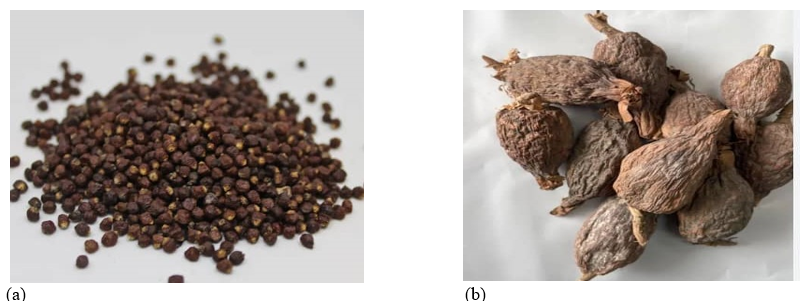
Aframomum melegueta (Roscoe) K. Schum is an herbaceous tropical perennial from the Aframomum genus, which is part of the Zingiberaceae family (the ginger family) within the angiosperm of the Plantae kingdom. The seeds and whole fruit of Aframomum melegueta were extracted separately with distilled water (1:10 w/v) by maceration for 24 hours at room temperature. The extracts were filtered, concentrated at 40°C, and stored at 4 °C until use. The resulting aqueous extract was subjected to qualitative and quantitative phytochemical analysis. The qualitative phytochemical screening revealed the presence of alkaloids, cardiac glycosides, saponins, phenolic compounds, tannins, steroids, carbohydrates, flavonoids and terpenoids. Quantitative analysis demonstrated significant concentrations of carbohydrates (13.94% and 13.94%), phenolic compounds (5.18% and 6.80%), and flavonoids (5.64% and 4.15%) from the seeds and whole fruits, respectively. The GC-MS analysis eluted twenty-two (22) bioactive compounds from A. melegueta seed extract and seventeen (17) bioactive compounds from the whole fruit aqueous extract. These bioactive compounds may act synergistically to offer strong antimicrobial, antioxidant and anti-inflammatory potential in aquaculture nutrition as well as manage the health of fish.
References
Adefegha, S. A., Oboh, G., Adefegha, O. M and Henle, T. (2016). Alligator pepper/grain of paradise (Aframomum melegueta) modulates angiotensin-I convering enzyme activity, lipid profile and oxidative imbalances in a rat model of hypercholesterolemia. Pathophysiology, 23(3): 191-202.
Adeyemi, M. A., Ekunseitan, D. A., Abiola, S. S., Dipeolu, M. A., Egbeyale, L. T. and Sogunle, O. M. (2017). Phytochemical analysis and GC-MS determination of Lagenaria breviflora R. fruit. International Journal of Pharmacognosy and Phytochemical Research, 9(7): 1045-1050. DOI:10.25258/phyto.v9.07.11178.
Afolabi, K. D. and Eko, P. M. (2016). Growth performance of Isa brown pullets fed diets with alligator pepper (Aframomum melegueta) seed meal. Nigerian Journal of Agriculture, Food and Environment, 12(4): 68-72.
Agidew, M. G. (2022). Phytochemical analysis of some selected traditional medicinal plants in Ethiopia. Bulletin of the National Research Centre, 46(87). https://doi.org/10.1186/s42269-022-00770-8.
Agim, C. S., Nosiri, C. I., Chukwuma, A. and Okechukwu, A. (2017). Evaluation of the phytochemical and GC-MS analysis of the aqueous seed extract of Aframomum melegueta. Journal of Pharmacognosy and Phytochemistry 6(2): 101-104.
Aguda, O. Y.and Gbadamosi, I. T. (2019). Nutritional and phytochemical components of three Aframomum species. Journal of Forestry Research and Management, 16(1): 118-128. www.jfrm.org.ng.
Ahmad, S. A. and Sirajo, M. (2024). Studies on volatile aromatic compounds associated with spoilt tomatoes in Sokoto metropolis. Sokoto State Caliphate Journal of Science and Technology, 2: 189-202 https://doi.org/10.4314/cajost.v6i2.8.
Ainsworth, E.A. and Gillespie, K.M. (2007) Estimation of total phenolic content and other oxidation substrates in plant tissues using Folin-Ciocalteu reagent. Nature Protocols, 2: 871-874.
Alamre, S., Algaraawi, N. L. and Algaraawi, N. (2020). Phytochemical profile and antifungal activity of stems and leaves methanol extract from the Juncus maritimus Linn. Junaceae family against some dermatophytes fungi. AIP Conference Proceedings, 2290(1). DOI: 10.106315.0027554.
Alhakmani, F., Kumar, S. and Khan, S. A. (2013). Estimation of total phenolic content, in-vitro antioxidant and anti-inflammatory activity of flowers of Moringa oleifera. Asian Pacific Tropical Biomedicine, 3(8): 623-627.
Anjusha, K. V., Mamun, M. A. A., Dharmakar, P., Shaimima, N. (2019). Effect of medicinal herbs on haematology of fishes. International Journal of Current Microbiology and Applied Sciences, 8(9): 2371- 2376. https:///doi.org/10/20546/ijemas.2019.809.274.
Arulnangai, R., Thabassoom, H. A., Banu, H. V., Thirugnanasambandham, K. and Ganesamoorthy, R. (2025). Recent developments on ursolic acid and its potential biological applications. Toxicology Reports, 10(14): 101900. Doi:10.1016/j.toxirep.2025.101900.
Bamidele, H. O. (2019). Antifungal potency of Aframomum melegueta (Alligator pepper) seed extracts in postharvest rot fungi of two citrus species. Sustainable Food Production, 6: 1-11.
Bartolome, A., Villasenor, M. and Young, W. (2013). Bidens pilosa L. (Asteraceae): Botanical properties, traditional uses, phytochemistry and pharmacology. Evidence-Based Complementary and Alternative Medicine, 2013: 1-51. https://doi.org/10.1155.2013/340215.
Behl, T., Kumar, K., Brisc, C., Rus, M., Nistor-Cseppento, D. C., Bustea, C., Aron, R. A. C., Pantis, C., Zengin, G., Sehgal, A., Kaur, R. Kumar, A., Arora, S., Setia, D., Chandel, D. and Bungau, S. (2021). Exploring the multi-focal role of phytochemicals as immunomodulators. Biomedicine and Pharmacotherapy, 133: 110959. https://doi.org/10.1016/j.biopha.2020.110959.
Beltran, J. M. A. and Esteban, M. A. (2022). Nature-identical compounds as feed additives in aquaculture. Fish and Shellfish Immunology, 123: 409-416.
Bennett, V. and Inengite, A. K. (2022). Composition of Alligator Pepper (Aframomum melegueta) obtained from Yenagoa in Bayelsa State, Nigeria. IOSR Journal of Applied Chemistry (IOSR-JAC), 15: 2278-5736.
Buchman, K. (2022). Control of parasitic diseases in aquaculture. Parasitology, 149(14), 1985-1997. Doi: 10.1017/S0031182022001093.
Doherty, V. F., Olaniran, O. O. and Kanife, U. C. (2010). Antimicrobial activities of Aframomum melegueta (Alligator Pepper). International Journal of Biology, 2(2): 126-131 https://doi.org/10.5539/ijb.v2n2p126.
Dubois, M., Gilles, K. M., Hamilton, J. K., Rebers, P. A., and Smith, F. (1956). Colorimetric method for determination of sugars and related substances. Analytical Chemistry, 28: 350-356.
Eko, P.M., Afolabi, K., Rotimi, O., Enyenihi, G., Mbaba, E. N. and Effiong, M. E. (2022). Haematology and serum metabolites of pre-laying Isa brown hens fed varying dietary levels of alligator pepper (Aframomum melegueta, k. Schum) seed meal. Journal of Biology, Agriculture and Healthcare, 12 (10). ISSN 2225-093X (online). www.iiste.org.
Godara, P., Dulara, B. K., Barwer, N. and Chaudhary, N. S. (2019). GC-MS analysis of bioactive phytochemicals from different plant parts and callus of Leptadania reticulata. Pharmacognosy Journal, 11(1): 129-140.
Harborne, J. B. (1973). Phytochemical Methods: A Guide to Modern Techniques of Plant Analysis, Chapman and Hall, London, UK, 1973.
Jeruto, P., Arama, P.F., Anyango, B. and Maroa, G. (2017). Phytochemical screening and antibacterial investigations of crude methanol extracts of Senna didymobotrya (Fresen.) H. S. Irwin & Barneby. Journal of Applied Biosciences, 114: 111357-11367.https://dx.doi.org/10.4314/jab.v114i1.9.
Jia, Z., Li, W., Bian, P., Yang, L., Liu, H., Pan, D. and Dou, Z. (2021). Ursolic acid treats renal tubular epithelial cell damage induced by calcium oxalate monohydrate via inhibiting oxidative stress and inflammation. Bioengineered, 12(1): 5450-5461. https://doi.org/10.1080/21655979.2021.1955176.
Khwaza, V., Oyedeji, O. O. and Aderibigbe, B. A. (2020). Ursolic acid-based derivatives as potential anti-cancer agents: An update. International Journal of Molecular Sciences, 21(16): 5920. https://doi.org/10.3390/ijms21165920.
Kim, H. J., Kim, I. S., Rehman, S. U., Ha, S. K., Nakamura, K. and Yoo, H. H. (2017). Effects of 6-paradol, an unsaturated ketone from gingers, on cytochrome P450-mediated drug metabolism. Bioorganic and Medicinal Chemistry Letters, 27(8): 1826-1830. https://doi.org/10.1016/j.bmcl.2017.02.047.
Kwankwa, T., Ityumbe, M. S., Ndumari, M. P., Garba, T. H., Habib, M., Usman, A. and Sogbesan, O. A. (2020). Effects of alligator pepper (Aframomum melegueta) meal additive diets on growth ANS feed utilization Clarias gariepinus (Burchell, 1822). International Journal of Innovative Studies in Aquatic Biology and Fisheries, 6(3): 1-6.
Liu, G., Qin, P., Cheng, X., Wu, L., Zhao, W. and Gao, W. (2024). Evaluation of the mechanistic basis for the antibacterial activity of ursolic acid against Staphylococcus aureus. Frontiers in Microbiology, 17(15): 1389242. https://doi.org/10.3389/fmicb.2024.1389242.
Makkar, H. P. S., Francis, G. and Becker, K. (2007). Bioactivity of phytochemicals in some lesser known plants and their effects and potential applications in livestock and aquaculture production systems. Animals, 1(9), 1371-1391. https://doi.org/10.1017/S175173110700029.
Mala, G. A., Wakil, I. M., Garba, H., Mindia, A., Musa, S. A., Ahmed, A. A., Fugu, M. B.and Waziri, I. (2024). Exploring the antibacterial properties of hydrazine Schiff bases derived from 4-aminodimethylbenzaldehyde: Synthesis, characterization and activity assessment. Arid Zone Journal of Basic and Applied Research, 3(2): 103-118. www.azjournalbar.com.
Mansoori, A., Noveirrian, H. A., Hoseinifar, S. H. Sajjadi, M., Ashouri, G., Imperatore, R. and Paolucci, M. (2024). Polyphenol-rich extracts enhance growth, immune function and antioxidant defense in juvenile rainbow trout (Onchyrhynus mykiss). Frontiers in Nutrition, 11: 1487209. https://doi.org/10.2289/fnut.2024.1487209.
Mao, Q., Xu, X., Cao, S., Gan, R., Corke, H., Beta, T. and Li, H. (2019). Bioactive compounds and bioactivities of ginger (Zingiber officinale Roscoe). Foods, 8(6): 185. https;//10.3390/foods8060185.
Marinova, D., Ribarova, F. and Atanassova, M. (2005). Total phenolics and total flavonoids in Bulgarian fruits and vegetables. Journal of the University of Chemical Technology and Metallurgy, 40(3): 255-260.
NCBI (2025). National center for biotechnology information. PubChem compound summary for CID 3473, 5-Hydroxy-1-1(4-2 hydroxy-3-methoxyphenyl decan-3-one.
Nimalan, N., Sorensen, S. L., Feckaninova, A., Koscova, J., Mudronova, D., Gancarcikova, S., Vatsos, I. N., Bisa, S., Kiron, V. and Sorensen, M. (2022). Mucosal barrier status in Atlantic salmon fed marine or plant based diets supplemented with probiotics. Aquaculture, 547: 737516. https://doi.org/10.1016/j.aquaculture.2021.737516.
Njoku, P. C., and Akumefula, M. I. (2007). Phytochemical and nutrient evaluation of Spondiasmombin leaves. Pakistan Journal of Nutrition, 6(6): 613-615.
Ogwu, M. C., Dunkwu-Okafor, A., Omakor, I. A. and Izah, S. C. (2024). Medicinal spice, Aframomum melegueta: An overview of phytochemical constituents, nutritional characteristics and ethno-medicinal values for sustainability. In: Izah, S. C., Ogwu, M. C. and Akram, M. (Eds). Herbal Medicine Phytochemistry, 1-23. https://doi.org/10.1007/978-3-031-43199-9_72.
Ohiri, R. C., Amadi, B. A. and Onwuzuruike, D. T. (2023). Variations in confinement of bioactive components in different seeds of Spondias mombin tree. Journal of Applied Sciences and Environmental Management, 27(3): 483-493. https://doi.org/10.4314/jasem.v27i3.11.
Okugbo, T. and Oriakhi, K. (2015). A comparative study of in vitro antioxidant activity and phytochemical constituents of methanol extract of Aframomum melegueta and Costus afer leaf. Jordan Journal of Biological Sciences, 8(4): 273-279.
Oladunmoye, M. K. (2019). Characterisation of organic compounds in Aframomum melegueta K. Schum using GC-MS. Medical Aromatic Plants, 8, 331. Doi:10.35248/2167-0412.19.8.331.
Olatunji, O. I.,Olaniyan, O. S., Olayiwola, O. B.,Olatunbosun, O. S. and Odunsi, A. A. (2018). Evaluation of growth performance, carcass quality and organoleptic indices of weaner rabbits fed two dietary protein levels with or without alligator pepper (Aframomum melegueta). Nigerian Journal of Animal Science, 307-312.
Onanuga, A. O and Oloyede, G. (2022). Phytochemical analysis and antifungal activity of Costus lucanusianus J. Braun and K. Schum aerial and rhizome crude extracts. GSC Biological and Pharmaceutical Sciences, 18(2): 215-223. Doi:10.30574/gscbps.2022.18.2.0068.
Osuntokun, O. T. (2020). Aframomum melegueta (grains of paradise). Annals of Microbiology and Infectious Diseases, 3(1): 1-6. https://doi.org/10.22259/2637-5346.0301001.
Owokotomo, A., Ekundayo, O. and Oguntuase, B. J. (2014). Chemical constituents of the leaf, stem, root and seed essential oils of Aframomum melegueta (K. Schum) from South West, Nigeria. International Research Journal of Pure and Applied Chemistry, 4: 395-401. https://doi.org/10.9734/IRJPAC/2014/7397.
Ozogul, Y., Ucar, Y., Tadesse, E. E., Rathod, N., Kulawik, P., Trif, M., Esatbeyoglu, T. and Ozogul, F. (2025). Tannins for food preservation and human health: A review of current knowledge. Applied Food Research, 5(1): 100738.
Rezaei, D. M. (2020). Effects of different levels of saponin on growth performance and food efficiency in convict cichlid (Amtitlania nigrofasciata). Journal of Fisheries and Aquatic Science, 15(1): 22-26. https://doi.org/ifas.2020.22.26.
Sakulpanich, A. and Gritsanapan, W. (2009). Determination of anthraquinone glycoside content in Cassia fistula leaf extracts for alternative source of laxative drug. Internation Journal of Biomedical and Pharmaceutical Sciences, 3(1): 42-45.
Seba, M. C., Mathew, A. T., Rekha, S. and Prasobh, G. R. (2020). 6-Paradol, a vital compound of medicinal significance: A concise report. International Journal of Research and Review, 7(10): 11-15.
Shamsa, F., Hamidreza, M., Rouhollah, G. and Mohammadreza, V. (2008). Spectrophotometric determination of total alkaloids in some Iranian medicinal plants. Thailand Journal of Pharmaceutical Science.
Sharief, M. D., Srinvasulu, A. and Uma, M. R. (2014). Estimation of alkaloids and total phenol in roots of Derris trifoliate L. and evaluation for antibacterial and antioxidant activity. Indian Journal of Applied Research.
Shettima, U. A., Ibrahim, M., Inogesit, E. E. (2024). Synthesis, characterization and antimicrobial studies of Schiff base ligand derived from salicylaldehyde and 2, 4-dinotrophenylhydrazine and its metals complexes. Nigeria Research Journal of Chemical Sciences, 12(1): 219-234.
Sofowora, A. (1993). Phytochemical Screening of Medicinal Plants and Traditional Medicine in Africa. Spectrum Books Ltd, Ibadan, Nigeria.
Solich, P., Sedliakova, V. and Karlicek, R. (1992). Spectrophotometric determination of cardiac glycosides by flow-injection analysis. Analytica Chimica Acta, 269(2): 199-203.
Trease, G. E. and Evans, W. C. (1989). “Phenols and phenolic glycosides,” in Textbook of Pharmacognosy, 12: 343–383, Balliese, Tindall and Co Publishers, London, UK, 1989.
Ugokwe, C. U., Ezewudo, B. I. and Amobi, M. I. (2025). Oxidative stress and histopathology responses of C. gariepinus exposed to stimulated waste ash leachate from Onitsha dumpsite, Nigeria. The Journal of Basic and Applied Zoology, 86(33). https://doi.org/10.1186/s41936-025-00455-4.
Umukoro, S. and Ashorobi, R. B. (2004). Pharmacological evaluation of the antidiarrheal activity of Aframomum melegueta seed extract. West African Journal of Pharmacology and Drug Research, 19(1). DOI: 10.4314/wajpdr.v19i1.14734.v.
Wei, C., Tsai, Y., Korinek, M., Hung, P., El-Shazly, M., Cheng, Y., Wu, Y., Hsieh, T. and Chang, F. (2017). 6-Paradol and 6-shogaol, the pungent compounds of ginger, promote glucose utilization in adipocytes and myotubes, and 6-paradolreduces blood glucose in high fat diet fed mice. International Journal of Molecular Science, 18(1): 168. https://doi.org/10.3390/ijms18010168.
Yerinbide, O., Onwugbuta, G. C., and Tonye, W. (2024). Phytochemical, mineral and proximate characterization of seed and pod of Alligator pepper (Aframomum melegueta), 3(1): 92-97.
Zhishen, J., Mengcheng, T. and Jianming, W. (1999). The determination of flavonoid contents in mulberry and their scavenging effects on superoxide radicals. Food Chemistry. https://doi.org/10.1016/S0308-8146(98)00102.
Downloads
Published
Issue
Section
Categories
License
Copyright (c) 2026 Grace Osisienemo Abe, Sonnie Joshua Oniye, Jehu Auta, Hassan Umaru Onimisi, Abdullateef Yusuf

This work is licensed under a Creative Commons Attribution 4.0 International License.


