
CHARACTERIZATION OF DOMESTIC GREYWATER FOR CONSTRUCTED WETLAND TREATMENT AND NON-POTABLE REUSE IN A TROPICAL PERI-URBAN RESIDENTIAL COMMUNITY
DOI:
https://doi.org/10.33003/fjs-2026-1002-4479Keywords:
Domestic greywater, Greywater characterization, Constructed wetland treatment, Free water surface wetlands, Non-potable reuseAbstract
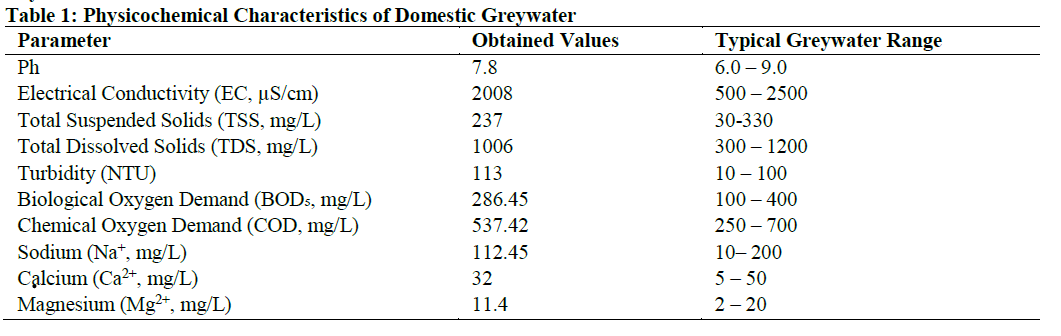
Increasing freshwater scarcity and rapid urbanization in tropical regions have intensified interest in greywater reuse as a sustainable water management strategy. Constructed wetlands offer a low-cost, nature-based solution for decentralized treatment; however, their effective design and optimization depend on a detailed understanding of influent greywater characteristics. Comprehensive characterization is therefore essential to guide system configuration, pretreatment requirements, and reuse risk assessment. This study characterized the physicochemical, nutrient, microbiological and trace-metal properties of domestic greywater generated from residential units at the National Water Resources Institute (NWRI), Kaduna, Nigeria, representing a tropical peri-urban environment. Composite samples were collected from bathrooms, kitchen sinks, wash basins and laundry outlets. Laboratory analyses were conducted using standard methods to determine organic strength indicators, solids content, nutrient levels, microbial loads, and selected heavy metals relevant to treatment design and reuse suitability. Greywater exhibited near-neutral pH (7.8) and moderate salinity (EC 2008 µS/cm). Organic pollution was high, with BOD₅ and COD concentrations of 286.45 mg/L and 537.42 mg/L, respectively and a BOD₅/COD ratio of 0.53, indicating good biodegradability. Suspended solids (237 mg/L) and turbidity (113 NTU) were elevated, suggesting pretreatment needs. Nutrient concentrations were appreciable, while sodium levels indicated potential irrigation constraints. Microbial indicators exceeded reuse limits, whereas trace metals remained low. The findings confirm that the greywater characteristics are suitable for treatment using small-scale Free Water Surface constructed wetlands, provided adequate pretreatment and post-treatment safeguards are incorporated to ensure safe non-potable reuse in tropical peri-urban communities.
References
Abed, S. N., Scholz, M., & Al-Fatlawi, H. J. (2020). Greywater generation and reuse: A review. Environmental Technology & Innovation, 20, 101064. https://doi.org/10.1016/j.eti.2020.101064
Abed, S. N., Scholz, M., & Al-Saffar, A. A. (2020). Assessment of greywater characteristics and treatment performance using constructed wetlands: A review. Environmental Technology & Innovation, 19, 100958. https://doi.org/10.1016/j.eti.2020.100958
APHA. (2022). Standard methods for the examination of water and wastewater (24th ed.). American Public Health Association.
https://www.standardmethods.org
Arden, S. (2024). Towards the definition of pathogen log reduction credits for treatment wetlands used in water reuse applications. Science of the Total Environment, 907, 168061. https://doi.org/10.1016/j.scitotenv.2024.168061
de Campos, S. X. (2024). Constructed wetlands for wastewater treatment and reuse: Challenges and opportunities for pathogen removal. Environments, 11(2), 35. https://doi.org/10.3390/environments11020035
FAO. (2020). Water quality for agriculture (FAO Irrigation and Drainage Paper 29 Rev.1). Food and Agriculture Organization. https://www.fao.org/3/t0234e/t0234e.pdf
Gyapong-Korsah, B., Oteng-Peprah, M., Acheampong, M. A., & Asare, E. (2026). Greywater quantities and qualities in low-income urban households: Source-specific characteristics and implications for treatment and reuse. PLOS Water, 5(1), e0000398. https://doi.org/10.1371/journal.pwat.0000398
Hardie, A. G., Madubela, N., Lategan, E. L., & Clarke, C. E. (2025). Comparison of household greywater sources and rainwater remediation effects on topsoil chemical and structural properties. Applied Water Science, 15, 60. https://doi.org/10.1007/s13201-025-02460-y
Langergraber, G., & Dotro, G. (2019). Wetland technology: Practical information on the design and application of treatment wetlands. IWA Publishing. https://iwaponline.com
Masoud, A. M. N., Alfarra, A., Al-Shurafat, A. W., & Sorlini, S. (2025). Sustainable greywater treatment using constructed wetlands as nature-based solutions in arid and semi-arid regions. Water, 17(16), 2497. https://doi.org/10.3390/w17162497
Mbiza, H., Moyo, P., & Nhapi, I. (2025). Microbial contamination and public health risks associated with untreated greywater reuse. Journal of Water, Sanitation and Hygiene for Development, 15(2), 309–320. https://doi.org/10.2166/washdev.2025.309
Metcalf & Eddy, Inc. (2014). Wastewater engineering: Treatment and resource recovery (5th ed.). McGraw-Hill Education.
Van de Walle, A., Vaneeckhaute, C., Meers, E., & Van Hulle, S. W. H. (2023). Greywater reuse as a key enabler for improving urban water resilience: Quality variability, risks, and treatment requirements. Water Research, 236, 119961. https://doi.org/10.1016/j.watres.2023.119961
Varma, M., Gupta, A. K., Ghosal, P. S., & Majumder, A. (2021). Performance of constructed wetlands in tropical and cold climates. Science of the Total Environment, 755, 142540. https://doi.org/10.1016/j.scitotenv.2020.142540
Vymazal, J., & Březinová, T. (2022). Long-term nutrient removal performance of constructed wetlands. Science of the Total Environment, 806, 150622. https://doi.org/10.1016/j.scitotenv.2021.150622
Downloads
Published
Issue
Section
Categories
License
Copyright (c) 2026 Hadiza Nuhu Ajoge, Rabia Lawal Batagarawa, Saminu Ahmed, Abdullahi Ibrahim, Nwude Michael Obiekwe

This work is licensed under a Creative Commons Attribution 4.0 International License.


