
GREEN SYNTHESIS AND CHARACTERIZATION OF ZINC OXIDE NANOPARTICLES USING Euphorbia lateriflora LEAF EXTRACT: EVALUATION OF ANTIMICROBIAL AND ANTIOXIDANT ACTIVITIES
DOI:
https://doi.org/10.33003/fjs-2026-1002-4456Keywords:
Green synthesis, Zinc oxide nanoparticles, Euphorbia Lateriflora, Antimicrobial Activity, Antioxidant Activity, PhytochemicalsAbstract
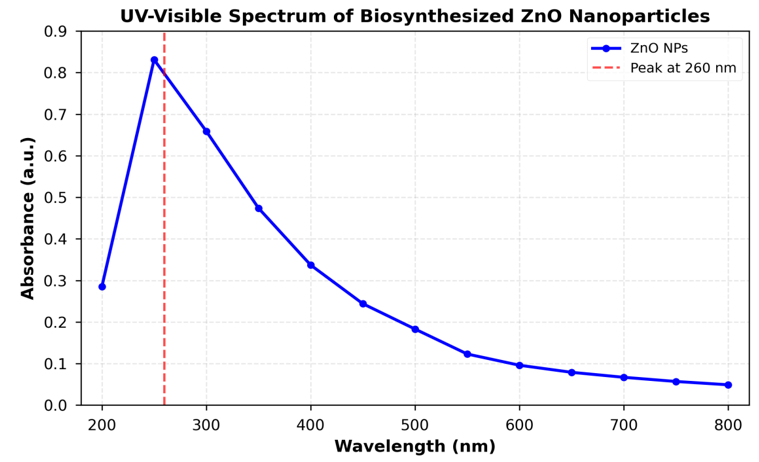
The biosynthesis of zinc oxide nanoparticles (ZnO NPs) using plant extracts has emerged as an environmentally friendly and cost-effective alternative to conventional chemical and physical methods. This study reports the green synthesis of ZnO NPs using aqueous leaf extract of Euphorbia lateriflora as both reducing and stabilizing agent. The biosynthesized nanoparticles were characterized using UV-visible spectroscopy, Fourier transform infrared spectroscopy (FTIR), X-ray diffraction (XRD), and scanning electron microscopy (SEM). UV-Vis spectroscopy revealed characteristic absorption peak at 260 nm, confirming the formation of ZnO NPs. FTIR analysis identified functional groups responsible for reduction and stabilization of nanoparticles. XRD patterns indicated crystalline monoclinic structure with diffraction peaks corresponding to JCPDS-36-1451. SEM analysis showed spherical morphology with polydispersed distribution. Phytochemical screening of Euphorbia lateriflora methanolic extract revealed presence of alkaloids, steroids, cardiac glycosides, saponins, sterols, terpenes, terpenoids, and flavonoids. The biosynthesized ZnO NPs demonstrated significant antibacterial activity against Klebsiella pneumoniae, Escherichia coli, and Pseudomonas aeruginosa, with inhibition zones of 27.00 ± 2.42 mm, 21.00 ± 1.83 mm, and 17.00 ± 1.25 mm respectively. Antioxidant assays showed DPPH radical scavenging activity with IC₅₀ value of 111.07 ± 15.72 μg/mL and FRAP value of 1.88 ± 0.06 μg/g. These findings demonstrate that Euphorbia lateriflora-mediated ZnO NPs possess promising antimicrobial and antioxidant properties suitable for biomedical applications.
References
Agidew, M.G. (2022). Phytochemical analysis of some selected traditional medicinal plants in Ethiopia. Bulletin of the National Research Centre, 46(1), 87-98.
Akinsipo (Oyelaja), O. B., Osinubi, A. D., Badeji, A. A., Ogunade , T. J., Idowu, A. D., Afolayan, O. J., Ajiwe, I. A., & Ameen, A. O. (2024). Green synthesized silver nanoparticles and their biomedical applications: a review. Scientia Africana, 23(3), 11–24. https://doi.org/10.4314/sa.v23i3.2
Anirudh, K., Rajesh, M., & Singh, R.K. (2020). Chemical synthesis of nanoparticles: Environmental impacts and green alternatives. Journal of Environmental Chemical Engineering, 8(5), 104234.
Ashwani, J., Aswathy, T.R., & Achuthsankar, S.N. (2021). Green synthesis and characterization of zinc oxide nanoparticles using Cayratia pedata leaf extract. Materials Letters, 285, 129145.
Azad, A., Zafar, H., Raza, F., & Sulaiman, M. (2023). Factors influencing the green synthesis of metallic nanoparticles using plant extracts: A comprehensive review. Green Chemistry Letters and Reviews, 16(1), 2165469.
Bandeira, M., Giovanela, M., Roesch-Ely, M., Declan, M.D., & Janaina da Silva Crespo. (2021). Green synthesis of zinc oxide nanoparticles: A review of the synthesis methodology and mechanism of formation. Sustainable Chemistry and Pharmacy, 23, 100512.
Bazinjyl, A.A., & Azeez, H.H. (2020). Green synthesis and characterization of zinc oxide nanoparticles using Eucalyptus globulus Labill. leaf extract and zinc nitrate hexahydrate salt. SN Applied Sciences, 2(7), 1-14.
Coker, M.E., Aderibigbe, A.O., & Odunola, O.A. (2021). Antimicrobial activity of Euphorbia lateriflora extracts and fractions against urogenital pathogens. Journal of Pharmaceutical Research International, 33(38A), 128-136.
Danish, M.S., Estrella, L.L., Alemaida, I.M.A., Lisin, A., Moiseev, N., Ahmadi, M., Nazari, M., Wali, M., Zaheb, H., & Senjyu, T. (2021). Biosynthesis of metal nanoparticles using plant extracts for energy and environmental sustainability. Sustainability, 13(5), 2918.
Elena, P., Miri, A., Darroudi, M., & Sarani, M. (2020). A review on generation, properties and applications of iron oxide nanoparticles. Current Pharmaceutical Design, 26(43), 5570-5583.
Fahadul, I., Sheikh, S., Md. Jalal, U., Md. Rezaul, I., Mohamed, H.N., Aklimer, A., Saikat, M., Arpita, R., Talía, B.E., & Cavalu, S. (2021). Exploring the journey of zinc oxide nanoparticles (ZnO-NPs) toward biomedical applications. Materials, 14(4), 812.
Falana, H.T., Ogundare, S.A., & Adelowo, O.O. (2022). Phytochemical constituents and antimicrobial potentials of Euphorbia lateriflora extracts. Nigerian Journal of Natural Products and Medicine, 26(1), 34-42.
Gopalan, R., Ambikapathi, N., Sundar, M., Theivendran, P., Murugesan, S., Pavadai, P., Kumar, S., Ilango, S., & Selvaraj, K. (2021). Mixed phytochemicals mediated synthesis of copper nanoparticles for anticancer and larvicidal applications. Nanotechnology for Environmental Engineering, 6(1), 1-11.
Harish, V., Tewari, D., Gaur, M., Yadav, A.B., Swaroop, S., Bechelany, M., & Barhoum, A. (2020). Review on nanoparticles and nanostructured materials: Bioimaging, biosensing, drug delivery, tissue engineering, antimicrobial, and agro-food applications. Nanomaterials, 10(4), 802.
Harsh, K., Rajput, V.D., Minkina, T., Sushkova, S., Mandzhieva, S., Keswani, C., & Sarkar, P. (2020). Green synthesis of nanoparticles: An eco-friendly approach. Biocatalysis and Agricultural Biotechnology, 29, 101841.
Martinez, M.C., Lopez-Garcia, M., Rodríguez-Barro, P., Valarino, T., Lodeiro, P., Herrero, R., & Bariada, J.L. (2021). Antioxidant capacity assessment of plant extracts for green synthesis of nanoparticles. Antioxidants, 10(6), 865.
Marslin, G., Karthik, S., Qaisar, M., Rajendra, K.S., Dariusk, K., Piotr, K., & Gregory, F. (2018). Secondary metabolites in the green synthesis of metallic nanoparticles. Materials, 11(6), 940.
Selvakesavan, R.K., Franklin, D.S., Vidhya, M., Amalraj, A., & Gopi, D. (2023). Phytochemicals as green precursors for the synthesis of bioactive metallic nanoparticles. Current Opinion in Green and Sustainable Chemistry, 39, 100736.
Shaba, E.Y., Jacob, J.O., Tijani, J.O., & Suleiman, M.A.T. (2021). A critical review of synthesis parameters affecting the properties of zinc oxide nanoparticle and its application in wastewater treatment. Applied Water Science, 11(3), 1-41.
Tayyab, M., Sher, F., Rasheed, T., Shuaib, M., Ilyas, M., Asghar, M., & Abid, N. (2021). Nanoparticles: Applications in medicine and environmental challenges. Environmental Technology & Innovation, 22, 101470.
Usman, H., Abdulrahman, F.I., & Ladan, A.A. (2014). Phytochemical and antimicrobial evaluation of Euphorbia lateriflora. Journal of Medicinal Plants Research, 8(3), 97-100.
Yasser, A.S., Maha, A.A., Islam, R., & Mohamed, H.M. (2020). Green synthesis of zinc oxide nanoparticles using aqueous extract of Deverra tortuosa and their cytotoxic activities. Scientific Reports, 10(1), 1-11.
Downloads
Published
Issue
Section
Categories
License
Copyright (c) 2026 Oyesolape Akinsipo, Adejoke Osinubi, Blessing Adebayo

This work is licensed under a Creative Commons Attribution 4.0 International License.