
EFFECT OF ANTHROPOGENIC ACTIVITIES ON PERIPHYTON ALGAL ASSOCIATION OF NWANIBA RIVER
DOI:
https://doi.org/10.33003/fjs-2026-1002-4414Keywords:
Nwaniba River, Anthropogenic Activities, Physicochemical Parameters, Periphyton, Sustainable ManagementAbstract
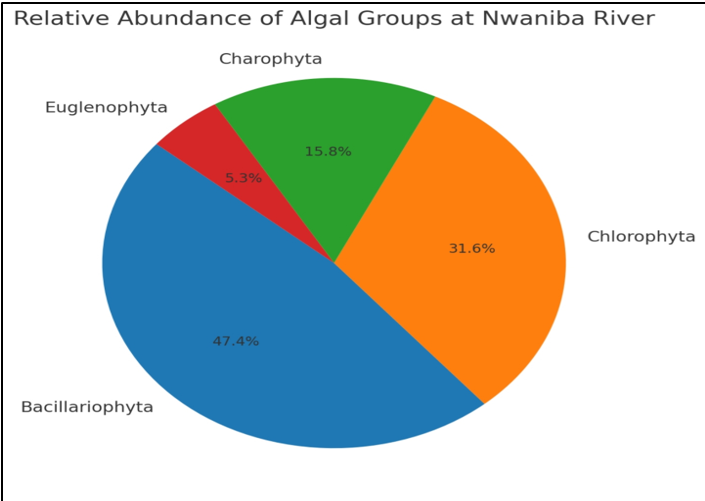
Freshwater ecosystems are increasingly threatened by anthropogenic activities that alter their physicochemical and biological integrity. This study investigated the impact of human activities on the physicochemical parameters and periphyton community of the Nwaniba River, Akwa Ibom State, Nigeria. Water samples were collected from three stations along the river—upstream (control), midstream (domestic waste influence), and downstream (agricultural and light industrial influence). Standard methods were employed to assess parameters including pH, dissolved oxygen, turbidity, conductivity, temperature, and nutrient levels, while periphyton samples were analyzed for composition, abundance, and diversity. Results showed that Bacillariophyta (47.4%) dominated the algal community, indicating relatively good water quality, while Chlorophyta (31.6%) reflected nutrient enrichment and early eutrophication linked to domestic and agricultural inputs. Charophyta (15.8%) suggested the presence of clean and oxygen-rich sections, whereas low Euglenophyta abundance (5.3%) indicated minimal organic pollution. Overall, findings reveal that while the Nwaniba River retains some ecological balance, increasing anthropogenic pressures are altering its water quality and periphyton structure, posing risks of progressive degradation if unmanaged.
References
Adefemi, O. S., and Awokunmi, E. E. (2010). Determination of physico-chemical parameters and heavy metals in water samples from Itaogbolu area of Ondo-State, Nigeria. African Journal of Environmental Science and Technology, 4(3), 145–148.
Akaninwor, J. O., and Egwim, O. (2006). The effects of urban storm run-off on the physicochemical parameters of the Ogunpa River in Ibadan City, Nigeria. African Journal of Environmental Pollution and Health, 4(1), 21–27.
Akpan, E. R., and Offem, J. O. (2011). Seasonal variation in water quality of the Calabar River: influence of tides and urban waste discharge. Journal of Environmental Protection, 2(9), 1149–1161.
Allan, J. D. (2004). Landscapes and riverscapes: the influence of land use on stream ecosystems. Annual Review of Ecology, Evolution, and Systematics, 35, 257–284. https://doi.org/10.1146/annurev.ecolsys.35.120202.110122
American Public Health Association. (2017). Standard Methods for the Examination of Water and Wastewater (23rd ed.). Washington, DC: American Public Health Association.
Arimoro, F. O., and Ikomi, R. B. (2008). Response of macroinvertebrate communities to water quality in a disturbed stream in the Niger Delta, Nigeria. Environmentalist, 28(2), 85–97.
Biggs, B. J. F. (2000). Eutrophication of streams and rivers: dissolved nutrient-chlorophyll relationships for benthic algae. Journal of the North American Benthological Society, 19(1), 17–31. https://doi.org/10.2307/1468273
Chindah, A. C., Braide, S. A., and Nduaguibe, D. A. (2004). Effect of industrial activities on the water quality and macrofauna of a typical Niger Delta creek. Journal of Nigerian Environmental Society, 2(1), 1–8.
Dudgeon, D., Arthington, A. H., Gessner, M. O., Kawabata, Z. I., Knowler, D. J., Lévêque, C., ... and Sullivan, C. A. (2006). Freshwater biodiversity: importance, threats, status and conservation challenges. Biological Reviews, 81(2), 163–182. https://doi.org/10.1017/S1464793105006950
Ezekiel, E. N., Hart, A. I., and Abowei, J. F. N. (2011). The physical and chemical condition of Sombreiro River, Niger Delta, Nigeria. Research Journal of Environmental and Earth Sciences, 3(4), 327–340.
Izonfuo, L. W. A., and Bariweni, P. A. (2001). The effect of urban runoff water and human activities on some physicochemical parameters of the Epie Creek in the Niger Delta. Journal of Applied Sciences and Environmental Management, 5(1), 47–55.
Malmqvist, B., and Rundle, S. (2002). Threats to the running water ecosystems of the world. Environmental Conservation, 29(2), 134–153.
Nkwoji, J. A., Yakubu, A. F., and Ajani, G. E. (2010). Assessment of the water quality and plankton of Epe Lagoon, Lagos, Nigeria. Research Journal of Environmental and Earth Sciences, 2(4), 199–204.
Odiete, W.O. (1999). Environmental Physiology of Animals and Pollution. Diversified Resources Ltd, Lagos.
Ogbeibu, A. E., Victor, R., and Osimen, E. C. (2007). Impact of effluents on water quality and macroinvertebrate community of a stream in southern Nigeria. African Journal of Environmental Pollution and Health, 6(1), 23–33.
Ogbuagu, D. H., and Ayoade, A. A. (2012). The impact of anthropogenic activities on the diversity and abundance of benthic macroinvertebrates of Imo River, Niger Delta Basin, Nigeria. International Journal of Biological and Chemical Sciences, 6(3), 1360–1371.
Palmer, C. M. (1969). A composite rating of algae tolerating organic pollution. Journal of Phycology, 5(2), 78–82.
Patrick, R. (1973). Use of algae, especially diatoms, in the assessment of water quality. American Society for Testing and Materials.
Rimet, F., and Bouchez, A. (2012). Life-forms, cell-sizes and ecological guilds of diatoms in European rivers. Knowledge and Management of Aquatic Ecosystems, (406), 1–14. https://doi.org/10.1051/kmae/2012018
Stevenson, R. J. (1996). The stimulation and drag of periphyton by moving water. In R. J. Stevenson, M. L. Bothwell, and R. L. Lowe (Eds.), Algal ecology: freshwater benthic ecosystems (pp. 321–340). Academic Press.
Stevenson, R. J., Bothwell, M. L., and Lowe, R. L. (2001). Algal Ecology: Freshwater Benthic Ecosystems. Academic Press.
Wetzel, R. G. (2001). Limnology: Lake and river ecosystems (3rd ed.). Academic Press.
Downloads
Published
Issue
Section
Categories
License
Copyright (c) 2026 Denise Mukoro, G. V. Asuquo, I. E. Effiong, N. Solomon, M. C. Akpan, C. A. Gabriel, R. S. Archibong, P. O. Hogan, M. U. Ukwe, S. E. Udoh, D. D. Obop, R .P. Dominic, A. M. Okpin, M.B. Johnny, U. Enoh, A. U. Effiong, G. A. Abia, B. P. Ben, I. S. Etim, U. U. Titus, P. N. Nwankwo, F. D. Godwin, R. C. Emmanuel, S. M. Sabinus, R. D. Douglas, S. U., Asibong, E. E. Akpan, W. V. Umoette, E. T. James, E. J. Enefiok, G. A. Udofia, O. S Enyinnaya, M. U. Ezekiel, A. I. Bassey, I. D. Archibong, E. G. Etim, L. E. Effiong

This work is licensed under a Creative Commons Attribution 4.0 International License.