
EFFECT OF PRE-PROCESSING OPERATIONS ON SENSORY PROPERTIES OF CONDIMENTS FROM Prosopis Africana SEED
DOI:
https://doi.org/10.33003/fjs-2026-1002-4404Keywords:
Sensory, Condiment, Pre-processing, Prosiopis africana, boilingAbstract
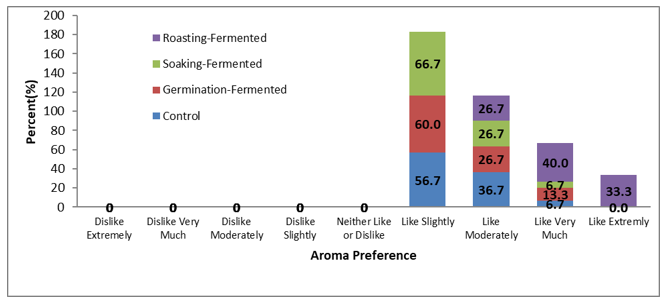
The study is on the effect of pre-processing operations on sensory properties of soup made with condiments from Prosopis africana seed. Boiling, germination, soaking and roasting were the various pre-processing operations considered with boiling serving as control. Okpehe prepared from the different processing methods was used to prepare bitter leaves (olugbu) soups; the prepared soups were coded and presented to semi-trained thirty-member panel of judges who are familiar with the consumption of the product. Each panellist was provided with enough privacy to avoid biased result. The samples were scored for appearance, mouth feel, taste, and general acceptability using a nine-point Hedonic scale, where 9 indicated liked extremely and 1 indicated disliked extremely. The data obtained were represented in charts. The roasted sample was most preferred in relation to aroma and taste with 33.3 % and 20.0 % liked extremely respectively. The boiled sample (control) was most preferred in relation to appearance and texture with a value of 10.0 % and 13.3% liked extremely respectively. In overall acceptability the roasted sample was the most preferred with a score of 46.7 % liked extremely. The study had revealed that pre-processing operations had effect on the sensory properties of condiments from Prosopis africana seeds.
References
1. Affrifah, N. S., Phillips, R. D., &Saalia, F. K. (2022). Cowpeas: Nutritional profile, processingmethods and products - A review. Legume Science, 4(3), e131.
2. Akpi, U. K., Zaini, N.A. M., Nnamchi, C. I., Ugwuanyi, J. O., Wan-Mohtar, W.A.Q.I., & Noor, W.S.A.W.M.(2023). Biotechnology of Okpeye: A Nigerian Traditional Fermented Food Condiment. Advances in Microbiology. 13:8.https://doi.org/10.4236/aim.2023.138024
3. Berk, E., Hamzalıo˘glu, A., & G¨okmen, V. (2019). Investigations on the Maillard reactionin sesame (Sesamum indicum L.) Seeds induced by roasting. Journal of Agriculturaland Food Chemistry, 67(17), 4923–4930.
4. Burak, S. E., Fatma E. Z., & Dolunay U. F. (2023). The Effect of Boiling on the Nutritional Quality and Sensory Characteristics of Cowpeas. Journal of Food Science and Human Nutrition, 2(1): 19-27. https://doi.org/10.58425/jfshn.v2i1.154 19.
5. Chen Y., Liu Y., & Feng X. (2023). Food Perception: Taste, Smell and Flavour. Foods. 12(19):3628. doi: 10.3390/foods12193628. PMID: 37835281; PMCID: PMC10572903.
6. Garcia-Casal, M.N., Pena-Rosas, J.P., & Gomez-Malave, H. (2016). ‘Sauces, spices, and condiments: definitions, potential benefits, consumption patterns, and global markets’, Annals of the New York Academy of Sciences, Issue: Fortification of condiments and seasonings with vitamins and minerals in public health. Available from:,://onlinelibrary.wiley.com/doi/10.1111/nyas. 13045/epdf.. [22 August 2016].
7. Ghada, S.R.A.S. (2021). What to Know about Food Flavor? A Review. Jordan Journal of Agricultural Sciences,18, (1) DOI: https://doi.org/10.35516/jjas.v18i1.100
8. Nalan, Y. (2022). Sensory analysis of microwave-roasted fenugreek and coffee blend. Legume Science, 5(3) https://doi.org/10.1002/leg3.166.
9. Oguntoyinbo, F.A., Sanni, A.I., Franz, C.M., & Holzapfel, W.H. (2007). In Vitro Fermentation Studies for Selection and Evaluation of Bacillus Strains as Starter Cultures for the Production of Okpehe, a Traditional African Fermented Condiment. International Journal of Food Microbiology, 113, 208-218.
https://doi.org/10.1016/j.ijfoodmicro.2006.07.006
10. Oyewole, O.A., & Isah, P. (2012). Locally Fermented Foods in Nigeria and Their Significance to National Economy: A Review. Journal of Recent Advances in Agriculture. 1:92-102.
11. Sruthi, N.U., Premjit,Y.,Pandiselvam, R., Kothakota,A., & Ramesh,S.V. (2021). An overview of conventional and emerging techniques of roasting: Effect on food bioactive signatures. Food Chemistry, 348.https://doi.org/10.1016/j.foodchem.2021.129088.
12. Ugwuanyi, J.O. (2016) Microbial Technology and Food Security: Microorganisms Put Safe Food on Our Tables. 106th Inaugural Lecture of the University of Nigeria, Nsukka. 1-74.
13. Uleh, M., & Fagbemi, T. (2017). Progeny trial of Prosopis africanain Benue State, Nigeria. Journal of Research in Forestry, wildlife and environment, 9(1), 61-66.
14. WHO 2015, Healthy diet, Fact sheetno. 394, Available from: ,http://www.who.int/nutrition/ publications/nutrientrequirements/healthy diet_factsheet394. pdf. [15 September 2016].
15. Wikipedia 2016, Condiment. Available from: ,https://en.wikipedia. org/wiki/Condiment. [15 September 2016].
Downloads
Published
Issue
Section
Categories
License
Copyright (c) 2026 Chizaram Blessing Nweke, Michael Odo

This work is licensed under a Creative Commons Attribution 4.0 International License.


