
FROM KITCHEN TO COMMUNITY: DOSE-DEPENDENT PUBLIC HEALTH RISK REDUCTION OF MEAT-BORNE PATHOGENS AND SPOILAGE BACTERIA THROUGH CURRY POWDER-SALT CURING
DOI:
https://doi.org/10.33003/fjs-2026-1002-4365Keywords:
Curry Powder, Salt Curing, Meat Preservation, Dose-Response Modelling, Foodborne Pathogens, Microbial Diversity, Public Health InterventionAbstract
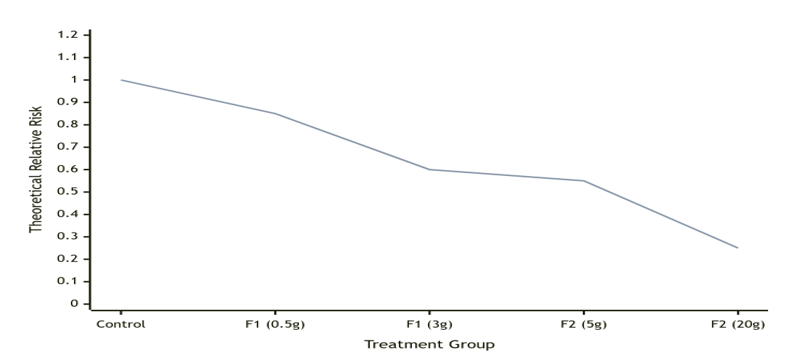
Lack of refrigeration in many developing regions leads to economic and public health challenges from meat spoilage and foodborne pathogens. This research evaluates combinations of curry powder and salt as a public health intervention to reduce microbial load on beef stored at 4 ± 1 °C for 7 days. Two curing formulations were tested: a low-concentration range (0.5 - 3 g curry powder + 1 g salt/100 mL) and a high-concentration range (5 - 20 g curry powder + 5 g salt/100 mL), with untreated samples as controls. Total heterotrophic and coliform counts were measured. A significant dose-response was observed (p < 0.05): microbial loads decreased as curry concentration increased. The strongest suppression was achieved with Formulation Two (20 g curry + 5 g salt), reducing total heterotrophic bacteria count (THBC) to 3.00 ± 2 log₁₀ CFU/g and significantly suppressed coliform growth by day 7 (p < 0.05 compared to control). Thirteen bacterial species were identified, including key pathogens, and their prevalence and diversity showed an inverse relationship with curry-salt concentration. The combination of salt-induced osmotic stress and curry’s bioactive compounds effectively reduced microbial load and diversity. This study demonstrates that curry powder and salt act as preservatives and provide a scalable, culturally accepted solution for public health risk reduction. By defining concentration thresholds, this approach can help small-scale processors in low-resource settings extend meat shelf-life and reduce foodborne illness risks, particularly among vulnerable populations. Further studies are needed to assess sensory acceptance and storage stability.
References
Bergeys Manual of Determinative Bacteriology. (1994). 9th edition. Williams & Wilkins.
Bouarab Chibane, L., Degraeve, P., Ferhout, H., Bouajila, J. and Oulahal, N. (2023). Applications of Plant-Derived Compounds as Antimicrobials in Meat and Meat Products: A Comprehensive Review. Comprehensive Reviews in Food Science and Food Safety, 22(4): 3175-3214.
Branda, F., Barone, C. and Mazzoleni, S. (2020). Meat preservation technologies and their impact on product quality: A review. Food Control, 110: 107019.
Cheesbrough, M. (2006). District laboratory practice in tropical countries (2nd ed.). Cambridge University Press.
Cheng, J., Sun, D. W., Han, Z. and Zeng, X. A. (2017). Texture and structure measurements and analyses for evaluation of meat quality: A review. Meat Science, 132, 169179.
Chouhan, S., Sharma, K. and Guleria, S. (2024). Natural Preservatives in Meat and Meat Products: A Green Solution to Combat Antimicrobial Resistance. Food Bioscience, 59: 103792.
Dharshini, K., Priyanka, K. and Ramesh, S. (2018). Antimicrobial resistance in foodborne pathogens: A global public health concern. International Journal of Current Microbiology and Applied Sciences, 7(4): 33313343.
FAO. (2022). The State of Food Security and Nutrition in the World 2022. Rome: Food and Agriculture Organization of the United Nations.
FAO. (2023). The State of Food Security and Nutrition in the World 2023. Rome: Food and Agriculture Organization of the United Nations.Gizaw, Z. (2019). 'Public health risks related to food safety issues in the food market: a systematic literature review'. Environmental Health and Preventive Medicine, 24(1): 68.
Gizaw, Z. (2019). 'Public health risks related to food safety issues in the food market: a systematic literature review'. Environmental Health and Preventive Medicine, 24(1): 68.
Gottardiz, J., Vandenberghe, L. P. S. and Pandey, A. (2016). Antioxidant and antimicrobial potential of spice extracts in meat preservation. Food Research International, 87: 93102.
Grace, D. (2015). Food Safety in Low- and Middle-Income Countries'. International Journal of Environmental Research and Public Health, 12(9): 10490-10507.
Havelaar, A.H., Kirk, M.D., Torgerson. P.R., Gibb, H.J., Hald, T., Lake, R.J., et al. (2015) World Health Organization Global Estimates and Regional Comparisons of the Burden of Foodborne Disease in 2010. PLoS Medicine, 12(12): e1001923
Horrigan, S. J. and MacCance, R. A. (1990). Laboratory techniques in microbiology. Edward Arnold.
Hyldgaard, M., Mygind, T. and Meyer, R. L. (2012). Essential oils in food preservation: Mode of action, synergies, and interactions with food matrix components. Frontiers in Microbiology, 3: 12.
Karrar, E., Sheth, S., Gasmalla, M.A.A., Mohamed, A.G. and Wang, X. (2024). Phytochemical profiling and in vitro evaluation of the antioxidant and antibacterial activities of five common spices. Food Science and Nutrition, 12(1): 502-513.
Lv, F., Liang, H., Yuan, Q. and Li, C. (2011). In vitro antimicrobial effects and mechanism of action of selected plant essential oils on four food-related microorganisms. Food Control, 22(5): 725732.
Michailidis, P. A. and Krokida, M. K. (2014). Preservation of meat and meat products: Methods and impact on quality. Journal of Food Engineering, 123: 1726.
Muthukumar, M., Naveena, B.M. and Muthukumar, M. (2024). Challenges and Opportunities in Adopting Natural Preservatives for Meat in Developing Countries. Current Opinion in Food Science, 56: 101124.
Odeyemi, O.A., Sani, N.A., Obadina, A.O. and Sarkan, B. (2024). Synergistic antimicrobial effect of salt and plant extracts in the preservation of meat products: A review. Food Control, 161: 110383.
Prescott, L. M. (2004). Microbiology (6th ed.). McGraw-Hill.
Purriños, L., Franco, D., Carballo, J., & and Lorenzo, J. M. (2011). Influence of salt level on the formation of volatile compounds in Celta dry-cured ham. Food Control, 22(7): 10541063.
Radha, K., Prakash, S. and Sivasubramanian, V. (2014). Synergistic antimicrobial effect of spices and salt in food preservation. Journal of Food Science and Technology, 51(2): 383389.
Rubió, L., Motilva, M. J. and Romero, M. P. (2013). Recent advances in biologically active compounds in herbs and spices: A review of the most effective compounds for meat preservation. Critical Reviews in Food Science and Nutrition, 53(9), 943953.
Sharifi-Rad, J., Herrera-Bravo, J., Kamiloglu, S., Petroni, K., Mishra, A.P., Monserrat-Mesquida, M., Sureda, A., Martorell, M., Aidarbekovna, D.S., Yessimsiitova, Z. and Calina, D. (2024). Recent advances on the antibacterial and antioxidant properties of vegetable spices in food safety and quality. Food Science & Nutrition, 12(1): 18-38.
Shilpa, R., Singh, R. and Kumar, P. (2018). Antimicrobial resistance in meat-borne pathogens and mitigation strategies. Food Reviews International, 34(5): 448463.
Tajkarimi, M. M., Ibrahim, S. A. and Cliver, D. O. (2010). Antimicrobial herb and spice compounds in food. Food Control, 21(9): 11991218.
Wang, Y., Dong, L., Li, C. and Xu, H. (2023). Application of spice-derived bioactives in meat preservation: Mechanisms and practical considerations. Food Chemistry, 404, 134659.
Wang, Y., Zhang, C., Li, J., Xu, Y. and Liu, Y. (2023). Mechanisms and applications of plant essential oils in food preservation: A review. Trends in Food Science & Technology, 138: 678-695.
Downloads
Published
Issue
Section
Categories
License
Copyright (c) 2026 Okon, Matthew Umanah, Igoche, Onje Kate, Adegoke, Ayodeji Anthony, Kooffreh, kooffreh Ita, Stephen, Nsikak Umo, Nchonwu, Marycynthia Chioma

This work is licensed under a Creative Commons Attribution 4.0 International License.


