
PRODUCTION AND CHARACTERISATION OF L-ASPARAGINASE FROM Priestia megaterium GAFA
DOI:
https://doi.org/10.33003/fjs-2026-1002-4354Keywords:
Environmental factors, Fermentation, Microbial Enzymes, Optimisation, Response Surface MethodologyAbstract
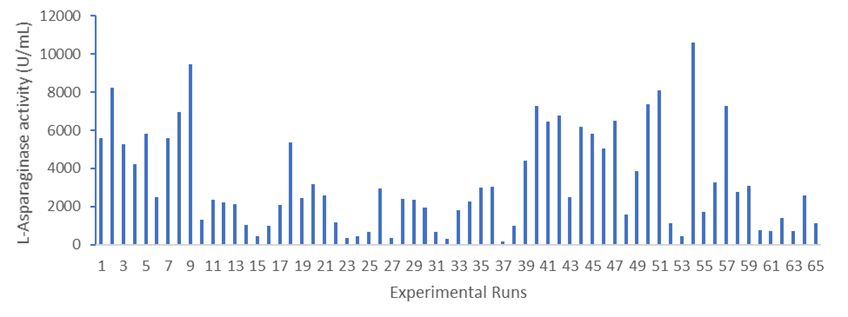
L-asparaginase is an enzyme used to treat acute lymphoblastic leukaemia due to its ability to break down external L-asparagine necessary for the growth of cancer cells. This work investigated the optimisation of L-asparaginase production and the effect of various factors on the activities of the produced enzyme. An L-asparaginase-producing bacterium collected from the Department of Microbiology and Biotechnology Laboratory was identified using 16S rRNA. The production of L-asparaginase was optimised using Response Surface Methodology (RSM), and the experimental design was validated. The effect of environmental factors on L-asparaginase was determined. The L-asparagine-producing bacterium was identified as Priestia megaterium GAFA with an accession number PP390497. Optimal production (10594.1 U/mL) was validated using glucose as a carbon source, L-asparaginase only as a nitrogen source, fermented at pH 7.76 for 73 hours with an inoculum load of 7.7%. The Ca²⁺ ion significantly increased L-asparaginase activity by 76% compared with the control at p<0.05. The enzyme was active over a wide pH range (4–8), with maximum activity at pH 6.0. The highest activity was observed at 60 °C after 1 hour of incubation. The production of L-asparaginase by Priestia megaterium GAFA was optimised, and environmental factors influenced its activity.
References
Abhini, K. N., Rajan, A. B., Zuhara, K. F., & Sebastian, D. 2022. Response surface methodological optimisation of L-asparaginase production from medicinal plant endophyte Acinetobacter baumannii ZAS1. Journal of Genetic Engineering and Biotechnology 20:22. https://doi.org/10.1186/s43141-022-00309-4
Al-Harbi, G. M., Kotb, E., Almiman, A. A., Berekaa, M. M., Alhamad, S., Alqarni, J. M., & Al-Suhaimi, E. A. 2025. Bacteria from the Arabian-Persian Gulf Region: First Report on Bacillus xiamenensis ASP-J1-4 as a Producer and its Potential Application. Marine drugs 23:194. https://doi.org/10.3390/md23050194
Al-kaabi, H. Q. M., & Chelab, R. L. 2024. Investigate the impact of probiotics of lactic acid bacteria obtained from various local sources on some pathogenic bacteria. Journal of Bioscience and Applied Research 10(1):59-71. https://doi.org/10.21608/jbaar.2024.256487.1029
Baraka, D. M., Hassan, M. G., Elawady, M. E., Abdelaziz, A. M., & Hassen, R. M. 2023. Screening of Actinomycetes for Asparaginase production and its optimization conditions. Egyptian Academic Journal of Biological Sciences Microbiology 15(1):67-75. https://doi.org/10.21608/eajbsg.2023.288660
Biswas, M., Sengupta, S., Gandhi, K.A., Gupta, S. K., Gera, P. B., Nayak, B. S., Jagadeb, M., Gota, V., & Sonawane, A. 2025. Engineered L-asparaginase variants with enhanced therapeutic properties to improve treatment of childhood acute lymphatic leukemia. Cancer Gene Ther 32, 1062–1075. https://doi.org/10.1038/s41417-024-00865-6
Chinnadurai, V., & Govindasamy, C. 2024. L-asparaginase producing ability of Aspergillus species isolated from tapioca root soil and optimized ideal growth parameters for L-Asparaginase production. Environmental Research 259:119543. https://doi.org/10.1016/j.envres.2024.119543
Cunha, M. C., Aguilar, J. G. S., Lindo, S. M. R. O., Catro, R. J. S., & Sato, H. H. 2021. L-asparaginase from Aspergillus oryzae spp.: effects of production process and biochemical parameters. Preparative Biochemistry and Biotechnology 52(3): 253-263. https://doi.org/10.1080/10826068.2021.1931881
Darnal, S., Patial V., Kumar, V., Kumar, S., Kumar, V., Padwad, Y. S., & Singh, D. 2023. Biochemical characterization of extremozyme L-asparaginase from Pseudomonas sp. PCH199 for therapeutics. AMB Express 13:22 https://doi.org/10.1186/s13568-023-01521-2
El-Aziz, A. B., Hassanein, W. A., Mattar, Z. A., & Al-Didamonhy, R. A. 2021. Production of Chemotherapeutic agent L-asparaginase from Gamma-Irradiated Pseudomonas aeruginosa WCHPA075019. Jordan Journal of Biological Sciences 14(3):403-412
El-Gendy, M. M. A., Awad, M. F., El-shenawy, F. S., & El-Bondkly, A. M. A. 2021. Production, purification, characterization, antioxidant and antiproliferative activities of extracellular L-asparaginase produced by Fusarium equiseti AHMF4. Saudi Journal of Biological Sciences 28:2540-2548. https://doi.org/10.1016/j.sjbs.2021.01.058
Fasiku, S. A., & Wakil, S. M. (2021). Pretreatment of maize straw with Pleurotus ostreatus and Lentinus squarrosulus for bioethanol production using Saccharomyces cerevisiae. Novel Research in Microbiology Journal 5(6):1480-1493. https://doi.org/10.21608/nrmj.2021.209731
Fasiku, S. A., & Wakil, S. M. 2022. Screening of factors responsible for conversion of maize straw into bioethanol. Journal of Microbiology, Biotechnology and Food Sciences. 12(2):e5901 https://doi.org/10.55251/jmbfs.5901
Fasiku, S. A., Afolabi, F. J., Egbeleke, T. A., & Fashogbon, R. O. (2026). Applications of Microbial Enzymes in Industries. Journal of Multidisciplinary Science: MIKAILALSYS 4(1): 26-40. https://doi.org/10.58578/mikailalsys.v4i1.8137
Fasiku, S. A., Bello, M. A., & Odeniyi, O. A. (2023). Production of xylanase by Aspergillus niger GIO and Bacillus megaterium through solid-state fermentation. Access Microbiology 5:000506.v5. https://doi.org/10.1099/acmi.0.000506.v5
Ikeda, J., Tsumura, Y., Kato, Saito, Y., Miyake, K., Kunimoto, H., Akahane, K., Takeda, J., Goto, H., Nakamura, H., Yoshikawa, N., Matsuzawa, T., Yamanishi, J., Yoshitomi, M., Takeuchi, M., Shiba, N., Nakajima, H., Kato, M., Inukai, T., Yoshida, K., Yokoyama, A., & Tsujimoto, S. 2025.Targeting metabolic vulnerabilities in Acute Myeloid Leukemia: Therapeutic potential of l-asparaginase and synergy with venetoclax. Blood. 146(1):3283. https://doi.org/10.1182/blood-2025-3283
Imada A, Igarasi S, Nakahama K, & Isono M (1973). Asparaginase and glutaminase activities of micro-organisms. Microbiology. 76(1):85–99
Kenari, S. L. D. K., Alemzadeh, I., & Maghsodi, V. 2011. Production of L-asparaginase from Escherichia coli ATCC 11303: Optimization by response surface methodology. Food and Bioproduct Processing 89:315-321 http://dx.doi.org/10.1016/j.fbp.2010.11.002
Kumar, S., Stecher, G., Li, M., Knyaz, C., & Tamura, K. (2018). MEGA X: Molecular Evolutionary Genetics Analysis across computing platforms. Molecular Biology and Evolution. 35:1547-1549. https://doi.org/10.1093/molbev/msy096
Lefin, N., Miranda, J., Costa, I. M., Reynaldo, A. P., Monteiro, G., Zamoran, M., Pessoa, A., & Farias, J. G. 2025. Optimized amino acid-enhanced medium for efficient L-asparaginase II production in E. coli: From shake flask to Bioreactor. Fermentation 11:239. https://doi.org/10.3390/fermentation11050239
Lu, X., Chen, J., Jiao, L., Zhong, L., Lu, Z., Zhang, C. & Lu, F. 2019. Improvement of the activity of L-asparaginase I improvement of the catalytic activity of L-asparaginase I from Bacillus megaterium H-1 by invitro directed evolution. Bioengineering 128(6):683-698. https://doi.org/10.1016/j.jbiosc.2019.06.001
Luhana, K., & Bariya, H. 2025. Purification and characterisation of the L-asparaginase enzyme derived from Aspergillus flavus HK03 along with its anti-proliferative activity. Biocatalysis and Biotransformation 43(3):254-265. https://doi.org/10.1080/10242422.2025.2470140
Moguel, I. S., Yamakawa, C. K., Brumano, L. P., Adalberto, P., & Mussatto, S. I. 2022. Efficient Production of L-Asparaginase by Leucosporidium scottii L115 – A Psychrotolerant Yeast. Fermentation 8:398 https://doi.org/10.3390/fermentation8080398
Odjoji, E. A., Fasiku, S. A., Alao, O. K., Salawu, K. O., Dada, M. T., Odeniyi, O. A., & Wakil, S. M. 2026. Amylase production by Streptomyces species and its application in orange juice clarification. Trakya University of Journal of Natural Sciences 6: 27(1) https://doi.org/10.23902/trkjnat.202562
Oladunni, A. A., Oladeji, O. D., & Orhadahwe, T. A. 2025. Effect of hydraulic retention time and substrate-to-inoculum ratio on batch anaerobic digestion of goat manure and response surface methodology optimization. European Journal of Sustainable Development Research 9(3):em0295 https://doi.org/10.29333/ejosdr/16337
Park, B., Yoon, J., Lee, J., Cho, S., Choi, Y., Cho, B. & Oh, M. 2025. Metabolic engineering of Priestia megaterium for 2’-fucosayllactose production. Microbial Cell Factories 24:2. https://doi.org/10.1186/s12934-024-02620-w
Phuong, D. T., Anh, N. M., Nga, N. T., Huyen, T. T., Cuc, N. T., Phuong, T. H., Minh, T. H. & Thao, D. T. 2024. Extracellular l-asparaginase productive potential of the Priestia megaterium strain GB911 from Khanh Hoa sea of Viet Nam. Vietnam Journal of Science and Technology 62(1):35-47. https://doi.org/10.15625/2525-2518/17906
Schmidt, M., Ivanov, A., Coriu, D., & Miron, I. 2021. L-Asparaginase toxicity in the treatment of children and adolescents with acute lymphoblastic leukemia. Journal of Clinical Medicine 10:4419. https://doi.org/10.3390/jcm10194419
Tamura, K., & Nei, M. 1993. Estimation of the number of nucleotide substitutions in the control region of mitochondrial DNA in humans and chimpanzees. Molecular Biology and Evolution 10(3):512-526. https://doi.org/10.1093/oxfordjournals.molbev.a040023
Trimpont, M., Peeters, E., De Visser, Y., Schalk, A.M., Mondelaers, V., De Moerloose, B., Lavie, A., Lammens, T., Goossens, S., & Van Vlierberghe, P. Novel Insights on the Use of L-Asparaginase as an Efficient and Safe Anti-Cancer Therapy. Cancers 2022, 14, 902. https://doi.org/10.3390/cancers14040902
Yap, Y. S., Lee W. L., & Ting A. S. Y. 2021. Optimization of L-asparaginase production from endophytic Fusarium proliferatum using OFAT and RSM and its cytotoxic evaluation. Journal of Microbiological Methods 191:106358 https://doi.org/10.1016/j.mimet.2021.106358
Yoon, S. E., Cho, J., Kim, H., Kim, S. J., & Kim, W. S. 2025. Aggressive natural killer cell leukemia therapy in the L-asparaginase era: why are we failing? Blood Res 60:55. https://doi.org/10.1007/s44313-025-00104-3
Yuan, Q., Yin, L., He, J., Zeng, Q., Liang, Y., Shen, Y., & Zu, X. 2024. Metabolism of asparagine in the physiological state and chancer Cell Communication and Signaling 22:163. https://doi.org/10.1186/s12964-024-01540-x
Downloads
Published
Issue
Section
Categories
License
Copyright (c) 2026 Samuel Adedayo Fasiku, Atilade Amos Oladunni, Gift Chimamaka Okpala, Taiwo Bukola Fasiku, Femi Johnson Afolabi

This work is licensed under a Creative Commons Attribution 4.0 International License.


