
Phytoplankton Community Structure, Cyanobacterial Proliferation, and Water Quality Relationships in the River Benue Basin, Adamawa State, Nigeria
DOI:
https://doi.org/10.33003/Keywords:
Phytoplankton, Bacillariophyta, Cyanobacteria, Fragilaria, Anabaena, Shannon Diversity, River Benue, Freshwater Ecology, NigeriaAbstract
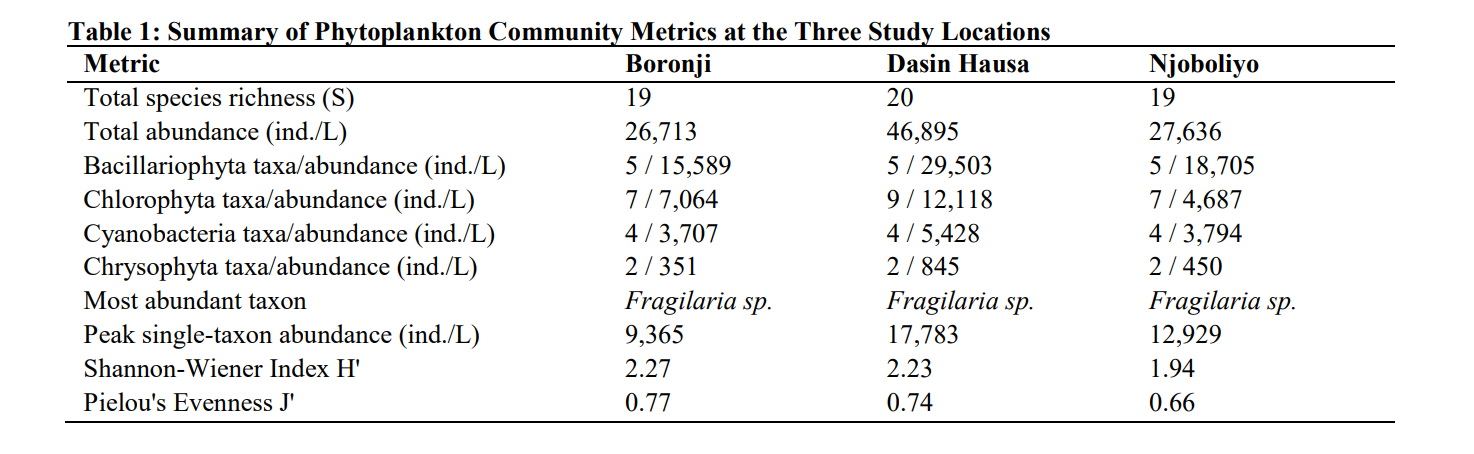
Phytoplankton communities are sensitive bioindicators of freshwater ecosystem health, yet their composition, diversity, and cyanobacterial status have never been quantitatively characterised for the River Benue Basin, Adamawa State, Nigeria. This study presents the first multi-location quantitative assessment of phytoplankton composition, abundance, and diversity across three contrasting anthropogenic pressure zones, and evaluates the public health significance of toxigenic cyanobacterial genera. Phytoplankton were collected monthly at Boronji, Dasin Hausa, and Njoboliyo during dry (February–April 2025) and rainy (June–August 2025) seasons by horizontal net towing (55 µm mesh), preserved in Lugol's iodine, and enumerated using Sedgewick-Rafter chambers under compound microscopy. Diversity was assessed using Shannon-Wiener (H') and Pielou's evenness (J') indices. Nineteen taxa were recorded at Boronji and Njoboliyo, and 20 at Dasin Hausa, spanning four divisions: Bacillariophyta, Chlorophyta, Cyanobacteria, and Chrysophyta. Fragilaria sp. dominated at all sites, peaking at 17,783 ind./L at Dasin Hausa, which also recorded the highest total abundance (46,895 ind./L), followed by Njoboliyo (27,636 ind./L) and Boronji (26,713 ind./L). Shannon-Wiener indices ranged from H' = 1.94 (Njoboliyo) to H' = 2.27 (Boronji). Four toxigenic genera Anabaena, Aphanocapsa, Oscillatoria, and Aphanizomenon occurred at all locations throughout the study, with Oscillatoria anomalously elevated at the most metal-contaminated site, Njoboliyo (868 vs. 282–284 ind./L elsewhere). The basin has crossed ecological thresholds enabling sustained cyanobacterial establishment at all sites; the Chlorophyta/Bacillariophyta ratio is identified as a sensitive bioindicator of heavy metal stress. Cyanobacterial surveillance and riparian buffer restoration are recommended as priority actions.
References
Abdulazeez, A.M., Kwaga, B.T. and Akosim, C. (2025a). Socio-demographic profile, livelihood structure, and anthropogenic activity patterns of riparian communities along the River Benue Basin, Adamawa State, Nigeria. [Companion article — this series].
Abdulazeez, A.M., Kwaga, B.T. and Akosim, C. (2025b). Physico-chemical water quality dynamics and heavy metal contamination in the River Benue Basin, Adamawa State, Nigeria. [Companion article — this series].
Adebayo, A.A. and Tukur, A.L. (1999). Adamawa State in Maps. Paraclete Publishers, Yola, Nigeria.
Alkali, M., Abubakar, U., Liman, A.B. and Sani, I. (2022). Assessment of water quality parameters of River Benue in selected communities in Adamawa State, Nigeria. Journal of Applied Sciences and Environmental Management, 26(4), 601–607.
APHA (2017). Standard Methods for the Examination of Water and Wastewater (23rd ed.). American Public Health Association, Washington, DC.
Bellinger, E.G. and Sigee, D.C. (2015). Freshwater Algae: Identification, Enumeration and Use as Bioindicators (2nd ed.). Wiley-Blackwell, Chichester.
Das, S.K., Grewal, A.S. and Banerjee, M. (2011). A brief review: heavy metals and their analysis. International Journal of Pharmaceutical and Biological Research, 11(1), 13–18.
Ekperusi, O.H., Ekperusi, A.O. and Olomukoro, J.O. (2022). Assessment of anthropogenic influences on the benthic invertebrate community of Oghan River in Edo State, Nigeria. Journal of Applied Sciences and Environmental Management, 26(8), 1423–1431.
Gao, W., Xiong, F., Lu, Y., Xin, W., Wang, H., Feng, G., Kong, C., Fang, L., Gao, X. and Chen, Y. (2024). Water quality and habitat drive phytoplankton taxonomic and functional group patterns in the Yangtze River. Ecological Processes, 13(11), 1–15.
Gebrehiwot, M., Kifle, D., Stiers, I. and Triest, L. (2022). Plankton diversity in tropical wetlands under different hydrological conditions (Lake Tana, Ethiopia). Frontiers in Environmental Science, 10, 816892.
Guiry, M.D. and Guiry, G.M. (2024). AlgaeBase. World-wide electronic publication, National University of Ireland, Galway. https://www.algaebase.org
Jost, L. (2007). Partitioning diversity into independent alpha and beta components. Ecology, 88(10), 2427–2439.
Kutama, R.M., Abubakar, M.M. and Balarable, M.L. (2014). The plankton as indicators of water quality in Kusalla Reservoir: a shallow man-made lake. IOSR Journal of Pharmacy and Biological Sciences, 9(3), 12–15.
Magurran, A.E. (2021). Measuring biological diversity in time (and space). In: Biological Diversity: Frontiers in Measurement and Assessment, pp. 85–94. Oxford University Press.
Mateo-Sagasta, J., Zadeh, S.M., Turral, H. and Burke, J. (2017). Water Pollution from Agriculture: A Global Review. FAO and IWMI, Rome and Colombo.
Odulate, D.O., Omoniyi, I.T., Alegbeleye, W.O., George, F.A. and Dimowo, B.O. (2017). Water quality in relation to plankton abundance and diversity in River Ogun, Abeokuta, Southwestern Nigeria. International Journal of Environmental Health Engineering, 6(3), 1–8.
Rai, P.K., Lee, S.S., Zhang, M., Tsang, Y.F. and Kim, K. (2019). Heavy metals in food crops: health risks, fate, mechanisms, and management. Environment International, 125, 365–385.
Reynolds, C.S. (1994). The long, the short and the stalled: on the attributes of phytoplankton selected by physical mixing in lakes and rivers. Hydrobiologia, 289(1–3), 9–21.
Rice, E.W., Baird, R.B. and Eaton, A.D. (eds.) (2017). Standard Methods for the Examination of Water and Wastewater (23rd ed.). APHA, AWWA, WEF, Washington, DC.
Samuel, O.O., Judith, S.N. and Lois, A.I. (2024). Influence of physicochemical parameters on distribution and abundance of macro-invertebrates from River Benue in Makurdi, Benue State. Global Scientific and Academic Research Journal of Multidisciplinary Studies, 3(3), 12–19.
Shang, L., Wang, Y., Jiang, H. et al. (2024). Using modern coexistence theory to understand distinct states of phytoplankton communities in a subtropical eutrophic river network. Water Research, 249, 120996.
Song, J., Hou, C., Liu, Q., Wu, X., Wang, Y. and Yi, Y. (2020). Spatial and temporal variations in the plankton community because of water and sediment regulation in the lower reaches of Yellow River. Journal of Cleaner Production, 261, 120972.
USEPA (1994). Method 3010A: Acid Digestion of Aqueous Samples and Extracts for Total Metals Analysis by FLAA or ICP Spectroscopy. SW-846. EPA, Washington, DC.
WHO (2022). Guidelines for Drinking-Water Quality (4th ed., incorporating First and Second Addenda). WHO Press, Geneva.
Zhang, Y., Wang, R., Qu, X. et al. (2024). Water quality and habitat drive phytoplankton taxonomic and functional group patterns in the Yangtze River. Ecological Processes, 13, 12.
Downloads
Published
Issue
Section
Categories
License
Copyright (c) 2026 Aminu Maulud Abdulazeez, Tizhe Kwaga, Callistus Akosim, Nuru Zakari

This work is licensed under a Creative Commons Attribution 4.0 International License.


