
Earthworm Casts as Selective Microhabitats Enriching Antagonistic Bacteria with in Vitro Inhibitory Potential against Enteric Bacterial Pathogens
DOI:
https://doi.org/10.33003/fjs-2026-1010-5423Keywords:
Antibacterial, Antibiosis, Biocontrol, VermicompostAbstract
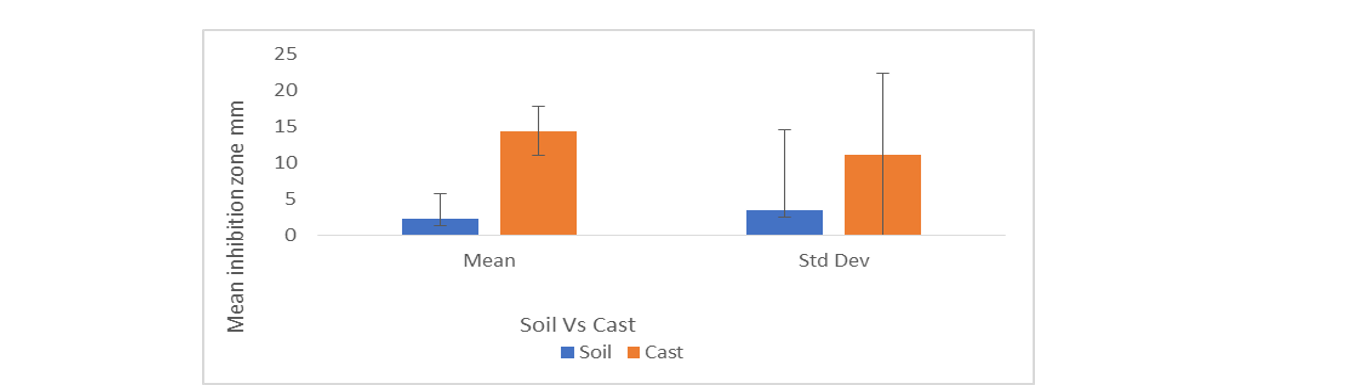
Earthworm casts as biologically active microhabitats significantly influence soil microbial compositions and activities. Analysis was conducted to evaluate the diversity and antagonistic potential of bacterial isolates in the casts of earthworm and adjacent soil against some selected enteric bacterial pathogens. A total of 30 bacterial isolates, comprising 18 isolates from earthworm casts and 12 isolates from the soil samples, were obtained. Morphological and biochemical characterization revealed the presence of dominant genera, including: Bacillus spp., Streptomyces spp., and Pseudomonas spp. Antagonistic activity was assayed using the agar well diffusion method against Escherichia coli, Salmonella spp., and Klebsiella spp. Among the total isolates obtained, 14 (46.7%) exhibited antagonistic activity, with a higher proportion originating from earthworm casts, and 10 isolates with 71.4% compared to soil, which had 4 isolates; 28.6%. The zones of inhibition ranged from 8 mm to 22 mm across all test organisms. Bacillus spp. demonstrated the highest inhibitory activity with a mean zone of 18 mm, followed by Streptomyces spp. (15 mm), while Pseudomonas spp. showed a comparatively lower activity. Escherichia coli was the most susceptible test pathogen, exhibiting a maximum inhibition zone of 22 mm, whereas Klebsiella spp. showed the least susceptibility with a minimum inhibition reading of 10 mm. Negative control experiments showed no zones of inhibition, confirming that antimicrobial effects were exclusively due to metabolites produced by the assayed bacterial isolates. The outcome of the finding suggests that earthworm cast may serve as a selective microenvironment that enriches bacterial populations with significant antagonistic potentials.
References
Aira, M., Garrido-Maestu, A., Prado, M., & Domínguez, J. (2024). Earthworm activity reduces bacterial pathogen loads in sewage sludge. Environmental Science and Pollution Research, 31(52), 61959–61966. https://doi.org/10.1007/s11356-024-35358-4
Blouin, M., Hodson, M. E., Delgado, E. A., Baker, G., Brussaard, L., Butt, K. R., Dai, J., Dendooven, L., Pérès, G., Tondoh, J. E., Cluzeau, D., & Brun, J.-J. (2013). A review of earthworm impact on soil function and ecosystem services. European Journal of Soil Science, 64(2), 161–182. https://doi.org/10.1111/ejss.12025
Brown, G. G., Barois, I., & Lavelle, P. (2000). Earthworm interactions with soil microorganisms. In C. A. Edwards (Ed.), Earthworm ecology (pp. 213–271). CRC Press.
Buivydaite, D., Vitale, A., Palese, A. M., & Sofo, A. (2023). Changes in soil microbial communities and growth of lettuce (Lactuca sativa L.) as affected by earthworm casting. Horticulturae, 9(3), 395. https://doi.org/10.3390/horticulturae9030395
Cai, Y. J., Li, G. X., & Wang, X. P. (2002). Changes of microbial community and activities in the earthworm (Eisenia fetida) gut. Chinese Journal of Applied and Environmental Biology, 8(3), 282–285.
Devi, R., & Serfoji, P. (2018). Molecular characterization and antibacterial activity of actinomycetes from earthworm gut (Eisenia foetida - Savingny, 1826). Journal of Emerging Technologies and Innovative Research, 5(8), 601–606.
Evangeline, R. S. (2023). Isolation and characterization of plant growth promoting and bio-control bacteria from vermicompost (Bachelor’s dissertation, Sathyabama Institute of Science and Technology).
Gómez-Brandón, M., Aira, M., Lores, M., & Domínguez, J. (2011). Epigeic earthworms exert a bottleneck effect on microbial communities through gut associated processes. PLoS ONE, 6(9), e24786. https://doi.org/10.1371/journal.pone.0024786
Goswami, D. (2025). Earthworm-microbiome interactions: Unlocking next-generation bioindicators and bioengineered solutions for soil and environmental health. Journal of Entomology and Zoology Studies, 13(4), 92–101.
Holt, J. G., Krieg, N. R., Sneath, P. H. A., Staley, J. T., & Williams, S. T. (Eds.). (1994). Bergey’s manual of determinative bacteriology (9th ed.). Williams & Wilkins.
Khyade, V. B. (2018). Bacterial diversity in the alimentary canal of earthworms. Journal of Bacteriology & Mycology: Open Access, 6(3), 183–185. https://doi.org/10.15406/jbmoa.2018.06.00200
Kumar, V., Bharti, A., Negi, Y. K., Gusain, O., Pandey, P., & Bisht, G. S. (2012). Screening of actinomycetes from earthworm castings for their antimicrobial activity and industrial enzymes. Brazilian Journal of Microbiology, 43(1), 205–214.
Lavelle, P., Lattaud, C., Trigo, D., & Barois, I. (1995). Mutualism and biodiversity in soils. In H. P. Collins, G. P. Robertson, & M. J. Klug (Eds.), The significance and regulation of soil biodiversity (pp. 23–33). Springer Netherlands. https://doi.org/10.1007/978-94-011-0479-1_2
Marashi, A., & Scullion, J. (2003). Earthworm casts, soil properties and microbial activity in an experimental grassland. Biology and Fertility of Soils, 37(3), 150–157. https://doi.org/10.1007/s00374-002-0574-z
Medina-Sauza, R. M., Álvarez-Jiménez, M., Delhal, A., Reverchon, F., Blouin, M., Guerrero-Analco, J. A., Cerdán, C. R., Guevara, R., Villain, L., & Barois, I. (2019). Earthworms building up soil microbiota: A review. Frontiers in Environmental Science, 7, 81. https://doi.org/10.3389/fenvs.2019.00081
Nechitaylo, T. Y., Yakimov, M. M., Timmis, K. N., & Golyshin, P. N. (2010). Microbial communities of the digestive tract of the earthworm Eisenia fetida. Environmental Microbiology Reports, 2(3), 427–434. https://doi.org/10.1111/j.1758-2229.2010.00161.x
Ongena, M., & Jacques, P. (2008). Bacillus lipopeptides: Versatile weapons for plant disease biocontrol. Trends in Microbiology, 16(3), 115–125. https://doi.org/10.1016/j.tim.2007.12.009
Pedersen, J. C., & Hendriksen, N. B. (1993). Fate of Escherichia coli and Bacillus thuringiensis introduced into an earthworm/soil system. Soil Biology and Biochemistry, 25(12), 1749–1756. https://doi.org/10.1016/0038-0717(93)90180-L
Rogasik, H., Onasch, I., Brunotte, J., Jégou, C., & Wendland, K. (2014). Assessment of soil structure using X-ray computed tomography as influenced by earthworms. Journal of Plant Nutrition and Soil Science, 177(1), 114–121. https://doi.org/10.1002/jpln.201300213
Sharma, A., Kumari, S., Chauhan, S., Sangal, R., Kumar, V., Naik, B. S. S. S., Pramanick, B., Sharma, S. K., Reddy, K. G., Reddy, G. K., Yadav, S. K., Medida, S. K., Tirunagari, R., Bamboriya, J. S., Bamboriya, S. D., Gurumurthy, P., & Susmitha, T. (2025). Bacterial community present in the earthworm’s gut and its role in soil biology and health. Plant Science Today, 12(1), 1–15. https://doi.org/10.14719/pst.3356
Sofo, A., Buivydaite, D., Ganugi, P., Vitale, A., & Palese, A. M. (2023). Earthworm-induced changes in soil microbial community structure and beneficial microbes. Agriculture, 13(2), 433. https://doi.org/10.3390/agriculture13020433
Stein, T. (2005). Bacillus subtilis antibiotics: Structures, syntheses and specific functions. Molecular Microbiology, 56(4), 845–857. https://doi.org/10.1111/j.1365-2958.2005.04587.x
Thimm, T., Hoffmann, A., Borkott, H., Munch, J. C., & Tebbe, C. C. (2001). The fate of antibiotic-resistant Klebsiella planticola in the digestive tract of the earthworm Lumbricus terrestris and its survival in casts. Biology and Fertility of Soils, 33(3), 236–241. https://doi.org/10.1007/s003740000315
Tiwari, D., Shouche, S., Chandorkar, S., & Das, P. (2015). Removal of pathogenic bacteria during vermicomposting of floral wastes. International Journal of Researches in Biosciences, Agriculture and Technology, 3(1), 134–140.
Turin, A. M., Antu, S. I., Chakraborty, S., Ali, M. H., Aff, T. A., & Khokon, M. A. R. (2025). Enhancing the biocontrol potential of compost and vermicompost tea with Bacillus spp. against bacterial wilt of tomato. Agriculture (Poľnohospodárstvo), 71(3), 146–160.
van Groenigen, J. W., van Groenigen, K. J., Koopmans, G. F., Stokkermans, L., Vos, H. M., & Lubbers, I. M. (2019). How do earthworms affect phosphorus cycling? A meta-analysis. Earth-Science Reviews, 190, 177–195. https://doi.org/10.1016/j.earscirev.2018.12.019
Vishnu, G. (2021). Microbial analysis of the gut of selected earthworms (Eisenia foetida, Eudrilus eugineae, Perionyx excavatus) (Master’s dissertation, Scott Christian College).
Yang, J., Schrader, S., & Tebbe, C. C. (2024). Legacy effects of earthworms on soil microbial abundance, diversity, and community dynamics. Soil Biology and Biochemistry, 190, 109294. https://doi.org/10.1016/j.soilbio.2023.109294
Zhang, H., & Schrader, S. (1993). Earthworm effects on selected physical and chemical properties of soil aggregates. Biology and Fertility of Soils, 15(3), 229–234. https://doi.org/10.1007/BF00361617
Downloads
Published
Issue
Section
Categories
License
Copyright (c) 2026 Collins Chukwunalu Ossai, Edward Ikenna Odum, Loveth Ngozi Bernard

This work is licensed under a Creative Commons Attribution 4.0 International License.


