
A Game-Theoretic Framework for Coupling Behavioral Dynamics with Compartmental Epidemiological Models: An Overview
DOI:
https://doi.org/10.33003/fjs-2026-1009-5262Keywords:
Game-Theoretic models, Behavioral changes, Disease-behavior Coupling, Intervention Strategies, Payoff Construction, Compartmental modelsAbstract
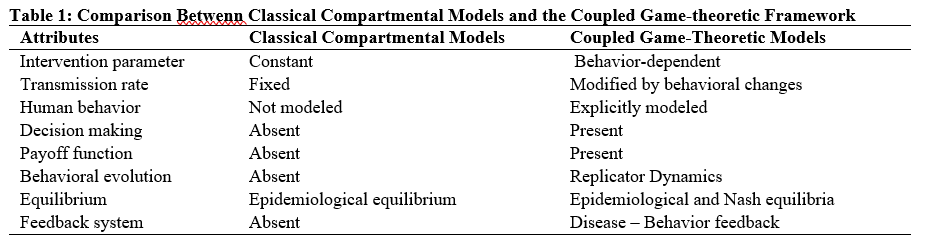
Classical compartmental models of infectious diseases, such as SIR model and its extensions, often assume that intervention-related parameters are fixed and independent of population behavior. However, in real epidemic settings, the uptake of interventions like, vaccination, hand hygiene, and isolation is highly influenced by individual decision-making. This study presents a structured game-theoretic approach for coupling behavioral dynamics with compartmental disease models. The framework outlines the steps in the construction of payoff functions that capture the interplay between intervention costs and disease risk and their dependence on the disease prevalence. These payoff structures are incorporated with epidemiological models through evolutionary game theory, yielding coupled systems in which disease dynamics and behavioral changes evolve. Through an illustrative example based on the classical SIR model, the steady-state behavior of the coupled system is interpreted using the concept of Nash equilibrium. Unlike classical compartmental models that uses fixed intervention parameters, the coupled framework accounts for adaptive behavior changes and provides a procedure for integrating decision-making into infectious disease models. By giving a clear outline of the steps involved in disease-behavior coupling, this overview provides a guide for developing adaptive behavioral disease models and enhances the design and evaluation of effective public health intervention strategies.
References
Anderson, R. M., & May, R. M. (1991). Infectious diseases of humans: Dynamics and control. Oxford University Press.
Bauch, C.T., d’Onofrio, A., & Manfredi, P. (2013). Behavioral epidemiology of Infectious diseases: An Overview. Physics of Life Reviews, 10(1), 1-20.
https://doi.org/10.1016/j.plrev.2011.07.001
Bauch, C. & Earn, D.J.C (2004). Vaccination and the theory of games. Proc. Natl. Acad. Sci. 101, pp. 13391-13394 https://doi.org/10.1073/pnas.0403823101
Chang, S. L., Piraveenan, M., Pattison, P., & Prokopenko, M. (2020). Game theoretic modelling of infectious disease dynamics and intervention methods: a review. Journal of Biological Dynamics, 14(1), 57–89. https://doi.org/10.1080/17513758.2020.1720322
Cooper, B.S., Medley, G.F., & Scott, G.M. (1999). Preliminary analysis of the transmission dynamics of nosocomial infections: stochastic and management effects. J Hosp Infect 43(2), 131-47 https://doi.org/10.1053/jhin.1999.0647
d’Onofrio, A. (2002). Stability properties of pulse vaccination strategy in SEIR epidemic model.
Mathematical Biosciences, 179(1), 57–72. https://doi.org/10.1016/S0025-5564(02)00087-8
d’Onofrio, A., Manfredi, P. & Salinelli, E. (2007). Vaccinating behavior, information and the dynamics of SIR vaccine preventable diseases. Theor. Popul. Biol. 71, pp. 301-317 https://doi.org/10.1016/j.tpb.2006.09.003
Ezeh, F. C., & Okuonghae, D. U. (2026). Nosocomial infections and their models: A narrative review. Transactions of Nigerian Association of Mathematical Physics, 24, 189–202. https://doi.org/10.60787/tnamp.v24.685
Funk, S., Salathe, M., & Jansen, V.A (2010). Modeling the influence of human behavior on the spread of infectious diseases: a review. J. R. Soc. Interface 7, pp. 1247 -1256
https://doi.org/10.1098/rsif.2010.0142
Hethcote, H. W. (2000). The mathematics of infectious diseases. SIAM Review, 42(4), 599–653. https://doi.org/10.1137/S0036144500371907
Hofbauer, J., & Sigmund, K. (1998). Evolutionary games and population dynamics. Cambridge University Press.
Kermack, W. O. & McKendrick, A. G., (1927). Contributions to the mathematical theory of Epidemics:part 1. Proceedings of the Royal Society of London A 115, 700- 721.
Nash, J. (1951). Non-cooperative games. Annals of Mathematics, 54(2), 286–295.
Okuonghae D., & Omame A. (2020). Analysis of a mathematical model for COVID-19 population dynamics in Lagos, Nigeria. Chaos Solitons Fractals, 139 , 110032
https://doi.org/10.1016/j.chaos.2020.110032
Osborne, M. J., & Rubinstein, A. (1994). A course in game theory. MIT Press.
Reluga, T. (2010). Game theory of social distancing in response to an epidemic. Plos Comput. Bio. 6, pp. 1-9 https://doi.org/10.1371/journal.pcbi.1000793
Schimit, P.H.T., Sergio, A.R. & Fontoura, M.A.R.(2025) Vaccination as a Game: Behavioural Dynamics, Network Effects, and Policy Levers - A Comprehensive Review. Mathematics , 13, 2242. https://doi.org/10.3390/math13142242
Taylor, P. D., & Jonker, L. B. (1978). Evolutionarily stable strategies and game dynamics. Mathematical Biosciences, 40(1–2), 145–156.
Towers, S., & Feng, Z. (2012). Social contact patterns and control strategies for influenza in the elderly. Mathematical Biosciences, 240(2), 241–249. https://doi.org/10.1016/j.mbs.2012.07.007
Verma, P., Kumar, V., & Bhattacharyya, S. (2025). Modelling behavioural interactions in infection disclosure during an outbreak: An evolutionary game theory approach. Mathematical Biosciences and Engineering, 22(8), 1931–1955. https://doi.org/10.3934/mbe.2025070
Wang, J., Zhang, X., Li, Y., & Liu, Z. (2025). Modeling and analysis of infectious diseases based on behavioral game theory in two-layer networks. PLOS ONE, 20(5), e0323076.
https://doi.org/10.1371/journal.pone.0323076
Zhang, W., Li, Y., Li, Q., Huang, G., & Feng, M. (2026). Modeling epidemic dynamics of mutant strains with evolutionary game-based vaccination behavior. Chaos, Solitons & Fractals, 205, 117849. https://doi.org/10.1016/j.chaos.2025.117849
Downloads
Published
Issue
Section
Categories
License
Copyright (c) 2026 Francis Chigozie Ezeh, Daniel Uhunoma Okuonghae

This work is licensed under a Creative Commons Attribution 4.0 International License.


