
A Novel Hybrid of Weibull-Exponential-Gamma (W-E-G) Distribution with Applications to Bladder Cancer Data
DOI:
https://doi.org/10.33003/fjs-2026-1010-5252Keywords:
WEG, Bladder Cancer, Survival Analysis, Hazard FunctionAbstract
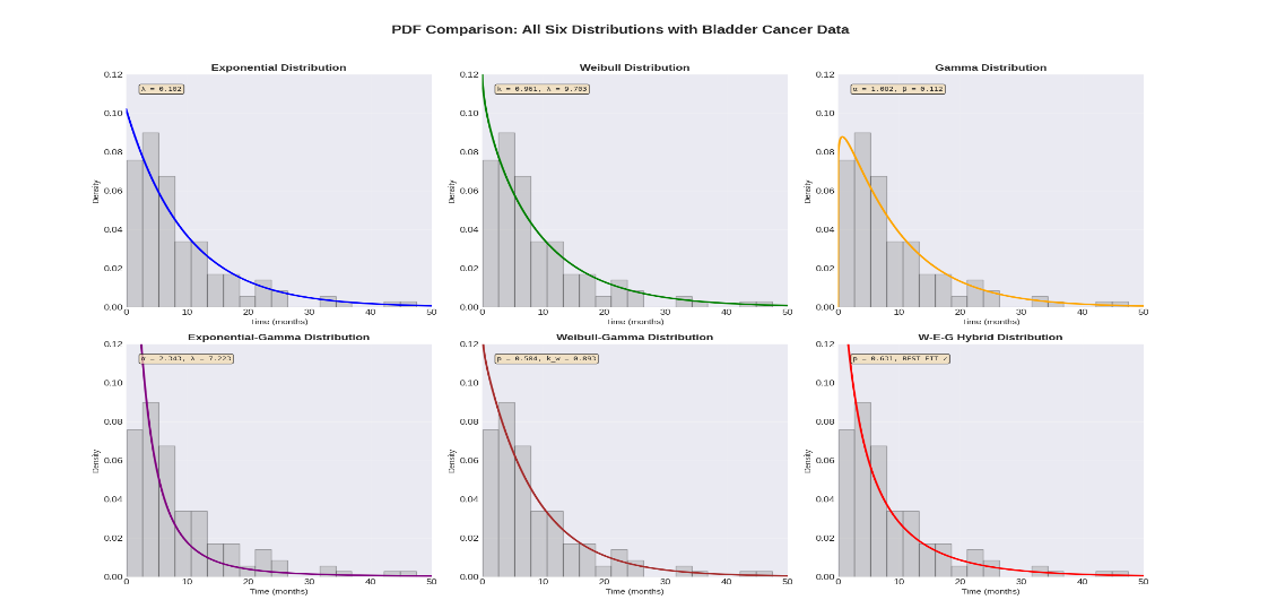
The Weibull-Exponential-Gamma (WEG) hybrid distribution is introduced for analyzing cancer survival data. The proposed distribution combines the flexibility of the Weibull and Gamma distributions with the simplicity of the Exponential model, providing a unified framework capable of accommodating increasing, decreasing, and non-monotonic hazard functions. The probability density function, cumulative distribution function, and key statistical properties-including moments, hazard function, and reliability characteristics-are derived and analyzed to understand the distribution’s behavior under varying parameter configurations. A Monte Carlo simulation with 1,000 replicates across sample sizes of 50 to 1,000 demonstrated that Bias, MSE, and RMSE approached zero as sample size grew, confirming estimator consistency. When applied to real-world cancer survival data, the WEG model outperformed Exponential (LL = -382.14, AIC = 766.28), Weibull, Gamma, Weibull-Gamma, and Exponential-Gamma distributions, achieving the highest LL (-361.42) and lowest AIC (732.85) and BIC (748.49). A clinical surveillance schedule derived from the WEG hazard function stratified post-treatment risk into six phases: very high (0-3 months, h = 0.14-0.10) requiring monthly visits; high (3–6 months, h = 0.10-0.08); moderate (6-12 months, h = 0.08-0.05); low (12-24 months, h = 0.05-0.03); very low (24-36 months, h = 0.03-0.02); and minimal (>36 months, h < 0.02) needing annual follow-up. The WEG distribution offers a flexible, evidence-based tool for bladder cancer survival modeling and risk-adapted patient monitoring. Based on these findings, the WEG distribution is recommended as a flexible and robust tool for survival analysis, particularly in biomedical research where heterogeneity and non-standard hazard behaviors are common.
References
Adamidis, K., & Loukas, S. (1998). A lifetime distribution with decreasing failure rate. Statistics & Probability Letters, 39(1), 35–42.
Babjuk, M., Böhle, A., Burger, M., et al. (2017). EAU guidelines on non–muscle-invasive urothelial carcinoma of the bladder. European Urology, 71(3), 447–461.
Cox, D. R., & Oakes, D. (1984). Analysis of Survival Data. Chapman & Hall.
Gross, A. J., Clark, V. A. (1975). Survival Distributions: Reliability Applications in the Biomedical Sciences. New York: John Wiley & sons.
Ismael, A. A., & Z. A. A. (2023). New extension for Chen distribution based on (0.1) truncated Nadarajah-Haghighi family. International journal of financial management and Economics, 7(1), 46-57.
Kalbfleisch, J. D., & Prentice, R. L. (2002). The Statistical Analysis of Failure Time Data (2nd ed.). Wiley.
Mudholkar, G. S., & Srivastava, D. K. (1993). Exponentiated Weibull family for analyzing bathtub failure-rate data. IEEE Transactions on Reliability, 42(2), 299–302.
Nadarajah, S., & Kotz, S. (2006). The beta-exponential distribution. Reliability Engineering & System Safety, 91(6), 689–697.
Stacy, E. W. (1962). A generalization of the gamma distribution. Annals of Mathematical Statistics, 33(3), 1187–1192.
Weibull, W. (1951). A statistical distribution function of wide applicability. Journal of Applied Mechanics, 18, 293–297.
Downloads
Published
Issue
Section
Categories
License
Copyright (c) 2026 Toba Timothy Olumi, Fatai Kolade Lawal, Kabir Jamiu, Kayode Zubairu

This work is licensed under a Creative Commons Attribution 4.0 International License.


