
Comparative Assessment of Soil Physicochemical Properties, Heavy Metal Uptake, and Health Risk Associated with Sorghum Cultivated under Inorganic Fertilizer and Animal Manure Amendments in Kano State, Nigeria
DOI:
https://doi.org/10.33003/Keywords:
Sorghum, Heavy Metals, Soil Physicochemical Properties, Environmental Toxicology, Hazard QuotientAbstract
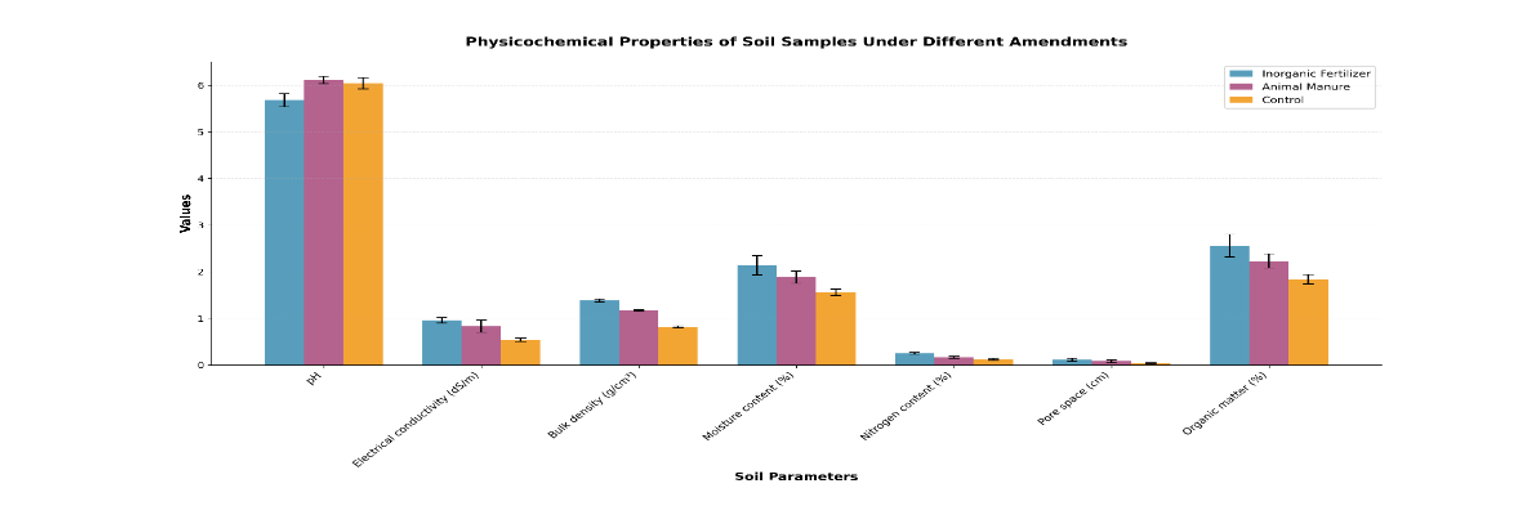
The use of inorganic fertilizers and animal manure can affect soil quality and may lead to high levels of heavy metals in crops. The effects of inorganic fertilizer and animal manure amendments on the physicochemical properties of the soil and heavy metal uptake in sorghum grown in Faragai town, Albasu Local Government Area of Kano State, Nigeria, were investigated in this study. Samples of the soil and sorghum grain were taken from the inorganic fertilizer, manure-amended, and control farms. The soil physicochemical parameters were measured, and the concentrations of the heavy metals: lead, zinc, copper, cadmium, and chromium, were determined by dry ashing digestion using Atomic Absorption Spectrophotometry (AAS) in the sorghum grains. Estimated Daily Intake (EDI) and Hazard Quotient (HQ) models were used to assess the possible health risks of sorghum consumption. The results showed that the soils treated with inorganic fertilizers had lower pH and higher electrical conductivity, Nitrogen content, and organic matter than manure and control soils. Sorghum grains cultivated on fertilizer-treated farms recorded higher concentrations of Pb, Zn, Cu, and Cr. Lead concentrations in sorghum grains from inorganic fertilizer and manure-amended farms slightly exceeded the WHO/FAO permissible limit for cereals. The Hazard Quotient values of all the examined metals were below the threshold value of 1.0, indicating no significant non-carcinogenic health risk to consumers. The study demonstrates that agricultural practices influence soil characteristics and heavy metal uptake in sorghum. Continuous environmental monitoring and sustainable strategies are therefore recommended to minimize food safety and environmental health risks.
References
Adeleye, A. S., Conway, J. R., Perez, T., Rutten, P., Keller, A. A. (2014). Influence of extracellular polymeric substances on the long-term fate, dissolution, and speciation of copper-based nanoparticles. Environmental Science & Technology, 48(21), 12561–12568.
Akinyele, I. O., & Shokunbi, O. S. (2015). Comparative analysis of dry ashing and wet digestion methods for the determination of trace and heavy metals in food samples. Food Chemistry, 173, 682–684. https://doi.org/10.1016/j.foodchem.2014.10.097
Alloway, B. J. (2013). Trace metals and metalloids in soils and their bioavailability. Heavy Metals in Soils, 22, 4–18.
AOAC International. (2023). Official Method 999.11: Lead, cadmium, copper, iron, and zinc in foods: Atomic absorption spectrophotometry after dry ashing. In Official Methods of Analysis of AOAC INTERNATIONAL. Oxford University Press. https://doi.org/10.1093/9780197610145.003.1788
Atafar, Z., Mesdaghinia, A., Nouri, J., Homaee, M., Yunesian, M., Ahmadimoghaddam, M., & Mahvi, A. H. (2010). Effect of fertilizer application on soil heavy metal concentration. Environmental Monitoring and Assessment, 160(1), 83–89.
Ben-Gigirey, B., Rodríguez-Velasco, M. L., & Gago-Martínez, A. (2012). Extension of the validation of AOAC official method SM 2005.06 for dc-GTX2, 3: interlaboratory study. Journal of AOAC International, 95(1), 111–121.
Bolan, N., & Kirkham, M. B. (2023). Soil constraints and productivity. CRC Press.
Bortey-Sam, N., Nakayama, S. M. M., Ikenaka, Y., Akoto, O., Baidoo, E., Yohannes, Y. B., Mizukawa, H., & Ishizuka, M. (2015). Human health risks from metals and metalloid via consumption of food animals near gold mines in Tarkwa, Ghana: Estimation of the daily intakes and target hazard quotients (THQs). Ecotoxicology and Environmental Safety, 111, 160–167.
Dahiru, M. F., Umar, A. B., & Sani, M. D. (2013). Cadmium, copper, lead and zinc levels in sorghum and millet grown in the city of Kano and its environs. Global Advanced Research Journal of Environmental Science and Toxicology, 2(3), 82–85.
Eisenbrand, G. (2015). Current issues and perspectives in food safety and risk assessment. Human & Experimental Toxicology, 34(12), 1286–1290.
Genchi, G., Sinicropi, M. S., Lauria, G., Carocci, A., & Catalano, A. (2020). The effects of cadmium toxicity. International Journal of Environmental Research and Public Health, 17(11), 3782.
Gray, C. W., McLaren, R. G., Roberts, A. H. C., & Condron, L. M. (1999). The effect of long-term phosphatic fertiliser applications on the amounts and forms of cadmium in soils under pasture in New Zealand. Nutrient Cycling in Agroecosystems, 54(3), 267–277.
Guo, J. H., Liu, X. J., Zhang, Y., Shen, J. L., Han, W. X., Zhang, W. F., Christie, P., Goulding, K. W. T., Vitousek, P. M., & Zhang, F. S. (2010). Significant acidification in major Chinese croplands. Science, 327(5968), 1008–1010.
Gupta, N., Yadav, K. K., Kumar, V., Krishnan, S., Kumar, S., Nejad, Z. D., Khan, M. A. M., & Alam, J. (2021). Evaluating heavy metals contamination in soil and vegetables in the region of North India: Levels, transfer and potential human health risk analysis. Environmental Toxicology and Pharmacology, 82, 103563.
Ilozobhie, N. E., Mbong, C. B., Chorio, P. T., Ushie, T. F., Usman, E., Aihebhoria, O. D., & Sani, A. (2025). Growth and yield performance of sorghum (Sorghum bicolor L. Moench) varieties under varying urea regimes in the Southern Guinea Savannah zone of Nigeria. FUDMA Journal of Sciences, 9(12), 229–240. https://doi.org/10.33003/fjs-2025-0912-3886
Jaishankar, M., Tseten, T., Anbalagan, N., Mathew, B. B., & Beeregowda, K. N. (2014). Toxicity, mechanism and health effects of some heavy metals. Interdisciplinary Toxicology, 7(2), 60.
M. Tahat, M., M. Alananbeh, K., A. Othman, Y., & I. Leskovar, D. (2020). Soil health and sustainable agriculture. Sustainability, 12(12), 4859.
Nziguheba, G., & Smolders, E. (2008). Inputs of trace elements in agricultural soils via phosphate fertilizers in European countries. Science of the Total Environment, 390(1), 53–57.
Obasi, N. A., Akubugwo, E. I., Ugbogu, O. C., & Otuchristian, G. (2012). Assessment of physico-chemical properties and heavy metals bioavailability in dumpsites along Enugu-port Harcourt Expressways, South-East, Nigeria.
Osakwe, S. A., & Okolie, L. P. (2015). Physicochemical characteristics and heavy metals contents in soils and cassava plants from farmlands along a major highway in Delta State, Nigeria. Journal of Applied Sciences and Environmental Management, 19(4), 695–704.
Rehman, Z. U., Khan, S., Qin, K., Brusseau, M. L., Shah, M. T., & Din, I. (2016). Quantification of inorganic arsenic exposure and cancer risk via consumption of vegetables in southern selected districts of Pakistan. Science of the Total Environment, 550, 321–329.
Rengel, Z. (2011). Soil pH, soil health and climate change. In Soil health and climate change (pp. 69–85). Springer.
Satarug, S., Garrett, S. H., Sens, M. A., & Sens, D. A. (2011). Cadmium, environmental exposure, and health outcomes. Ciencia & Saude Coletiva, 16(5), 2587–2602.
Shahid, M., Dumat, C., Khalid, S., Schreck, E., Xiong, T., & Niazi, N. K. (2017). Foliar heavy metal uptake, toxicity and detoxification in plants: A comparison of foliar and root metal uptake. Journal of Hazardous Materials, 325, 36–58.
Taylor, J. R. N., Anyango, J. O., & Wright, H. H. (2021). The role of sorghum in food and nutrition security. Cereal Foods World, 66(1), 1–9.
Tchounwou, P. B., Yedjou, C. G., Patlolla, A. K., & Sutton, D. J. (2012). Heavy metal toxicity and the environment. Molecular, Clinical and Environmental Toxicology: Volume 3: Environmental Toxicology, 133–164.
Tian, D., & Niu, S. (2015). A global analysis of soil acidification caused by nitrogen addition. Environmental Research Letters, 10(2), 24019.
Ulirsch, G. V, & Li, Z. (2022). New Web-Based Public Health Assessment Guidance Manual—A Foundational Tool for Evaluating Exposure and Public Health Impacts in Communities. Journal of Environmental Health, 85(2), 38.
US EPA. (2009). Risk Assessment Guidance for Superfund Volume I: Human Health Evaluation Manual (Part F, Supplemental Guidance for Inhalation Risk Assessment). Office of Superfund Remediation and Technology Innovation Environmental Protection Agency, I(January), 1–68. http://www.epa.gov/sites/production/files/2015-09/documents/partf_200901_final.pdf
Wang, F.-H., Ma, W.-Q., Dou, Z.-X., Ma, L., Liu, X.-L., Xu, J.-X., & Zhang, F.-S. (2006). The estimation of the production amount of animal manure and its environmental effect in China. China Environmental Science, 26(5), 614–617.
Wang, F., Wang, Z., Kou, C., Ma, Z., & Zhao, D. (2016). Responses of wheat yield, macro-and micro-nutrients, and heavy metals in soil and wheat following the application of manure compost on the North China Plain. PLoS One, 11(1), e0146453.
Downloads
Published
Issue
Section
Categories
License
Copyright (c) 2026 Ibrahim Hamisu Abdul, Bahijja Abdul Faragai

This work is licensed under a Creative Commons Attribution 4.0 International License.


