Determination of Elemental Composition of Treated Sewage Compost Used as Fertilizer in Zaria Metropolis, Nigeria, Using Instrumental Neutron Activation Analysis
DOI:
https://doi.org/10.33003/fjs-2026-1009-5202Keywords:
Sewage compost, Heavy metals, Instrumental neutron activation analysis, Environmental monitoring, Soil contamination, NigeriaAbstract
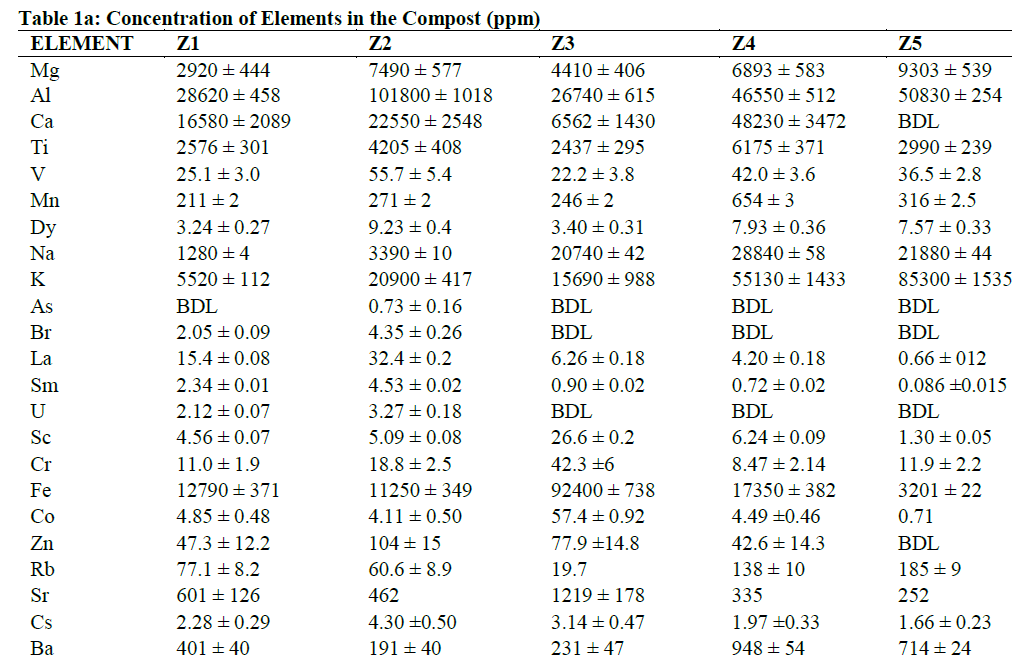
The use of treated sewage compost in agriculture promotes nutrient recycling and sustainable waste management. However, the presence of potentially toxic elements (heavy metals) necessitates detailed knowledge of elemental composition before large-scale land application. In this work, we determined the elemental composition of treated sewage compost used by farmers in Zaria metropolis, Nigeria, using instrumental neutron activation analysis (INAA). Ten samples were collected from ten dump sites as well as and two reference soil samples from uncontaminated locations. The samples were analysed at the Nigeria Research Reactor-1 (NIRR-1) laboratory, located at the Centre for Energy Research and Training (CERT), Ahmadu Bello University, Zaria, where they were irradiated in a thermal neutron flux of 5.0 × 10¹¹ n·cm⁻²·s⁻¹. Gamma-ray spectrometry was performed using a high-purity germanium detector. A total of 32 elements Mg, Al, Ca, Ti, V, Mn, Dy, Na, K, As, Br, La, Sm, U, Sc, Cr, Fe, Co, Zn, Rb, Sr, Cs, Ba, Nd, Eu, Tb, Yb, Lu, Hf, Ta, Sb, and Th were detected. Comparative evaluation with reference soils revealed higher concentration of elements in the compost. Although most concentrations were within internationally recommended agricultural limits, however, long-term accumulation may pose environmental risks under continuous application. The study provides baseline data for regulatory assessment in Nigeria.
References
Bertanza, G., Pietro, B., and Matteo, C. (2016). Ranking sewage sludge management strategies. Resources, Conservation and Recycling, 110, 1–15.
Bolan, N., Tomoyuki, M., Anitha, K., Pil-Ioo, K., Satoru, I., Masaharu, M., Ravi, N., Mary, K., (2013) Cadmium Contamination and Its Risk Management in Rice Ecosystems. Journal of Advances in Agronomy 119, 189 – 273.
Glascock, M., and Neff, H. (2003). Neutron activation analysis and provenance research. Measurement Science and Technology, 14, 1516–1526.
IAEA (2017). Applications of Neutron Activation Analysis in Environmental Studies. IAEA Technical Reports Series No. 476.
Islam, S., Kawser A., Mohammad R., Habibullah, A., Goutam, K.K. (2017).Heavy metals in the industrial sludge and their ecological risk: a case study for a developing country. Journal of Geochemical exploration. 172, 41 - 49.
Jones, L., Green, P., and White, H. (2020). Regional variations in sewage compost composition. Journal of Agriculture and Environment, 12, 112–120.
Lamastra, L., Suciu, N., and Trevisan, M. (2018). Sewage sludge for sustainable agriculture. Chemical and Biological Technologies in Agriculture, 5, 1–6.
Ozge, H., Halil, H., Nilufer, N., Sibel, A. (2008) Evaluation for Agricultural Usage with Speciation of Heavy Metal in a Municipal Sewage Sludge. Journal of Environmental Contamination Topical, 81, 42-46.
Pereira, I., Bamberg, A., Oliveira de Sousa, R., Monteiro, A., Martinazzo, R., Silveira, C., Silveira, A. (2020). Agricultural use and pH Correction of Anaerobic Sewage Sludge with Acid pH. Journal of Environmental Management, 275.
Smith, J., Brown, A., and Taylor, R. (2018). Elemental analysis of sewage compost using NAA. Journal of Environmental Science, 45, 234–241.
US EPA (2016). Guidelines for the Use of Sewage Sludge in Agriculture. EPA Publication No. EPA-822-R-16-003.
Downloads
Published
Issue
Section
Categories
License
Copyright (c) 2026 Emmanuel Itodo Okpokwu

This work is licensed under a Creative Commons Attribution 4.0 International License.