
Cryptic Maternal Lineages in Nigerian Pterocarpus santalinoides: Morphology–Genetics Discordance Across Rainforest-Savanna Ecozones
DOI:
https://doi.org/10.33003/fjs-2026-1009-5190Keywords:
Pterocarpus Santalinoides, Cryptic Genetic Diversity, Morphology–Genetics Discordance, Asymmetric Gene Flow, Maternal Lineages (Cpssr), Conservation GeneticsAbstract
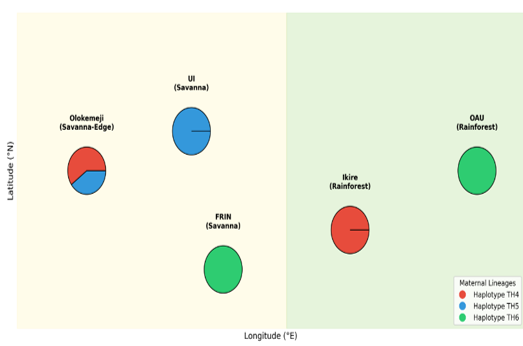
Habitat fragmentation across Nigeria’s rainforest–savanna ecozones threatens multipurpose trees like Pterocarpus santalinoides, yet morphological stasis often obscures underlying evolutionary divergence. This study integrates vegetative morphology, chloroplast microsatellites (cpSSR), and nuclear AFLP markers to resolve population structure across five Southwest Nigerian locations. Analysis of 30 vegetative descriptors revealed 100% phenotypic uniformity (Jaccard similarity = 1.00) across all sites, failing to distinguish ecological or geographic origins. In contrast, cpSSR data uncovered three strictly partitioned maternal lineages (TH4, TH5, TH6), with Olokemeji identified as a critical admixture hub exhibiting a haplotype diversity (Hd) of 0.733. AFLP markers revealed high within-population cohesion (≥92.9%) and moderate-to-high inter-population connectivity (74.3–98.6%), indicating extensive pollen-mediated gene flow between savanna and rainforest sites, with the exception of the relatively isolated Ikire lineage. This morphology–genetics discordance (m2 = 0.73, p = 0.002) highlights asymmetric gene flow: widespread pollen dispersal homogenizes the nuclear genome while restricted seed movement preserves cryptic maternal lineages. Conservation frameworks must transcend phenotypic assessments to prioritize these Evolutionary Significant Units, safeguarding maternal diversity and critical gene-flow corridors in West Africa’s fragmented landscapes.
References
Amani M, Ghorbanian A, Ahmadi SA, Kakooei M, Moghimi A, Mirmazloumi SM, Moghaddam SHA, Mahdavi S, Ghahremanloo M, Parsian S, Wu Q, Brisco B (2020) Google Earth Engine cloud computing platform for remote sensing big data applications: a comprehensive review. IEEE Journal of Selected Topics in Applied Earth Observations and Remote Sensing 13:5326–5350. https://doi.org/10.1109/JSTARS.2020.3021052
Austerlitz F, Dick CW, Dutech C, Klein EK, Oddou-Muratorio S, Smouse PE, Sork VL (2004) Using genetic markers to estimate the pollen dispersal curve. Molecular Ecology 13(9):2625–2638. https://doi.org/10.1111/j.1365-294x.2004.02100.x
Bickford D, Lohman DJ, Sodhi NS, Ng PK, Meier R, Winker K, Ingram KK, Das I (2007) Cryptic species as a window on diversity and conservation. Trends in Ecology & Evolution 22(3):148–155. https://doi.org/10.1016/j.tree.2006.11.004
Dick CW, Hardy OJ, Jones FA, Petit RJ (2008) Spatial scales of pollen and seed-mediated gene flow in tropical rain forest trees. Molecular Ecology 17(1):223–236. https://doi.org/10.1007/s12042-007-9006-6
FAO (2020) Global Forest Resources Assessment 2020: Main report. Food and Agriculture Organization of the United Nations, Rome. https://www.fao.org/forest-resources-assessment/past-assessments/fra-2020/en
Foden WB, Young BE, Akçakaya HR, Garcia RA, Hoffmann AA, Stein BA, Thomas CD, Wheatley CJ, Williams SE, Huntley B (2019) Climate change vulnerability assessment of species. Nature Climate Change 9(10):756–762. https://doi.org/10.1002/wcc.551
Lovett JC, Rudd S, Taplin J, Frimodt-Møller C (2000) Patterns of plant diversity in Africa south of the Sahara and their implications for conservation management. Biodiversity and Conservation 9(1):37-46. https://doi.org/10.1023/A:1008956529695
Madubuike K, Nnadi CO, Anaga AO, Asuzu IU (2023) Bioactivity-guided isolation of the antidiabetic principle in Pterocarpus santalinoides leaf extract. Brazilian Journal of Pharmaceutical Sciences 59:e21726. https://doi.org/10.1590/s2175-97902023e21726
Mayaux P, Pekel JF, Desclée B, Donnay F, Lupi A, Achard F, Clerici M, Bodart C, Brink A, Nasi R, Belward A (2013) State and evolution of the African rainforests between 1990 and 2010. Philosophical Transactions of the Royal Society B: Biological Sciences 368(1625):20120300. https://doi.org/10.1098/rstb.2012.0300
Moritz C (2002) Strategies to protect biological diversity and the evolutionary processes that sustain it. Systematic Biology 51(2):238–254. https://doi.org/10.1080/10635150252899752
Petit RJ, Duminil J, Fineschi S, Hampe A, Salvini D, Vendramin GG (2005) Comparative organization of chloroplast, mitochondrial and nuclear diversity in plant populations. Molecular Ecology 14(13):3899–3912. https://doi.org/10.1111/j.1365-294x.2004.02410.x
Sen S, Ravikanth G (2022) Genetic consequences of fragmentation in tropical forests: novel approaches to assess and monitor critically endangered species. In: Molecular genetics and genomics tools in biodiversity conservation. Springer, Singapore, pp 103–124. https://doi.org/10.1007/978-981-16-6005-4_5
Vos P, Hogers R, Bleeker M, Reijans M, van de Lee T, Hornes M, Frijters A, Pot J, Peleman J, Kope M and Zabeau M (1995) AFLP: a new technique for DNA fingerprinting. Nucleic Acids Research 23: 4407-4414. https://doi.org/10.1093/nar/23.21.4407
Weising K and Gardner RC (1999) A set of conserved PCR primers for the analysis of simple sequence repeat polymorphisms in chloroplast genomes of dicotyledonous plants. Genome 42: 9-19. PMID: 10207998
Downloads
Published
Issue
Section
Categories
License
Copyright (c) 2026 Saheed Adebisi, Odunayo Olawuyi

This work is licensed under a Creative Commons Attribution 4.0 International License.


