
ASSESSMENT OF MICROBIAL REDUCTION IN CHICKEN EGG SUBJECTED TO DIFFERENT BOILING DURATION
DOI:
https://doi.org/10.33003/fjs-2026-1006-5165Keywords:
Egg, Microbial Safety, Boiling duration, Egg texture and quality, Microbial ContaminationAbstract
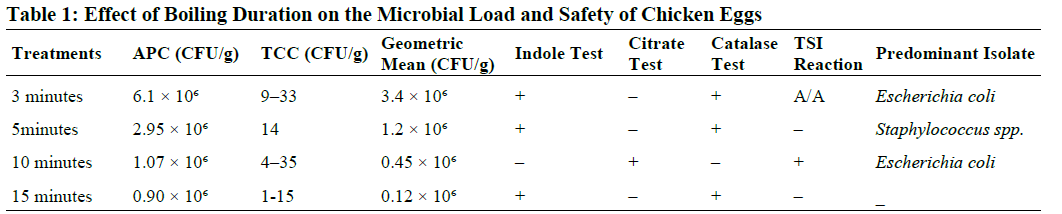
The microbial safety of eggs is a major public health concern, particularly in regions where handling and storage conditions may predispose them to contamination. This study evaluated the effect of different boiling durations (3, 5, 10, and 15 minutes) on the microbial load and safety of chicken eggs. Fresh egg samples were subjected to controlled boiling at the specified time intervals, after which microbiological analyses were conducted to determine aerobic plate count (APC) and total coliform count (TCC). Standard biochemical tests were further employed to identify predominant bacterial isolates. Results revealed a progressive reduction in microbial load with increasing boiling time. Eggs boiled for 3 minutes recorded the highest APC and TCC values, indicating insufficient microbial inactivation, while samples boiled for 15 minutes showed the lowest counts, suggesting improved microbial safety. Intermediate reductions were observed at 5 and 10 minutes of boiling. Biochemical characterization identified Staphylococcus spp. and Escherichia coli as the predominant isolates, with their presence markedly reduced at longer boiling durations. The findings demonstrate that boiling time significantly influences the microbial quality of eggs, with longer durations enhancing bacterial reduction and safety. It is therefore recommended that eggs be boiled for at least 10–15 minutes to ensure adequate microbial inactivation and minimize potential health risks. This study provides useful insights for consumers and public health authorities on safe egg preparation practices.
References
Adams, M. R., & Moss, M. O. (2008). Food microbiology (3rd ed.). Royal Society of Chemistry.
Board, R. G., & Tranter, H. S. (1995). The microbiology of eggs. In W. J. Stadelman & O. J. Cotterill (Eds.), Egg science and technology (4th ed., pp. 81–104). Food Products Press.
D’Aoust, J. Y. (2000). Salmonella and the international food trade. International Journal of Food Microbiology, 62(1–2), 15–29.
Favier, G. I., Escudero, M. E., & de Guzmán, A. M. S. (2013). Microbiological quality of eggs and egg products. Food Control, 30(2), 575–580.
Fellows, P. J. (2009). Food processing technology: Principles and practice (3rd ed.). Woodhead Publishing. Kluwer Academic/Plenum Publishers.
Food and Agriculture Organization. (2010). Eggs and egg products in human nutrition. FAO Corporate Document Repository.
Gast, R. K. (2007). Serotype-specific and serotype-independent strategies for preharvest control of food-borne Salmonella in poultry. Poultry Science, 86(12), 2548–2562.
Humphrey, T. J. (1994). Contamination of egg shell and contents with Salmonella enteritidis: A review. International Journal of Food Microbiology, 21(1–2), 31–40.
International Commission on Microbiological Specifications for Foods (ICMSF). (2002). Microorganisms in foods 7: Microbiological testing in food safety management. Kluwer Academic/Plenum Publishers.
Jay, J. M., Loessner, M. J., & Golden, D. A. (2005 (7th ed.). Springer Science+Business Media.
World Health Organization. (2015). Estimates of the global burden of foodborne diseases. WHO Press.
Board, R. G., & Tranter, H. S. (1995). The microbiology of eggs. In W. J. Stadelman & O. J. Cotterill (Eds.), Egg Science and Technology.
D’Aoust, J. Y. (2000). Salmonella and the international food trade. International Journal of Food Microbiology.
Jay, J. M., Loessner, M. J., & Golden, D. A. (2005). Modern Food Microbiology.
Stadelman, W. J., & Cotterill, O. J. (1995). Egg Science and Technology.
World Health Organization (WHO). (2015). Estimates of the global burden of foodborne diseases. WHO Press.
Downloads
Published
Issue
Section
Categories
License
Copyright (c) 2026 Samson Sukumun Kyakma, Chabiya Atu Bathon, Nasiru Abuh

This work is licensed under a Creative Commons Attribution 4.0 International License.


