
DYNAMIC LEARNER PROFILING AND ENGAGEMENT-DRIVEN ADAPTATION USING LARGE LANGUAGE MODELS
DOI:
https://doi.org/10.33003/fjs-2026-1006-5120Keywords:
Adaptive Learning, Educational AI, Engagement, Learner Profiling, Large Language ModelsAbstract
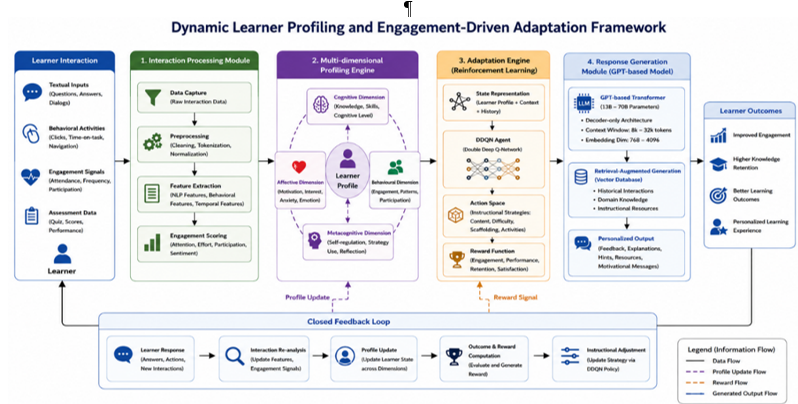
Dynamic learner profiling has become a critical component in adaptive learning systems, particularly with the emergence of large language models (LLMs) capable of processing complex natural language interactions. This paper presents a framework for engagement-driven adaptation using GPT-based large language models, behavioural analytics, and reinforcement learning to continuously update learner profiles in real time. The study adopted a design science and experimental research approach in developing a multi-dimensional learner profiling system that models cognitive, affective, behavioural, and metacognitive learner states. A Double Deep Q-Network (DDQN) was integrated to optimise instructional adaptation strategies, while retrieval-augmented generation improved contextual response generation. Experimental evaluation was conducted using public educational datasets and a proprietary tutoring interaction corpus containing over 1.8 million interaction records. The proposed framework was compared with static rule-based systems, vanilla GPT models, and profiling systems without reinforcement learning. Results showed significant improvements in profiling accuracy (overall F1-score of 0.86), learner engagement (65% deep engagement rate), knowledge retention (84%), and learning efficiency (1.5× improvement) compared with baseline systems. The findings demonstrate the potential of large language models and reinforcement learning to support highly personalised and adaptive educational systems capable of improving learner engagement, retention, and overall learning outcomes.
References
Oladipo, S. O., Kuyoro, A., Eweoya, I., Amanze, R. C., Fatade, O. B., Akinwunmi, D. S., & Idepefo, F. (2026). User-centric web-based location navigation system for Babcock University. FUDMA Journal of Sciences (FJS), 10(1), 27–34. https://doi.org/10.33003/fjs-2026-1001-4290
2. Baker, R. S., & Inventado, P. S. (2022). Educational data mining and learning analytics: Potentials and possibilities for online education. Journal of Educational Data Mining, 14(2), 1-25.
3. Clement, B., Oudeyer, P. Y., & Lopes, M. (2023). Adaptive learning frameworks using real-time data for content difficulty adjustment. IEEE Transactions on Learning Technologies, 16(3), 412-425. https://doi.org/10.1109/TLT.2023.3245678
4. Corbett, A. T., & Anderson, J. R. (1995). Knowledge tracing: Modeling the acquisition of procedural knowledge. User Modeling and User-Adapted Interaction, 4(4), 253-278. https://doi.org/10.1007/BF01099821
5. Csikszentmihalyi, M. (1990). Flow: The psychology of optimal experience. Harper & Row.
6. Deci, E. L., & Ryan, R. M. (2000). The "what" and "why" of goal pursuits: Human needs and the self-determination of behavior. Psychological Inquiry, 11(4), 227-268. https://doi.org/10.1207/S15327965PLI1104_01
7. D’Mello, S., Lehman, B., Pekrun, R., & Graesser, A. (2014). Confusion can be beneficial for learning. Learning and Instruction, 29, 153-170. https://doi.org/10.1016/j.learninstruc.2012.05.003
8. Doroudi, S., Aleven, V., & Brunskill, E. (2022). Reinforcement learning for personalized hint generation and instructional sequencing. International Journal of Artificial Intelligence in Education, 32(4), 892-928. https://doi.org/10.1007/s40593-021-00272-8
9. Fredricks, J. A., Blumenfeld, P. C., & Paris, A. H. (2004). School engagement: Potential of the concept, state of the evidence. Review of Educational Research, 74(1), 59-109. https://doi.org/10.3102/00346543074001059
11. Holmes, W., Bialik, M., & Fadel, C. (2022). Artificial intelligence in education: Promises and implications for teaching and learning. Center for Curriculum Redesign.
12. Kasneci, E., Sessler, K., Küchemann, S., Bannert, M., Dementieva, D., Fischer, F., Gasser, U., Groh, G., Günnemann, S., Hüllermeier, E., & Kieser, M. (2023). ChatGPT for good? On opportunities and challenges of large language models for education. Learning and Individual Differences, 103, 102-118. https://doi.org/10.1016/j.lindif.2023.102274
13. Kovanović, V., Joksimović, S., & Gašević, D. (2021). Learning analytics for uncovering patterns in student behavior and engagement. Journal of Learning Analytics, 8(2), 45-67.
15. Picard, R. W. (1997). Affective computing. MIT Press.
16. Piech, C., Bassen, J., Huang, J., Ganguli, S., Sahami, M., Guibas, L. J., & Sohl-Dickstein, J. (2015). Deep knowledge tracing. Advances in Neural Information Processing Systems, 28, 505-513.
18. Sweller, J. (1988). Cognitive load during problem solving: Effects on learning. Cognitive Science, 12(2), 257-285. https://doi.org/10.1207/s15516709cog1202_4
19. Wood, D., Bruner, J. S., & Ross, G. (1976). The role of tutoring in problem solving. Journal of Child Psychology and Psychiatry, 17(2), 89-100. https://doi.org/10.1111/j.1469-7610.1976.tb00381.x
Downloads
Published
Issue
Section
Categories
License
Copyright (c) 2026 Damilare S. Akinwunmi, Afolashade Kuyoro, Uchenna Nzenwata

This work is licensed under a Creative Commons Attribution 4.0 International License.


