
BREEDING HABITATS AND INSECTICIDE SUSCEPTIBILITY OF Anopheles gambiae AND Culex Quinquefasciatus IN ILORIN, NIGERIA
DOI:
https://doi.org/10.33003/fjs-2026-1006-5105Keywords:
Malaria, insecticide resistance, Anopheles gambiae, Culex quinquefasciatus, urban breeding habitats, NigeriaAbstract
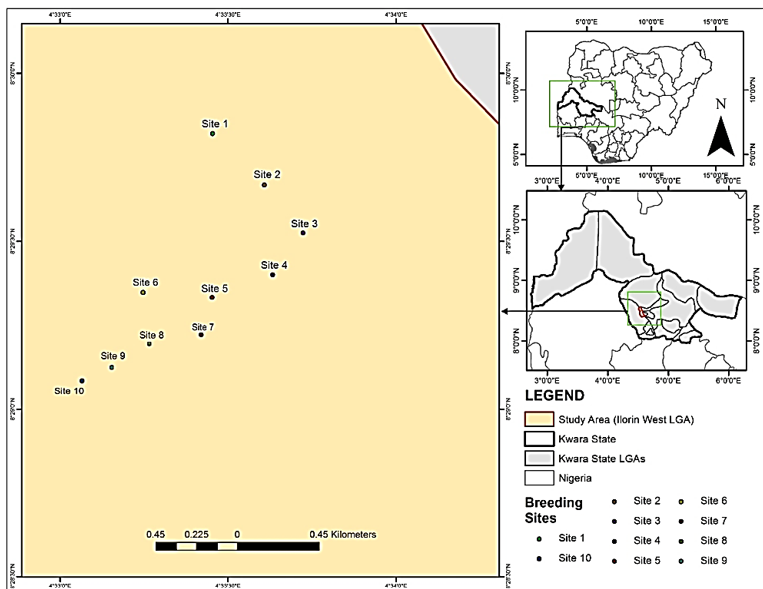
Urban mosquito breeding habitats and insecticide resistance pose major public health challenges in Nigeria. This study characterised larval habitats and insecticide susceptibility of Anopheles gambiae and Culex quinquefasciatus in Ilorin. Larvae were collected from ten sites during the 2011 rainy season, and habitats were profiled by water physicochemical properties (temperature, pH, conductivity, total dissolved solids, heavy metals) and vegetation. Adult susceptibility was tested against five WHO-recommended insecticides. An. gambiae predominated in sunlit, turbid, polluted waters with submerged vegetation; Cx. quinquefasciatus occurred in both sunlit and shaded habitats. Propoxur gave the highest mortality: 80.3% in An. gambiae and 94.1% in Cx. quinquefasciatus. Primiphos methyl was least effective, killing only 4.9% of An. gambiae. Pyrethroids showed moderate efficacy (60–75%). Principal component analysis revealed strong correlations of iron and manganese with polluted sites, indicating heavy metal contamination. These pre-long-lasting insecticidal net baseline data expose alarming resistance to DDT and organophosphates and underline the urgent need for integrated vector management, insecticide rotation, larval habitat modification, and continuous resistance monitoring.
References
Agbor, O. V., Idowu, T. E., Fagbohun, K. I., Oyeniyi, A. T., Jimoh, R. T., & Otubanjo, A. O. (2020). Molecular identification and insecticide resistance status of Culex mosquitoes collected from blocked drainages in Lagos State, Nigeria. Pan African Journal of Life Sciences, 4(1), 1–6.
American Public Health Association. (1998). Standard methods for the examination of water and wastewater (20th ed.). United Book Press.
Ande, A. T., Adelaja, O. J., Agada, A. V., Akanni, O. I., & Omotayo, A. I. (2022). Biological fitness costs associated with the various permethrin resistance development statuses in Nigeria. Sri Lankan Journal of Biology, 7(1), 1–11. https://doi.org/10.4038/sljb.v7i1.73
Chandre, F., Darriet, F., Doannio, J. M., Riviere, F., Pasteur, N., & Guillet, P. (1998). The presence of two members of the Anopheles gambiae complex in the rice fields of the Nouna district (Burkina Faso) with the same chromosomal structure as An. gambiae s.s. Insect Molecular Biology, 7(1), 9–16.
Chukwuekezie, O., Nwosu, E., Nwangwu, U., Abakpa, G., Anioke, C., & Okolo, E. (2020). Resistance status of Anopheles gambiae (s.l.) to four commonly used insecticides for malaria vector control in South-East Nigeria. Parasites & Vectors, 13, 152. https://doi.org/10.1186/s13071-020-04027-z
Fagbohun, F. I., Oyeniyi, T. A., Idowu, T. E., Otubanjo, O. A., & Awolola, T. S. (2019). Cytochrome P450 mono-oxygenase and resistance phenotype in DDT- and deltamethrin-resistant Anopheles gambiae (Diptera: Culicidae) and Culex quinquefasciatus in Kosofe, Lagos, Nigeria. Journal of Medical Entomology, 56(3), 817–821.
Fossog, B. T., Kopya, E., Ndo, C., Menze-Djantio, B., Costantini, C., Njiokou, F., Awono-Ambene, P., & Antonio-Nkondjio, C. (2012). Water quality and Anopheles gambiae larval tolerance to pyrethroids in the cities of Douala and Yaoundé (Cameroon). Journal of Tropical Medicine, 2012, Article 429817. https://doi.org/10.1155/2012/429817
Fouque, F., & Reeder, J. C. (2019). Impact of past and on-going changes on climate and weather on vector-borne diseases transmission: A look at the evidence. Infectious Diseases of Poverty, 8, 51. https://doi.org/10.1186/s40249-019-0565-1
Gillies, M. T., & Coetzee, M. (1987). A supplement to the Anophelinae of Africa south of the Sahara (Afrotropical Region). South African Institute for Medical Research.
Gillies, M. T., & De Meillon, B. (1968). The Anophelinae of Africa south of the Sahara (Ethiopian Zoogeographical Region). South African Institute for Medical Research.
Kabula, B., Tungu, P., Matowo, J., Kitau, J., Mweya, C., Emidi, B., Masue, D., Sindato, C., Malima, R., Minja, J., Msangi, S., Njau, R., Mosha, F., Magesa, S., & Kisinza, W. (2012). Susceptibility status of malaria vectors to insecticides commonly used for malaria control in Tanzania. Tropical Medicine and International Health, 17(6), 742–750.
Malaria Research and Reference Reagent Resource (MR4). (2007). Methods in Anopheles research. CDC, NIH, ATCC.
Manyi, M. M., Aker, P., & Dechi, A. A. (2017). Anopheles and Culex mosquito species diversity and its epidemiological implications in the Makurdi area of Benue State, North Central Nigeria. Annals of Experimental Biology, 5(1), 9–13.
Matowo, N. S., Abbasi, S., Munhenga, G., Tanner, M., Mapua, S. A., Oullo, D., Koekemoer, L. L., Kaindoa, E., Ngowo, H. S., Coetzee, M., Utzinger, J., & Okumu, F. O. (2019). Fine-scale spatial and temporal variations in insecticide resistance in Culex pipiens complex mosquitoes in rural south-eastern Tanzania. Parasites & Vectors, 12, 413. https://doi.org/10.1186/s13071-019-3676-4
Mattah, P. A. D., Futagbi, G., Amekudzi, L. K., Mattah, M. M., de Souza, D. K., Kartey-Attipoe, W. D., Bimi, L., & Wilson, M. D. (2017). Diversity in breeding sites and distribution of Anopheles mosquitoes in selected urban areas of southern Ghana. Parasites & Vectors, 10, 25. https://doi.org/10.1186/s13071-016-1941-3
Minakawa, N., Sonye, G., Mogi, M., & Yan, G. (2002). The effects of climatic factors on the distribution and abundance of malaria vectors in Kenya. Journal of Medical Entomology, 39(6), 833–841.
Mwangangi, J. M., Shililu, J., Muturi, E. J., Muriu, S., Jacob, B., Kabiru, E., Mbogo, C. M., Githure, J., Novak, R., & Beier, J. C. (2010). Anopheles larval abundance and diversity in three rice agro-village complexes Mwea Irrigation Scheme, central Kenya. Malaria Journal, 9, 228. https://doi.org/10.1186/1475-2875-9-228
NGuessan, R., Corbel, V., Akogbeto, M., & Rowland, M. (2007). Reduced efficacy of insecticide-treated nets and indoor residual spraying for malaria control in pyrethroid resistance area, Benin. Emerging Infectious Diseases, 13(2), 199–206.
Oduola, A. O., Obembe, A., Adelaja, O. J., & Ande, A. T. (2016). Surveillance and insecticide susceptibility status of culicine mosquitoes in selected communities utilizing long-lasting insecticidal nets in Kwara State, Nigeria. Animal Research International, 13(3), 2483–2491.
Paaijmans, K. P., Read, A. F., & Thomas, M. B. (2009). Understanding the link between malaria risk and climate. Proceedings of the National Academy of Sciences, 106(33), 13844–13849.
Tongo, I., & Ezemonye, L. (2015). Heavy metal contamination in outdoor insecticide usage: Environmental impacts of common insecticides. Environmental Monitoring and Assessment, 187(7), 482. https://doi.org/10.1007/s10661-015-4704-8
World Health Organization. (1998). Test procedures for insecticide resistance monitoring in malaria vectors, bio-efficacy and persistence of insecticides on treated surfaces (WHO/CDS/MAL/98.12). Geneva.
World Health Organization. (2020). World malaria report 2020: 20 years of global progress and challenges. Geneva. Licence: CC BY-NC-SA 3.0 IGO.
World Health Organization. (2023). World malaria report 2023. Geneva. Licence: CC BY-NC-SA 3.0 IGO.
Yusuf, M. A., Oshaghi, M. A., Vatandoost, H., Hanafi-Bojd, A. A., Enayati, A., Jalo, R. I., Aminu, A. O. A. A., & Daneji, I. M. (2021). Current status of insecticide susceptibility in the principal malaria vector, Anopheles gambiae in three northern states of Nigeria. Journal of Arthropod-Borne Diseases, 15(2), 196–206. https://doi.org/10.18502/jad.v15i2.7489
Downloads
Published
Issue
Section
Categories
License
Copyright (c) 2026 James Adelaja Olukayode, Awodoyin Tosin, Palegh Aker, Emmanuel Abiola Ayoola, Ore Hassanat, Taiwo Ande Adeolu

This work is licensed under a Creative Commons Attribution 4.0 International License.


