
INVESTIGATING THE EFFECTS OF PH ON THE SOLUBILITY OF EXPLOSIVE MATERIALS
DOI:
https://doi.org/10.33003/fjs-2026-1006-5091Keywords:
Explosives, Solubility, pH, Environmental fate, Hydrolysis, NitroaromaticsAbstract
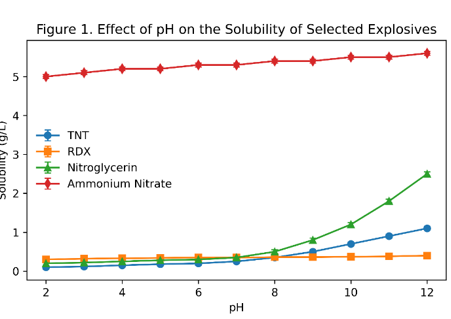
The solubility behaviour of explosive materials plays a pivotal role in determining their environmental mobility, persistence, and safe handling. This study investigates the influence of pH on the solubility of representative explosive compounds, including nitroaromatics, nitramines, nitrate esters, and inorganic oxidizers. Experimental observations indicate that pH significantly affects solubility through ionization, hydrolysis and molecular stability mechanisms. Nitroaromatic compounds exhibit increased solubility under alkaline conditions, while nitrate esters undergo pH-dependent hydrolysis. Nitramines show limited sensitivity to pH variations, whereas inorganic oxidizers remain highly soluble across all conditions. These findings have important implications for environmental risk assessment, remediation strategies, and storage protocols.
References
Beck, A. J., van der Lee, E. M., Eggert, A., Stamer, B., Gledhill, M., Schlosser, C., & Achterberg, E. P. (2019). In situ measurements of explosive compound dissolution fluxes from exposed munition material in the Baltic Sea. Environmental Science & Technology, 53(10), 5652–5660.
U.S. Environmental Protection Agency. (2005). Best management practices for lead at outdoor shooting ranges (EPA 902B01001).
Bannon, D. I., Drexler, J. W., Fent, G. M., Casteel, S. W., Hunter, P. J., Brattin, W. J., & Major, M. A. (2009). Evaluation of small arms range soils for metal contamination and lead bioavailability. Environmental Science & Technology, 43(23), 9071.
U.S. Environmental Protection Agency. (2011). Site characteristics for ammunition (EPA 505S11001). Federal Facilities Forum Issue Paper.
Royal Military College of Science. (1988). Lead particulates in armoured fighting vehicles (Unpublished report). Shrivenham, UK.
Wang, L., Xu, Z., Wang, P., Wang, L., Lin, Z., & Meng, Z. (2013). Investigation of the solubility of octahydro-1,3,5,7-tetranitro-1,3,5,7-tetrazocine and 1,3,5-triacetyl-hexahydro-s-triazine. Journal of Chemical & Engineering Data, 58(3), 737–740.
Sviatenko, L. K., Gorb, L., Hill, F. C., Leszczynska, D., Shukla, M. K., Okovytyy, S. I., Hovorun, D., & Leszczynski, J. (2016). In silico alkaline hydrolysis of octahydro-1, 3, 5, 7-tetranitro-1, 3, 5, 7-tetrazocine: Density functional theory investigation. Environmental Science & Technology, 50(18), 10039–10046.
Chaudhri, M. M., & Field, J. E. (1970, August 18–21). Deflagration in single crystal lead azide. In 5th Symposium (International) on Detonation (p. 301). Pasadena, CA, USA.
Los Alamos National Laboratory. (n.d.). Making a safer bang for the buck. Retrieved from http://www.lanl.gov/news/index.php/fuseaction
Rogalski, M. H., Dang, A. N., & Mezyk, S. P. (2026). Going out with a bang: Absolute kinetics of removing organic energetic compounds from waters using hydroxyl radicals. Environmental Science & Technology, 60(4), 3508–3518.
Scott, R. I. (2001). Lead contamination in soil at outdoor firing ranges. Princeton University Report. Retrieved from http://www.princeton.edu/∼mizzo/firingrange.html.
Kumar, R., Soni, P., & Siril, P. F. (2019). Engineering the morphology and particle size of high energetic compounds using drop-by-drop and drop-to-drop solvent–antisolvent interaction methods. ACS Omega, 4(3), 5424–5433.
Wijker, R. S., Bolotin, J., Nishino, S. F., Spain, J. C., & Hofstetter, T. B. (2013). Using compound-specific isotope analysis to assess biodegradation of nitroaromatic explosives in the subsurface. Environmental Science & Technology, 47(13), 6872–6883.
Xu, R., Tang, G., Fu, X.-L., & Yan, Q.-L. (2022). Phase equilibrium and thermodynamics studies on dissolving processes of energetic compounds: A brief review. Crystal Growth & Design, 22(1), 909–936.
U.S. National Library of Medicine. (n.d.). Lead small arms initiators. Retrieved from http://www.ncbi.nlm.nih.gov/pubmed.
U.S. Environmental Protection Agency. (2003). EPA typical TRW recommendations for performing human health risk analysis on small arms shooting ranges (EPA 540R92615). Retrieved from http://www.epa.gov.
Lima, D. R., Bezerra, M. L., Neves, E. B., & Moreira, F. R. (2011). Impact of ammunition and military explosives on human health and the environment. Reviews on Environmental Health, 26(2), 101–110.
Saalidong, B. M., Aram, S. A., Otu, S., & Lartey, P. O. (2022). Examining the dynamics of the relationship between water pH and other water quality parameters in ground and surface water systems. PLoS ONE, 17(1), e0262117.
Brooke, D., Movahed, N., & Bothner, B. (2015). Universal buffers for use in biochemistry and biophysical experiments. AIMS Biophysics, 2(3), 336–342.
Downloads
Published
Issue
Section
Categories
License
Copyright (c) 2026 Moses Azubuike Nmeka, Aderonke Peace Ejenavi

This work is licensed under a Creative Commons Attribution 4.0 International License.


