
Cultural Beliefs, Misconceptions, and Maternal Health-Seeking Behaviour: A Study of Rhesus Factor Incompatibility in The Makoko Community, Lagos, Nigeria
DOI:
https://doi.org/10.33003/fjs-2026-1009-5051Keywords:
Rhesus factor incompatibility, Cultural awareness, Mental health behaviourAbstract
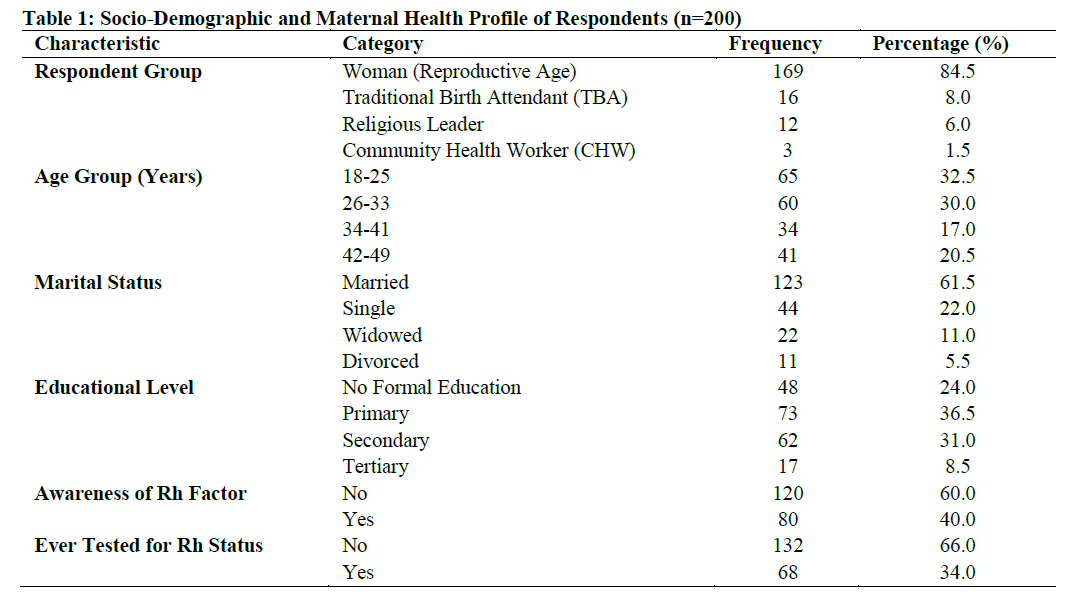
Rhesus (Rh) factor incompatibility is a preventable cause of adverse outcomes for mothers and newborns. In marginalized urban communities, socio-cultural factors shape awareness and health behaviors. This study examined cultural beliefs and knowledge about Rh incompatibility and their impact on maternal health in Makoko, Lagos, Nigeria. A descriptive cross-sectional study involving 200 women of reproductive age (18-49 years) was conducted. Data collection was through questionnaires, analyzed with descriptive and inferential statistics (SPSS v25). Awareness of Rh incompatibility was limited, with only 40% knowing about the Rh factor. Cultural and religious beliefs strongly influenced perceptions of pregnancy complications, often attributing them to spiritual or traditional causes (Mean = 2.88). Maternal health practices were suboptimal: 33.5% regularly attended antenatal care, 66% had never checked their Rh status, and 37% used traditional birth attendants. There was a moderate positive correlation between awareness and health-seeking behavior (r=0.46, p<0.05), and cultural beliefs significantly predicted maternal health practices (β=0.52, p<0.05). A significant knowledge gap exists regarding Rh incompatibility in Makoko, further reinforced by cultural beliefs that hinder acceptance of biomedical care. To improve awareness, antenatal attendance, and Rh screening, community-based, culturally sensitive health education is essential.
References
AbdElhakim, A. S., Ahmad, N. T., & Ibrahim, W. H. (2024). Assessment of pregnant women's knowledge regarding Rhesus incompatibility. Assiut Scientific Nursing Journal, 12(45), 30-40.
Abimbola, O., & Olasubomi, O. (2021). Assessment of pregnant women’s knowledge and attitude about Rhesus incompatibility prevention at Babcock University Teaching Hospital Ilishan-Remo Ogun State. International Journal of Academic Research in Business, Arts and Science, 3(6), 5-15.
Adebayo, A., Liu, M., & Cheah, W. (2019). Sociocultural understanding of miscarriages, stillbirths, and infant loss: A study of Nigerian women. Journal of Intercultural Communication Research, 48(2), 91-111.
Adejoh, S. O., Olorunlana, A., & Olaosebikan, O. (2018). Maternal health: A qualitative study of male partners’ participation in Lagos, Nigeria. International Journal of Behavioral Medicine, 25(1), 112-122.
Awoleye, A. F., Solanke, B. L., Kupoluyi, J. A., & Adetutu, O. M. (2022). Exploring the perception and socio-cultural barriers to safer sex negotiation among married women in Northwest Nigeria. BMC Women’s Health, 22(1), 411.
Bowman, J. M. (1988). The prevention of Rh immunization. Transfusion Medicine Reviews, 2(3), 129-150.
Claeys, A., Berdai-Chaouni, S., Tricas-Sauras, S., & De Donder, L. (2025). From knowledge to practice: Design, implementation, and evaluation of an evidence-based educational module to increase cultural awareness in nursing students. Creative Nursing, 31(1), 51-60.
Gajida, A. U., Ibrahim, U. M., Jalo, R. I., Tukur, J., Usman, T. I., Jaafar, J. S., et al. (2019). Predictors of knowledge and management practice of Rhesus negative pregnant women among primary health care workers in Kano, Nigeria. Pyramid Journal of Medicine, 2(2).
Hackett, S., Janssen, J., Beach, P., Perreault, M., Beelen, J., & Van Tartwijk, J. (2023). The effectiveness of Collaborative Online International Learning (COIL) on intercultural competence development in higher education. International Journal of Educational Technology in Higher Education, 20(1), 5.
Hendrickson, J. E., & Delaney, M. (2016). Hemolytic disease of the fetus and newborn: Modern practice and future investigations. Transfusion Medicine Reviews, 30(4), 159-164.
Iacoella, F., & Tirivayi, N. (2019). Determinants of maternal healthcare utilization among married adolescents: Evidence from 13 Sub-Saharan African countries. Public Health, 177, 1-9.
Kuo, B. C., Hussein, N., Makhzoum, N., Sabhnani, P., & Zvric, M. (2023). Evaluating the effects of cultural immersion on counselor trainees' multicultural development and intercultural competence: A metasynthesis of qualitative evidence. International Journal of Intercultural Relations, 94, 101798.
Myle, A. K., & Al-Khattabi, G. H. (2021). Hemolytic disease of the newborn: A review of current trends and prospects. Pediatric Health, Medicine and Therapeutics, 12, 491-498.
Nearagh, F. K., Ghasemi, S., Shariatpanahi, S., Dabaghi, S., & Sarbakhsh, P. (2025). The effects of an educational intervention based on the Campinha-Bacote model on cultural competence among nursing students: An experimental study. BMC Nursing, 24(1), 228.
Oikarainen, A., Mikkonen, K., Kenny, A., Tomietto, M., Tuomikoski, A. M., Meriläinen, M., et al. (2019). Educational interventions designed to develop nurses’ cultural competence: A systematic review. International Journal of Nursing Studies, 98, 75-86.
Ojiakor-Umenze, I., Kasarachi, H. I., Onyekachi, N. A., & Cynthia, A. N. (2024). Assessment of Rhesus factor awareness and knowledge among women in Imo State Nigeria. COMMIcast, 5(3), 486-504.
Olu-Abiodun, O. O., Sodimu, O., & Ademola, S. (2025). Pregnant women's knowledge of Rhesus incompatibility at selected primary healthcare centres in Ogun State, Nigeria. African Journal of Midwifery and Women’s Health, 19(2), 1-8.
Opara, U. C., Iheanacho, P. N., & Petrucka, P. (2024). Cultural and religious structures influencing the use of maternal health services in Nigeria: A focused ethnographic research. Reproductive Health, 21(1), 188.
Roberts, A. (2018). Genetic diseases and prenatal genetic testing knowledge gaps, determinants of uptake and termination of pregnancies among antenatal clinic attendees in Lagos, Southwest Nigeria (Unpublished master’s thesis).
Shewamene, Z., Dune, T., & Smith, C. A. (2017). The use of traditional medicine in maternity care among African women in Africa and the diaspora: A systematic review. BMC Complementary and Alternative Medicine, 17(1), 382.
Downloads
Published
Issue
Section
Categories
License
Copyright (c) 2026 Joy Abiola Onipede, Rosheed Abioye Seidu, Ismaheel Adewale Liadi, Abayomi Taiwo Ogunleye, Oluwabukola Samuel Oyeyinka, Olawole Kehinde Ajisafe

This work is licensed under a Creative Commons Attribution 4.0 International License.


