
DETERMINANTS OF SAVINGS AND INVESTMENT AMONG COCOA FARMERS IN BOKI LOCAL GOVERNMENT AREA OF CROSS RIVER STATE, NIGERIA
DOI:
https://doi.org/10.33003/fjs-2026-1006-5040Keywords:
Cocoa farmers, Savings, Investment, Socio-economic determinants, Nigeria, Rural developmentAbstract
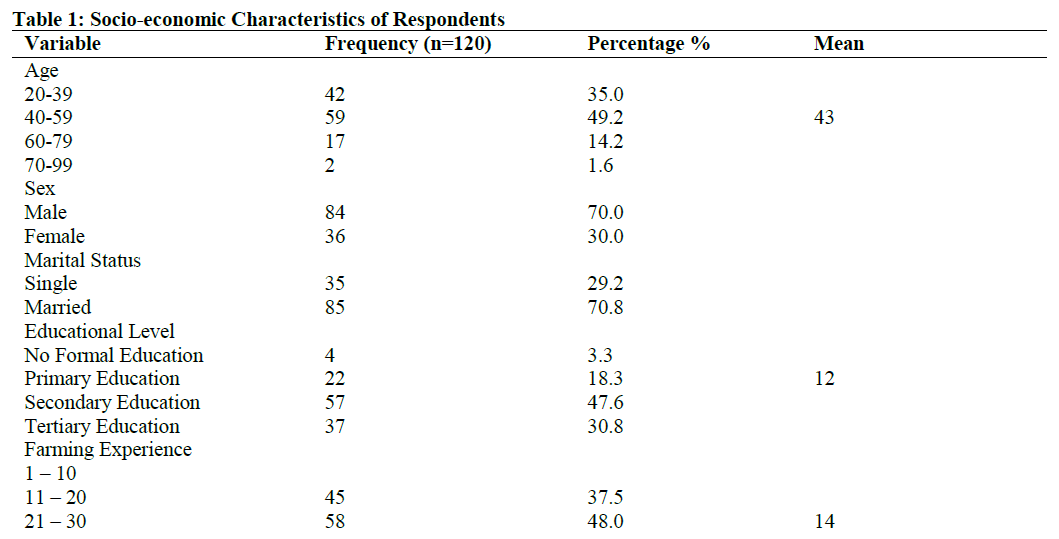
This study examined the determinants of savings and investment among cocoa farmers in Boki Local Government Area, Cross River State, Nigeria. Specifically, the study identified the different forms of saving and investment, examined the socio-economic factors influencing savings, analysed the determinants of investment and identified the constraints affecting savings and investment decisions of cocoa farmers. A multi-stage sampling technique was employed to select 120 cocoa farmers and primary data was obtained through structured questionnaire. Data was analysed using descriptive and inferential statistics. Results showed that 70% of respondents were male, 70.8% married, and 49.2% within the economically active age group (40–59 years), reflecting a labour-intensive, experience-driven production system. About 68.3% used formal financial institutions for savings, while 62.5% invested in land and real estate due to perceived security and long-term value. Regression results indicated that income (p < 0.01), farm size (p < 0.05), and farming experience (p < 0.05) significantly influenced savings, while age, marital status, farming experience, and income significantly influenced investment decisions. These patterns reflect income capacity and life-cycle dynamics. However, price volatility, high input costs, and poor infrastructure constrained financial accumulation. The study concludes that savings and investment among cocoa farmers are primarily income-driven but structurally constrained. It recommends strengthening rural financial systems, stabilizing agricultural incomes, and improving infrastructure to enhance farmers’ capacity for sustainable investment.
References
Amu, M. E. K., & Amu, E. K. (2012). Savings behaviours in Ghana: A study of rural households in the Ho Municipality of the Volta Region. International Journal of Applied Sociology, 2(4), 41–46.
Anga, J. M. (2016). The Role of Smallholder Farmers in Cocoa Production: A Global Perspective. International Cocoa Organization (ICCO) Report.City Population. (2022). Population statistics for Boki Local Government Area, Cross River State. Retrieved from https://www.citypopulation.deDemirgüç-Kunt, A., Klapper, L., Singer, D., Ansar, S., & Hess, J. (2017). The Global Findex Database 2017: Measuring financial inclusion and the fintech revolution. World Bank.Dupas, P., & Robinson, J. (2013). Savings constraints and microenterprise development. American Economic Journal: Applied Economics, 5(1), 163–192.Food and Agriculture Organization. (2020). FAOSTAT database.Ike, P. C., & Idoge, D. E. (2006). Determinants of financial savings among rural households in Delta State, Nigeria. Journal of Applied Chemistry and Agricultural Research, 2(9), 95–107.International Cocoa Organization. (2022). Quarterly bulletin of cocoa statistics.Karlan, D., Ratan, A. L., & Zinman, J. (2014). Savings by and for the poor. Annual Review of Economics, 6, 321–344.National Population Commission (NPC) [Nigeria], & National Bureau of Statistics (NBS). (2022). Population projections for Nigerian administrative areas. Retrieved from https://www.citypopulation.deNwibo, S. U. (2013). Determinants of savings and investment capacities of farming households in Udi Local Government Area of Enugu State, Nigeria. Journal of Finance and Accounting, 4(15), 59–68.Odoemenem, I. U., Ezihe, J. A. C., & Akerele, S. O. (2013). Savings and investment pattern of small-scale farmers in Benue State, Nigeria. Global Journal of Human Social Science, 13(1), 7–12. Ogunwolu, Q. A., Akinpelu, A. O., Adesanya, K. A., Adelusi, A. A., Taiwo, O., Adesida, F. A. & Buari, R. A. (2022). Analysis of Strengths, Weaknesses, Opportunities and Threats (SWOT) of Cocoa Industry in Nigeria. Moor Journal of Agricultural Research, 23(1), 42-49.Saleh, A., Ochi, J. E., Sani, M. H., & Sulaiman, A. (2024). Analysis of household savings behaviour of dry season rice farmers in Gombe State, Nigeria. Journal of Agripreneurship and Sustainable Development, 7(2), 1-9. DOI: 10.59331/jasd. v7i2.741World Bank. (2020). World development indicators.World Bank. (2022). World development report 2022: Finance for an equitable recovery. World Bank.Xplorer.ng. (2025). Cross River State population by local government area (2026 projection). Retrieved from https://xplorer.ng
Downloads
Published
Issue
Section
Categories
License
Copyright (c) 2026 Balthiya Alfred Fakuta, Uket Ikpi Ofem, Eucharia Agom Ajah, Susana Ben Ohen

This work is licensed under a Creative Commons Attribution 4.0 International License.