
Effect of Eggshell Sealing Methods on Embryonic Mortality and Hatchability in Cracked Broiler Eggs
DOI:
https://doi.org/10.33003/fjs-2026-1009-4911Keywords:
Cracked Eggs, Embryonic Mortality, Hatchability, Eggshell Sealing, Broiler ChickensAbstract
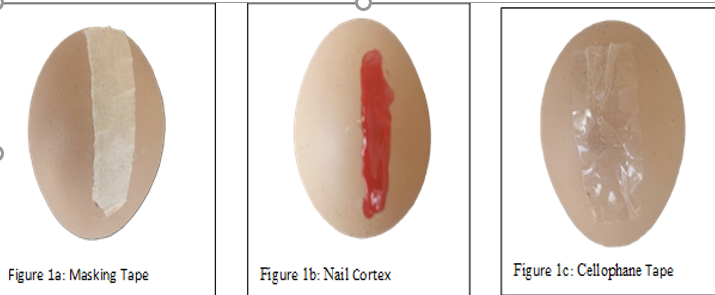
Eggshell cracking remains a major challenge in broiler hatchery operations due to its adverse effects on embryonic mortality and hatchability. This study evaluated the effectiveness of different eggshell sealing methods on embryonic mortality and hatchability of cracked broiler eggs. A total of 480 fertile broiler breeder eggs obtained from the National Animal Production Research Institute were used. The eggs were sourced from breeder hens aged 32 weeks and randomly assigned to four treatment groups: uncracked eggs (control), cracked eggs sealed with masking tape, nail cortex, and cellophane tape. Each treatment consisted of 120 eggs with five replicates of 24 eggs each in a completely randomized design. Eggs were incubated under standard conditions, and embryonic mortality and hatchability were determined. The results revealed significant differences (P < 0.05) among treatments. Embryonic mortality was lowest in the uncracked control and eggs sealed with cellophane tape, while masking tape recorded the highest mortality. Eggs sealed with nail cortex showed intermediate mortality. Similarly, hatchability was highest in the control and cellophane treated groups, moderate in nail cortex, and lowest in masking tape treated eggs. The superior performance of cellophane tape suggests its effectiveness in restoring eggshell integrity, maintaining moisture balance, and allowing adequate gaseous exchange necessary for embryonic development. In contrast, masking tape negatively affected embryo mortality, likely due to restriction of shell pore function and increased susceptibility to contamination. These findings suggest that cellophane tape is a practical and effective method for salvaging cracked broiler eggs, minimizing losses, and improving hatchery efficiency.
References
1. Afolayan, M., & Abiola, S.S. (2010). Effect of eggshell defects and sealing methods on hatchability of broiler eggs. Journal of Agricultural Research and Development, 9(2), 45–52.
2. Al-Nasser, A., Al-Khalifa, H., Al-Saffar, A., Khalil, F., Albahouh, M., Ragheb, G., Al-Haddad, A., & Mashaly, M. (2020). Overview of chicken taxonomy and factors influencing egg quality and hatchability. Brazilian Journal of Poultry Science, 22(1), 1–10. https://doi.org/10.1590/1806-9061-2019-1148
3. Ar, A., & Bettaieb, K. (2012). Eggshell structure and gas permeability in avian species. Journal of Avian Biology, 43, 103–113.
4. Arora, S.P., & Sandhu, J.S. (2021). Poultry production and management. CBS Publishers.
5. Butcher, G. D., & Nilipour, A. H. (2005). Broiler production goals -important numbers: VM134/VM099.https://edis.ifas.ufl.edu/publication/VM099
6. Deeming DC. Avian incubation: Behaviour, environment, and evolution. Oxford: Oxford University Press; 2001
7. Fathi, M., Abou-Emera, O., Al-Homidan, I., Galal, A., & Rayan, G. (2022). Effect of genotype and egg weight on hatchability properties and embryonic mortality pattern of native chicken populations. Poultry Science, 101(11), 102129. https://doi.org/10.1016/j.psj.2022.102129
8. Food and Agriculture Organization (FAO). (2021). FAOSTAT statistical database. Retrieved from https://www.fao.org/faostat/
9. Gholami, J., Seidavi, A., & Corazzin, M. (2018). Efficacy of sealing methods on hatchability of micro-cracked eggs, Revista Colombiana de Ciencias Pecuarias, 31, 223–228.
10. Gulcihan, S.U., & Gurses, M. (2009). Effects of covering broiler breeder eggs with hairline cracks by nail polish on hatchability results, In: Proc. II Mediterraean Summit of WPSA, 285−287. https://doi.org/10.56093/ijps.v59i2.165173
11. Jassim, E.W., Grossman, M., Koops, W.J., & Luykx, R.A. (1996). Multiphasic analysis of embryonic mortality in chickens. Poultry Science, 75(4):464-71. doi: 10.3382/ps.0750464.
12. Khabisi, M.M.., Salahi, A., & Mousavi, S.N. (2012). The influence of egg shell crack types on hatchability and chick quality. Turkish Journal of Veterinary & Animal Sciences, 36, 289–295
13. King’ori, A.M. (2011). Review of the factors that influence egg fertility and hatchability in poultry. International Journal of Poultry Science, 10(6),483–492. https://doi.org/10.3923/ijps.2011.483.492
14. Kumar, R., Kirti J., Nitin B., Varun S., Krishanender D., & Shivani, K. (2025). Effects of egg size on hatchability parameters and chick quality in native chicken: Egg size on hatchability. Indian Journal of Poultry Science, 59(2), 193-198.
15. Li, Q., Duan Z., Sun, C., Zheng, J., Xu, G., & Yang, N. Genetic variations for the eggshell crystal structure revealed by genome-wide association study in chickens. BMC. Genomics, 22:786. doi:10.1186/s12864-021-08103-1.
16. Masia, K.S., Idowu, P.A., Nephawe, K.A., Mtileni, B., Ngcobo, J.N., Modiba, M.C., & Mpofu, T.J. (2025). Effect of incubation temperature on hatchability, chick quality and post-hatch performance – Review. Animal Science and Genetics, 21(3): 59-87.
17. McDaniel, G.R., Roland, D.A., & Coleman, M.A. (1979). Effect of eggshell quality on hatchability and embryonic mortality. Poultry Science, 58(1),10–13. https://doi.org/10.3382/ps.0580010
18. Narahari, D., Rajini, R.A., Srinivasan, G., & Ramamurthy, N. (2000). Methods to improve the hatchability of cracked chicken eggs. British Poultry Science, 41, 178–181.
19. Nazareno, A.C., da Silva, I.J.O., Vieira, A.M.C., Vieira, F.M.C., & Miranda, K.O.S. (2013). Levels of vibration and shock on different roads during transportation of fertile eggs. Revista Brasileira de Engenharia Agrícola e Ambiental, 17, 900–905.
20. Neto, F.L.K., Barbosa, B.B., Novaes, G.A., Blank, M.H., Fireman, A., Junior, Á.B., & Pereira, R.J.G. (2024). Eggshell translucency: its relationship with specific gravity and eggshell color and its influence on broiler egg weight loss, hatchability, and embryonic mortalities. Poultry Science, 103(5):103528. doi: 10.1016/j.psj.2024.103528.
21. Onagbesan, O., Bruggeman, V., Smit, L.D., Debonne, M., Witters, A., Tona, K., Everaert, N., & Decuypere, E. (2007). Gas exchange during storage and incubation of Avian eggs: effects on embryogenesis, hatchability, chick quality and post-hatch growth. World’s Poultry Science Journal, 63:553–573. doi: 10.1017/S0043933907001614
22. Perić, L., Mitraković, M., Vekić, M., Đukić, S.M., Žikić, D., Savić, Đ., Meijerhof, R., & Jotanović, S. (2023). Improving the incubation results by sealing the eggshell of cracked hatching eggs with surgical tape. Poultry Science, 102(3):102466. doi: 10.1016/j.psj.2022.102466.
23. Pilotto, F., Ribeiro, A.M.L., Cargnelutti Filho, A., & Klein, V. A. (2015). Development and performance of a mechanical egg collection system versus hand-operated nest. Revista Brasileira de Ciência Avícola, 17, 523–530.
24. R Core Team. (2015). R: A language and environment for statistical computing. R Foundation for Statistical Computing, Vienna, Austria.
25. Rayan, G.N., Galal, A., Fathi, M.M., Alawaid, S., Shehata, W., El-Attar, A.H. (2023). Assessing differences in the quality properties and ultrastructure of eggshell as affected by chicken strain and flock age during incubation period. Brazilian Journal of Poultry Science, 25:1–10. doi: 10.1590/1806-9061-2022-1647.
26. Reijrink, I.A.M., Meijerhof, R., Kemp, B., & Van Den Brand, H. (2008). The chicken embryo and its micro environment during egg storage and early incubation. World’s Poultry Science Journal, 64(4), 581-598
27. Romanoff, A. L., & Romanoff, A. J. (1949). The avian egg. John Wiley & Sons.
28. Simsek, G., & Gurses, M. (2009). Effects of covering broiler breeder eggs with hairline cracks by nail polish on hatchability results. In: Proceedings of the 2nd Mediterranean Summit of WPSA, 285–287.
29. Solomon, S.E. (2010). The eggshell: strength, structure and function. British Poultry Science, 1:52-9. doi: 10.1080/00071668.2010.497296.
30. Tullett, S. (2009). Investigating hatchery practice. Ross Tech Scotland, United Kingdom.
31. Weather Atlas. (2026). Climate and weather averages in Makurdi, Nigeria. Retrieved April 6, 2026, from https://www.weather-atlas.com/en/nigeria/makurdi-climate
32. Wesam, A.F., Mona, R.A., Rizk, R.E., & Shahein, E.A. (2017). Effect of eggshell conductance constant on embryonic intestine function, hatching characters and subsequent growth for developed chickens and its relation with 2- flock age. Egyptian Poultry Science, 37: 1217-1235. https://doi.org/10.21608/ epsj.2017.5608
33. Wilson, H.R. (1991). Interrelationships of egg size, chick size, post hatching growth and hatchability. World’s Poultry Science Journal, 47:5–20.
34. Yamak, U.S., Sarica, M., Boz, M.A., & Onder, H. (2015). The effect of egg shell thickness on some hatching traits of broiler breeders. Kafkas Universitesi Veteriner Fakultesi Dergisi, 21 (3):421-424. DOI: 10.9775/kvfd.2014.12485.
Downloads
Published
Issue
Section
Categories
License
Copyright (c) 2026 Chiemela Peter Nwogwugwu, Mercy Ochefije Audu, Sesugh Shadrach Anjie

This work is licensed under a Creative Commons Attribution 4.0 International License.


