ANTIMICROBIAL ACTIVITY OF LOCALLY PRODUCED BLACK SOAPS SOLD IN AGBOR, DELTA STATE, NIGERIA
DOI:
https://doi.org/10.33003/fjs-2026-1006-4886Keywords:
Antimicrobial efficacy, Black soap, Staphylococcus aureus, Escherichia coli, Candida albicans, Traditional hygiene practices, Public healthAbstract
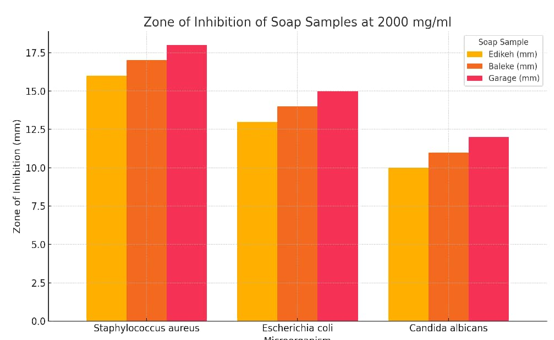
Antimicrobial resistance is a key global health challenge, particularly in developing regions where access to medicated hygiene products is limited. Locally produced black soap in Agbor, Delta State, Nigeria, holds cultural significance and is widely used for skin care. However, scientific evaluation of its antimicrobial efficacy and quality remains insufficient. Black soap samples were collected from three major markets in Agbor and tested for antimicrobial activity against Staphylococcus aureus, Candida albicans, and Escherichia coli using agar well diffusion, minimum inhibitory concentration, and minimum bactericidal concentration assays. Physicochemical properties including pH, total alkali, free fatty matter, and moisture content were also analyzed. Data were statistically evaluated to assess correlations between properties and antimicrobial effectiveness. All black soap samples showed antimicrobial activity, with greater inhibition observed against S. aureus and C. albicans compared to E. coli. The soaps exhibited alkaline pH and varied physicochemical parameters depending on source and formulation. Soaps with higher free fatty matter and moderate alkali content generally showed stronger antimicrobial effects, whereas excessive alkali could pose skin irritation risks. The study provides evidences, supporting the antimicrobial efficacy of locally produced black soap in Agbor. Variation in quality highlights the need for standardization to ensure consistent antimicrobial performance and consumer safety. These findings support the integration of indigenous hygiene products in public health strategies.
References
Akinmoladun, F. O., & Olaleye, T. M. (2013). Antimicrobial activity of local black soap on clinical isolates of bacteria. Journal of Microbiology and Antimicrobials, 5(2), 2–26.
Aliyu, G., Abdulrahman, M. B., & Suleiman, M. (2012). Analysis of the antibacterial activity of African black soap on some selected pathogens. ARPN Journal of Science and Technology, 2(2), 358–364.
Aliyu, M. S., Tijjani, M. B., Doko, M. H. I., Garba, I., Ibrahim, M. M., Abdulkadir, S. M., Abba, D., & Zango, U. U. (2012). Antimicrobial activity of Sabulun Salo, a local traditional medicated soap. Nigerian Journal of Basic and Applied Sciences, 20(1), 35–38.
Aneja, K. R. (2018). A textbook of basic and applied microbiology (7th ed.). New Age International Publishers.
AOAC International. (2019). Official methods of analysis of AOAC International (21st ed.).
Clinical and Laboratory Standards Institute. (2023). Performance standards for antifungal susceptibility testing of filamentous fungi (CLSI M38).
Clinical and Laboratory Standards Institute. (2023). Reference method for broth dilution antifungal susceptibility testing of filamentous fungi (CLSI Standard M38).
Eziuzo, K., Obinna, A., & Ogunlana, T. (2021). Analysis of antibacterial activity of different soaps on skin flora. Journal of Applied Life Sciences, 14(1), 25–30.
Hassan, F. U., Tukur, H. A., & Umar, M. A. (2022). Comparative analysis of local and commercial soaps sold in Nigerian markets. Nigerian Journal of Health and Environment, 8(2), 72–80.
Hudzicki, J. (2009). Kirby‑Bauer disk diffusion susceptibility test protocol. American Society for Microbiology.
Idoko, O., Emmanuel, S. A., Salau, A. A., & Obigwa, P. A. (2018). Quality assessment on some soaps sold in Nigeria. Nigerian Journal of Technology (NIJOTECH), 37(4), 1137–1140. https://doi.org/10.4314/njt.v37i4.37
Mahesar, S. A., Chohan, R., & Sherazi, S. T. H. (2019). Evaluation of physico‑chemical properties in selected branded soaps. Pakistan Journal of Analytical and Environmental Chemistry, 20(2), 177–183. https://doi.org/10.21743/pjaec/2019.12.22
Ogunbiyi, A., & Enechukwu, N. A. (2021). African black soap: Physiochemical, phytochemical properties, and uses. Dermatologic Therapy, 34(3), e14870.
Okoro, C. K., Okafor, M. I., & Iheanacho, C. C. (2020). Evaluation of the antimicrobial potential of natural herbal soaps. Journal of Microbiological Research, 10(3), 45–52. https://doi.org/10.12691/jmr‑10‑3‑1
Oyeleke, M. A., Sanni, A. I., & Oladele, J. O. (2023). Characterization and health assessment of pH and moisture content in local cosmetic products. African Journal of Public Health Research, 6(1), 12–18.
Prescott, L. M., Harley, J. P., & Klein, D. A. (2008). Microbiology (7th ed.). McGraw‑Hill.
Stevens, D. L., & Bryant, A. E. (2017). Severe skin and soft-tissue infections. New England Journal of Medicine, 376(23), 2253–2265. https://doi.org/10.1056/NEJMra1607771
Taylor, T. A., & Unakal, C. G. (2021). Staphylococcus aureus. In StatPearls. StatPearls Publishing. https://www.ncbi.nlm.nih.gov/books/NBK441868/
Downloads
Published
Issue
Section
Categories
License
Copyright (c) 2026 Pass Chijindu, Grandy Jaboro, Lucy Oshilonyah, Augustina Oyibe

This work is licensed under a Creative Commons Attribution 4.0 International License.