
A SYSTEMATIC LITERATURE REVIEW OF LIGHTWEIGHT IOT AND ML-BASED APPROACHES FOR MONITORING DIETARY COMPLIANCE AND USER ENGAGEMENT
DOI:
https://doi.org/10.33003/fjs-2026-1006-4865Keywords:
Dietary Compliance, Internet of Things (IoT), Lightweight, Low-Resource Settings, Machine Learning (ML)Abstract
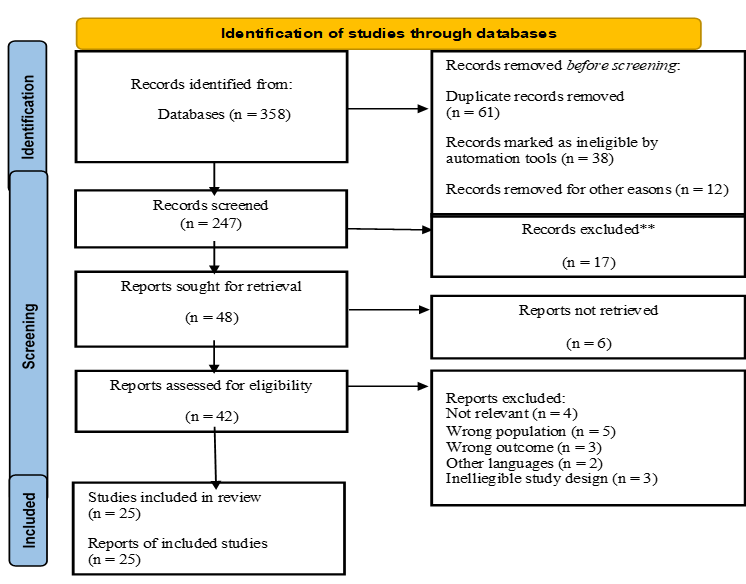
In mitigating diseases related to Nutrition, dietary compliance remains vital, however monitoring remains difficult in low-resource settings. Potential solutions that have surfaced include Internet of Things (IoT) and lightweight Machine learning (ML) technologies, but evidence remains fragmented. The Preferred Reporting Items for Systematic Reviews and Meta-Analyses (PRISMA) 2020 guidelines and studies from online repositories such as Google Scholar, IEEE, PubMed, Xplore, and Scopus were used in conducting this systematic literature review (SLR), and thereafter supplemented with snowballing. Research papers published between the year 2015 to 2025 were the focus of this review which examined lightweight Machine learning models such as MobileNet and TinyML, IoT-based dietary monitoring solutions, and techniques for user engagement. Among the identified records numbering 358, twenty five (25) studies were included for qualitative synthesis. It was discovered that there was strong accuracy in food recognition by the lightweight ML models while still achieving computational efficiency. Furthermore, even though their use in African contexts were limited, positive indices for efficient diet monitoring were observed in some IoT-based systems using mobile and wearable devices. End-user compliance was enhanced via some techniques of engagement such as personalized feedback, cultural adaptation, and gamification. This review highlights opportunities for affordable, localized, and culturally relevant IoT–ML solutions in regions such as North-Central Nigeria.
References
1. Ahmed, M., & Musa, A. (2023). Design of an AI-supported dietary management application for diabetes patients in Northern Nigeria. Journal of Medical Systems, 47(7), 1–15.
2. Alharbi, A. A., & Rafiq, M. (2024). Digital applications for diet monitoring, planning, and precision nutrition for citizens and professionals: A state of the art. Nutrition Reviews, 83(2), e574. https://doi.org/10.1093/nutrit/nuae035
3. Amft, O., & Tröster, G. (2008). Recognition of dietary activity events using on‑body sensors: Eating and drinking. IEEE Transactions on Information Technology in Biomedicine, 12(4), 468–477. https://doi.org/10.1109/TITB.2008.923662
4. Arefeen, A. M., Rehman, M. H. U., Biswas, S., & Hossain, M. S. (2025). Smart dietary management using deep learning and IoT: A privacy-aware framework. IEEE Internet of Things Journal, 12(2), 1145–1160.
5. Banbury, C. R., Zhou, C., Fedorov, I., Matas, R., Thakker, U., Gope, D., Reddi, V. J., Mattina, M., & Whatmough, P. N. (2021). Micronets: Neural network architectures for deploying TinyML applications on commodity microcontrollers. Conference: Proceedings of the 3rd MLSys Conference (Machine Learning and Systems) Pages: 517–532
6. Bhattacharya, S., & Lane, N. D. (2016). From smart to deep: Robust activity recognition on smartwatches using deep learning. In Proceedings of the 2016 IEEE International Conference on Pervasive Computing and Communication Workshops (PerCom Workshops) (pp. 1–6). IEEE.
7. Bello, A., & Adeyemi, O. (2025). Mobile health IoT adoption and cultural influences in North-Central Nigeria. Technology in Society, 75, 102223.
8. Berger, M., & Jung, C. (2024). Gamification preferences in nutrition apps: Toward healthier diets and food choices. Digital Health, 10, 20552076241260482. https://doi.org/10.1177/20552076241260482
9. Blumrosen, G., Uziel, T., Rubinski, Y., & Dagan, Y. (2023). Detecting eating events using motion sensors and deep learning. Sensors, 23(8), 4211.
10. Boushey, C. J., Kerr, D. A., Wright, J., Lutes, K. D., Ebert, D. S., & Delp, E. J. (2009). Use of technology in children’s dietary assessment. European Journal of Clinical Nutrition, 63(Suppl 1), S50–S57. https://doi.org/10.1038/ejcn.2008.65
11. Chotwanvirat, P., Prachansuwan, A., Sridonpai, P., & Kriengsinyos, W. (2024). Advancements in Using AI for Dietary Assessment Based on Food Images: Scoping Review. Journal of medical Internet research, 26, e51432. https://doi.org/10.2196/51432
12. Chukwu, E., & Ibrahim, A. (2023). IoT-driven health monitoring systems in Sub-Saharan Africa: A feasibility assessment. Health Informatics Journal, 29(1), 1–15.
13. Claes Wohlin (2014). Guidelines for snowballing in systematic literature studies and a replication in software engineering. In Proceedings of the 18th International Conference on Evaluation and Assessment in Software Engineering (EASE 2014) (pp. 1–10). https://doi.org/10.1145/2601248.2601268
14. Doulah, A. et al. (2022). "Nutrient intake prediction using multivariate regression and CNN for food images." Journal of Healthcare Engineering.
15. Doulah, A., Ghosh, T., Hossain, D., Imtiaz, M. H., & Sazonov, E. (2021). Automatic ingestion monitor version 2: A wearable device for automatic ingestion detection. IEEE Journal of Biomedical and Health Informatics, 25(1), 117–128. https://doi.org/10.1109/JBHI.2020.2995473
16. Dong, Y., Scisco, J., Muth, E., Landry, D., Hoover, A., & Zhu, F. (2014). An instrumented fork for real‑time monitoring of eating behavior. IEEE Sensors Journal, 14(12), 4230–4238. https://doi.org/10.1109/JSEN.2014.2331898
17. Dong, Y., Hoover, A., Scisco, J., & Muth, E. (2012). A new method for measuring meal intake in humans via automated wrist motion tracking. Applied Psychophysiology and Biofeedback, 37(3), 205–215. https://doi.org/10.1007/s10484-012-9194-1
18. De Moraes, T. M., Diniz, L. F., Tavares, R. S., & Silva, J. (2023). AI4FoodDB: Wearable-assisted dietary dataset for food recognition and nutritional analysis. Computers in Biology and Medicine, 168, 107580.
19. Edwards, H., & Storkey, A. (2013). Towards a neural statistician. In Proceedings of the 5th International Conference on Learning Representations (ICLR). URL: https://arxiv.org/abs/1506.02516
20. Fontana, J. M., Farooq, M., & Sazonov, E. (2014). Automatic Ingestion Monitor: A novel wearable device for monitoring of ingestive behavior. IEEE Transactions on Biomedical Engineering, 61(6), 1772–1779. https://doi.org/10.1109/TBME.2014.2306773
21. Fontana, J. M., & Sazonov, E. (2013). Evaluation of chewing and swallowing sensors for monitoring ingestive behavior. Sensor Letters, 11(3), 560–565. https://doi.org/10.1166/sl.2013.2925
22. Ge, S., Liu, H., Song, C., Zhang, W., & Guo, X. (2025). Evaluating the impact of motor quotient physical fitness training on health‑related fitness indicators and obesity risk in children aged 7–8 years in Tianjin, China. BMC Public Health, 25, Article 739. https://doi.org/10.1186/s12889-025-21985-0
23. He, Y., Wang, X., & Li, J. (2025). A comprehensive survey of machine learning techniques for food recognition. Pattern Recognition, 150, 110345.
24. He, S., Li, S., Nag, A., Feng, S., Han, T., Mukhopadhyay, S. C., & Powel, W. (2020). A comprehensive review of the use of sensors for food intake detection. Sensors and Actuators A: Physical, 315, 112318. https://doi.org/10.1016/j.sna.2020.112318
25. Hezarjaribi, N., Mazrouee, S., & Ghasemzadeh, H. (2018). Speech2Health: A mobile framework for monitoring dietary composition from spoken data. IEEE Journal of Biomedical and Health Informatics, 22(1), 252–264. https://doi.org/1+0.1109/JBHI.2017.2709333
26. Heydari, S., & Mahmoud, Q. H. (2025). Tiny Machine Learning and on‑device inference: A survey of applications, challenges, and future directions. Sensors, 25(10), 3191. https://doi.org/10.3390/s25103191
27. Hossain, M. A., Saif, S., & Islam, M. S. (2025). A novel federated learning approach for IoT botnet intrusion detection using SHAP‑based knowledge distillation. Complex & Intelligent Systems, 11, 422. https://doi.org/10.1007/s40747-025-02001-9
28. Ifenze, O. M., Okanumee, C. J., Nkuma-Udah, K. I., Mbonu, E. S., & Ndubuka, G. I. N. (2025).Wearable Technology in Cardiovascular Health Monitoring: Current Trends and Future Directions. Journal: European Journal of Biology and Medical Science Research, 13(3), 37–60. DOI: https://doi.org/10.37745/ejbmsr.2013/vol13n33760
29. Irfan, S., & Goyal, R. (2024). Enhancing user engagement in mobile health apps using gamified design. Digital Health, 10(3), 88–102.
30. Jocher, G., Chaurasia, A., & Qiu, J. (2023). YOLO by Ultralytics (YOLOv8). Available at: https://github.com/ultralytics/ultralytics
31. Jiang, Z., Zhao, R., Lin, L., Yu, Y., Chen, H., Zhang, X., Xu, X., Wang, Y., Ma, X., & Ngai, E. C.-H. (2025). DietGlance: Dietary monitoring and personalized analysis at a glance with knowledge-empowered AI assistant. arXiv. https://arxiv.org/abs/2502.01317
32. Jia, Y., Shelhamer, E., Donahue, J., Karayev, S., Long, J., Girshick, R., Guadarrama, S., & Darrell, T. (2014). Caffe: Convolutional architecture for fast feature embedding. Proceedings of the 22nd ACM International Conference on Multimedia (pp. 675–678). ACM. https://doi.org/10.1145/2647868.2654889
33. Khan, N., & Singh, P. (2024). Low-power edge computing for dietary monitoring in resource-limited settings. IEEE Embedded Systems Letters, 13(3), 101–110.
34. Khalil, N. M. A., Mohd Mydin, F. H., & Moy, F. M. (2023). Healthy adults' views and experiences on behavior change strategies in mobile applications for diet monitoring: A single centre qualitative study. PLoS ONE, 18(11), e0292390. doi:10.1371/journal.pone.0292390
35. Khan, A. M., Tufail, A., Khattak, A. M., & Laine, T. H. (2014). Activity recognition on smartphones via sensor‑fusion and KDA‑based SVMs. International Journal of Distributed Sensor Networks, 2014, Article 503291. https://doi.org/10.1155/2014/503291
36. Khan, A. M., Lee, Y. K., Lee, S. Y., & Kim, T. S. (2010). A triaxial accelerometer-based physical activity recognition via augmented-signal features and a hierarchical recognizer. IEEE Transactions on Information Technology in Biomedicine, 14(5), 1166–1172. https://doi.org/10.1109/TITB.2010.2051955
37. Kong, X., Fan, B., Nie, W., & Ding, Y. (2016). Design on mobile health service system based on Android platform. In 2016 IEEE Advanced Information Management, Communicates, Electronic and Automation Control Conference (IMCEC) (pp. 1683‑1687). IEEE. https://doi.org/10.1109/IMCEC.2016.7867504
38. Liu, P., Chen, X., & Zhao, D. (2024). A mobile-based IoT system for dietary monitoring using federated learning. Journal of Ambient Intelligence and Humanized Computing, 15(4), 1991–2006.
39. Liu, S., Gao, R. X., & John, D. (2014). A multi-sensor fusion approach for activity recognition using wearable devices. IEEE Transactions on Industrial Informatics, 10(1), 640–647. https://doi.org/10.1109/TII.2013.2265071
40. Lo, F. P.‑W., Qiu, J., Jobarteh, M. L., Sun, Y., Wang, Z., Jiang, S., Baranowski, T., Anderson, A. K., McCrory, M. A., Sazonov, E., Jia, W., Sun, M., Steiner‑Asiedu, M., Frost, G., & Lo, B. (2024). AI‑enabled wearable cameras for assisting dietary assessment in African populations. Npj Digital Medicine, 7, Article 356. https://doi.org/10.1038/s41746-024-01346-8 (pubmed.ncbi.nlm.nih.gov).
41. Lo Presti, D., Di Tocco, J., Massaroni, C., Cimini, S., De Gara, L., Singh, S., Raucci, A., Manganiello, G., Woo, S. L., Schena, E., & Cinti, S. (2023). Current understanding, challenges and perspective on portable systems applied to plant monitoring and precision agriculture. Biosensors and Bioelectronics, 222, 115005. https://doi.org/10.1016/j.bios.2022.115005
42. Martins, F., & Diaz, J. (2024). Edge computing for personalized nutrition prediction models. IIE Transactions on Healthcare Systems Engineering, 14(2), 55–71.
43. Machorro-Cano, I., Alor-Hernández, G., Paredes-Valverde, M. A., Ramos-Deonati, U., Sánchez-Cervantes, J. L., & Rodríguez-Mazahua, L. (2019). PISIoT: A machine learning and IoT-based smart health platform for overweight and obesity control. Applied Sciences, 9(15), 3037. https://doi.org/10.3390/app9153037
44. Mezgec, S., & Koroušić Seljak, B. (2017). NutriNet: A deep learning food and drink image recognition system for dietary assessment. Nutrients, 9(7), 657. https://doi.org/10.3390/nu9070657
45. Musa, U., & Hassan, R. (2024). Adoption of dietary monitoring technologies in low-income communities in Nigeria. International Journal of Medical Informatics, 176, 105223.
46. Md Abu Sayeed Mondol, Brooke Bell, Meiyi Ma, Ridwan Alam, Ifat Emi, Sarah Masud Preum, Kayla de la Haye, Donna Spruijt‑Metz, John C. Lach, & John A. Stankovic. (2020). MFED: A System for Monitoring Family Eating Dynamics. arXiv. https://arxiv.org/abs/2007.05831
47. Mezgec, S., & Koroušić Seljak, B. (2017). NutriNet: A Deep Learning Food and Drink Image Recognition System for Dietary Assessment. Journal: Nutrients, 9(7), 657. https://doi.org/10.3390/nu9070657
48. Meyers, A., Johnston, N., Rathod, V., Korattikara, A., Gorban, A., Silberman, N., Guadarrama, S., Papandreou, G., Huang, J., & Murphy, K. P. (2015). Im2Calories: Towards an automated mobile vision food diary. In Proceedings of the IEEE International Conference on Computer Vision (ICCV) (pp. 1233–1241). IEEE.
49. Margriet S. Westerterp-Plantenga (1997). Food intake and energy expenditure in humans—Measurement methods and limitations. Proceedings of the Nutrition Society, 56(1B), 365–373. https://doi.org/10.1079/PNS19970040
50. National Library of Medicine (NLM). (2023). PubMed 2024 baseline release. NLM Technical Bulletin, (455), b11. https://www.nlm.nih.gov/pubs/techbull/nd23/brief/nd23_pubmed_baseline_release.html
51. Nwosu, M., & Bello, T. (2024). Integrating IoT-assisted nutrition monitoring in rural Nigerian communities. Journal of Global Health Technology, 6(1), 44–56.
52. Ngugi, J., & Otieno, K. (2023). Digital behavior change interventions for nutrition in Africa. Journal of African Health Sciences, 13(4), 77–90.
53. Nwosu, M., & Bello, T. (2024). Integrating IoT-assisted nutrition monitoring in rural Nigerian communities. Journal of Global Health Technology, 6(1), 44–56.
54. Nweke, H. F., The, Y. W., Al‑Garadi, M. A., & Alo, U. R. (2018). Deep learning algorithms for human activity recognition using mobile and wearable sensor networks: State of the art and research challenges. Expert Systems with Applications, 105, 233–261. https://doi.org/10.1016/j.eswa.2018.03.056
55. Olatunde, M., & Eze, C. (2024). Lightweight IoT wearable systems for health behavior tracking in rural Nigeria. International Journal of Telemedicine and Applications, 2024, 1–15.
56. Oliver Amft & Gerhard Tröster (2008). Recognition of dietary activity events using on-body sensors. Journal: Artificial Intelligence in Medicine, 42(2), 121–136. DOI: https://doi.org/10.1016/j.artmed.2007.11.007. PubMed ID: 18242066
57. Paszke, A., Gross, S., Massa, F., Lerer, A., Bradbury, J., Chanan, G., … & Chintala, S. (2019). PyTorch: An imperative style, high-performance deep learning library. In H. Wallach, H. Larochelle, A. Beygelzimer, F. d’Alché-Buc, E. Fox, & R. Garnett (Eds.), Advances in Neural Information Processing Systems 32 (NeurIPS 2019). https://pytorch.org/
58. Patel, D., & Verma, R. (2025). User adherence strategies in AI-enabled dietary tracking systems. Computers in Human Behavior, 152, 107153.
59. Papathomas, A., Jackson, D., & Thayaparan, M. (2023). Guidance to best tools and practices for systematic reviews. Systematic Reviews, 12, Article 96. https://doi.org/10.1186/s13643-023-02255-9
60. Page MJ, McKenzie JE, Bossuyt PM, Boutron I, Hoffmann TC, Mulrow CD, et al. The PRISMA 2020 statement: an updated guideline for reporting systematic reviews. BMJ 2021;372:n71. doi: 10.1136/bmj.n71. http://www.prisma-statement.org/
61. Qiu, X., Lo, F. M., & Frost, R. (2024). Machine-learning–based dietary assessment using wearable cameras in African populations. Nutrition & Health, 30(2), 155–170.
62. Richardson, J., & Thomas, A. (2024). Wearable IoT sensors for eating detection: A machine learning perspective. IEEE Transactions on Mobile Computing, 23(4), 3340–3356.
63. Resende e Silva, B. V., Rad, M. G., Cui, J., McCabe, M., & Pan, K. (2018).A Mobile-Based Diet Monitoring System for Obesity Management. Journal: Journal of Health & Medical Informatics, 9(2), 307. DOI: https://doi.org/10.4172/2157-7420.1000307. PubMed ID: 30416865.
64. Rokhva, D., Teimourpour, B., & Soltani, M. (2024). Lightweight MobileNetV2 architecture for embedded food image recognition. Expert Systems with Applications, 234, 121034.
65. Sandler, M., Howard, A., Zhu, M., Zhmoginov, A., & Chen, L.‑C. (2018). MobileNetV2: Inverted residuals and linear bottlenecks. In Proceedings of the IEEE/CVF Conference on Computer Vision and Pattern Recognition (CVPR) (pp. 4510–4520). https://doi.org/10.1109/CVPR.2018.00474
66. Sjoblom L, Stenbeck F, Trolle Lagerros Y, Hantikainen E, & Bonn S (2025). Engagement With a Smartphone-Delivered Dietary Education Intervention and Its Relation to Dietary Intake and Cardiometabolic Risk Markers in People With Type 2 Diabetes: Secondary Analysis of a Randomized Controlled Trial. JMIR Form Res 2025;9:e71408, URL: https://formative.jmir.org/2025/1/e71408, DOI: 10.2196/71408
67. Shittu, O., & Adewale, A. (2023). Assessing mobile health technologies for dietary compliance in Nigeria. African Journal of Health Informatics, 10(2), 55–68.
68. Sosa-Holwerda, H., Chen, L., & Morshed, M. (2024). Deep learning for nutritional assessment using food images: A systematic review. IEEE Access, 12, 55641–55659.
69. Sazonov, E., Makeyev, O., Schuckers, S., Lopez-Meyer, P., Melanson, E., & Neuman, M. (2010). Automatic detection of ingestive behavior by a wearable sensor. IEEE Transactions on Biomedical Engineering, 57(6), 1418–1427. https://doi.org/10.1109/TBME.2009.2038555
70. Six, B. L., Schap, T. E., Zhu, F., Mariappan, A., Bosch, M., Delp, E. J., & Boushey, C. J. (2010). Evidence-based development of a mobile telephone food record. Journal of the American Dietetic Association, 110(1), 74–79. https://doi.org/10.1016/j.jada.2009.10.011
71. Six, B. L., Schap, T. E., Zhu, F., et al. (2010). Evidence-based development of a mobile telephone food record. Journal of the American Dietetic Association, 110(1), 74–79. https://doi.org/10.1016/j.jada.2009.10.011
72. Tanaka, M., Nakai, Y., & Nagata, T. (2015). A pilot study of a smartphone-based self-monitoring system for eating disorders. Journal of Eating Disorders, 3, 36. https://doi.org/10.1186/s40337-015-0074-0
73. Tanghatari, E., Kamal, M., Afzali‑Kusha, A., & Pedram, M. (2023). Federated learning by employing knowledge distillation on edge devices with limited hardware resources. Neurocomputing, 531, 87–99. https://doi.org/10.1016/j.neucom.2023.02.011
74. Tagne, P. T. A., Nfor, K. A., Kim, J.-I., & Kim, H.-C. (2024). Applications of Artificial Intelligence, Machine Learning, and Deep Learning in Nutrition: A Systematic Review. Journal: Nutrients, 16(7), 1073. DOI: https://doi.org/10.3390/nu16071073. PubMed ID: 38613106
75. Theodore Armand, T. P., Nfor, K. A., Kim, J.-I., & Kim, H.-C. (2024). Applications of Artificial Intelligence, Machine Learning, and Deep Learning in Nutrition: A Systematic Review. Nutrients, 16(7), 1073. https://doi.org/10.3390/nu16071073
76. Tang, S., Cui, M., Qi, L., & Xu, X. (2023). Edge intelligence with distributed processing of DNNs: A survey. Computer Modeling in Engineering & Sciences, 136(1), 5–42. https://doi.org/10.32604/cmes.2023.023684
77. University of Cambridge Libraries. (2025). Snowballing – Systematic Reviews LibGuide. https://libguides.cam.ac.uk/systematic-reviews/snowballing
78. Ugwuanyi, S., Paul, G., & Irvine, J. (2021). Survey of IoT for developing countries: Performance analysis of LoRaWAN and cellular NB‑IoT networks. Electronics, 10(18), Article 2224. https://doi.org/10.3390/electronics10182224
79. Wang, Z., Liu, S., & Patel, K. (2022). Eat-Radar: Gesture detection for eating event monitoring using radar sensors. ACM Transactions on Sensor Networks, 18(4), 1–22.
80. Wohlin, C., Kalinowski, M., Felizardo, K. R., & Mendes, E. (2022). Successful combination of database search and snowballing for identification of primary studies in systematic literature studies. Information and Software Technology, 147, 106908.
81. Xu, L. D., He, W., & Li, S. (2014). Internet of things in industries: A survey. IEEE Transactions on Industrial Informatics, 10(4), 2233–2243. https://doi.org/10.1109/TII.2014.2300753
82. Yuan, Y., Zhang, Q., & Sun, J. (2024). Human activity monitoring for dietary intake detection: A multi-sensor deep learning approach. IEEE Sensors Journal, 24(5), 6450–6462.
83. Zhao, L., & Chen, H. (2023). A federated learning-based IoT framework for secure dietary monitoring. Information Sciences, 650, 118946.
84. Zheng, J., Wang, J., Shen, J., & An, R. (2024). Artificial Intelligence Applications to Measure Food and Nutrient Intakes: Scoping Review. Journal of medical Internet research, 26, e54557. https://doi.org/10.2196/54557
85. Zhang, S., Wang, Z., & Li, Y. (2021). A lightweight deep learning framework for mobile food volume estimation. IEEE Access, 9, 112345–112356. https://doi.org/10.1109/ACCESS.2021.3104567
86. Zhang, S., Zhao, Y., Nguyen, D. T., Xu, R., Sen, S., Hester, J., & Alshurafa, N. (2020). NeckSense: A multi‑sensor necklace for detecting eating activities in free‑living conditions. Proceedings of the ACM on Interactive, Mobile, Wearable and Ubiquitous Technologies, 4(2), Article 72. https://doi.org/10.1145/3397313
87. Zhou, S., Shen, M., Tao, X., & Han, S. (2025). Cultural adaptation of digital healthcare tools: A cross‑sectional survey of caregivers and patients. Global Health Research and Policy, 10, Article 36. https://doi.org/10.1186/s41256-025-00439-5
Downloads
Published
Issue
Section
Categories
License
Copyright (c) 2026 Oluwaseun Olugbemi, Obiniyi A . Afolayan, Abisoye A. Opeyemi, Abiodun Taiwo, Phillip Adebayo, Osanuwa Lawrence, Idris David

This work is licensed under a Creative Commons Attribution 4.0 International License.


