
NUTRITIONAL AND MICROBIAL QUALITY OF HOME-MADE COMPOSITE BREAKFAST CEREALS PRODUCED IN ILARO OGUN STATE, NIGERIA
DOI:
https://doi.org/10.33003/fjs-2026-1006-4855Keywords:
Breakfast cereals, Date, Micronutrients, Microbial qualityAbstract
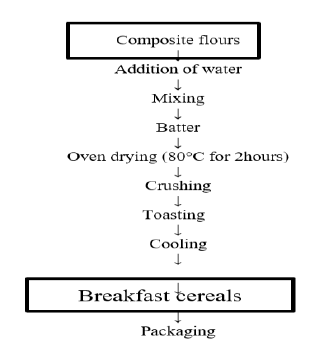
Breakfast cereals (BFCs) consumption is spreading and steadily replacing traditional diets due to its compositions and convenience for various consumers. This study assessed vitamins, minerals, anti-nutrients and microbial quality of BFCs produced from yellow maize, unripe plantain, soybeans and dates. These crops were processed into flours and formulated into blends of five samples at different percentages: Sample A-100% maize; Sample B-60:5:20:15; Sample C-55:10:20:15; Sample D-50:15:20:15 and Sample E-45:20:20:15. Flour blends were mixed, moist, lightly kneaded, oven dried at 80°C for 2 hours, crushed and lightly toasted. Vitamins, minerals, anti-nutrients and microbial contents of BFCs were determined using standard methods. Data were analyzed using SPSS version 20.0, with significance tested at a 5% probability level. Results revealed that Vitamins A (98.12- 121.64 µg/100g), B1 (0.17 – 0.21 mg/100), C (6.19 – 7.88 mg/100); iron (3.11 – 3.82 mg/100), zinc (0.62 – 0.79 mg/100) and potassium (701.08 - 781.44 mg/100) contents of BFCs significantly increased (P<0.05) with increasing addition of unripe plantain flour. The oxalate (0.61 – 0.67 mg/100), phytate (0.39 – 0.41 mg/100), tannin (0.12 – 0.13 mg/100), total bacterial count (0.25×10⁴ - 1.75×10⁴ CFU/g) total fungi count (0.00 – 0.50×10⁴ CFU/g) and total coliform count (0.10 to 0.30×10⁴ CFU/g) contents of BFCs were within recommended safe limits. This study demonstrates that supplementing yellow maize with unripe plantain flour in soybean-date-based BFCs can enhance the vitamins and minerals, yield low anti-nutrient and safe food products. Commercial breakfast cereal producers could incorporate unripe plantain flour, in maize-soybean-date blend for consumer healthier choice.
References
Abogunrin, T., & Ujiroghene, A. (2022). The significance of maize in breakfast cereal production. Journal of Cereal Science Research, 18(4), 112–125.
Achinkanu, C.S. , Eze-Steven, P.E., Ude, C.M. and Ugwuokolie, O.C. (2013). Determination of the Vitamin and Mineral Composition of Common Leafy Vegetables in South Eastern Nigeria. International Journal of Current Microbiology and Applied Sciences, 2(11), 347 – 353.
Ariviani, S., & Nastiti, A. S. (2024). Development of extruded breakfast cereals from mixed grains: A review. International Journal of Food Science and Technology. https://doi.org/10.1007/s12345-024-01234-5.
Ayanwale, A., Fatunbi, A., & Ojo, M. (2016). Innovation Opportunities in Plantain Production in Nigeria (Guidebook 1). Forum for Agricultural Research in Africa (FARA), Accra, Ghana.
Barber, D., Watson, M., & Drake, S. (2017). Nutritional evaluation of maize and its deficiencies. Cereal Foods World, 62(3), 123–130.
Dragana, D., Jane, T., & Ivana, M. (2015). Amino acid profiling of maize products: Addressing nutritional deficits. Journal of Grain Science, 21(3), 221–227.
Famakin, O., Fatoyinbo, A., Ijarotimi, O., Badejo, A., & Fagbemi, T. (2016). Assessment of nutritional quality, glycaemic index, antidiabetic, and sensory properties of plantain (Musa paradisiaca)-based functional dough meals. Journal of Food Science and Technology, 53(11), 3865–3875.
Fasuan, T. O., Ayodele, A. B., & Olaniyi, J. O. (2021). Extrusion processing of breakfast cereals from cereals and legumes: A review. Journal of Food Processing Technology, 8(5), 302–317.
Félix-Medina, J. V., Montes-Ávila, J., Reyes-Moreno, C., Perales-Sánchez, J. X. K., Gómez-Favela, M. A., Aguilar-Palazuelos, E., & Gutiérrez-Dorado, R. (2020). Second-generation snacks with high nutritional and antioxidant value produced by an optimized extrusion process from corn/common bean flours mixtures. Lwt, 124, 109172.
Honfo, F., Togbe, E., Ahohouendo, A., & Ahohouendo, B. (2020). Physical characteristics of some banana plantain cultivars (Musa spp.) consumed in Benin. Annals of the University of Parakou, Series Science and Nature, Agriculture, 10(2) 17–22.
ICMSF, 1996: International Commission on Microbiological Specifications for Foods. (1996). Microorganisms in foods 5: Characteristics of microbial pathogens. Published by Springer New York.
Lamptey, R., Velayoudom, F., Kake, A., Uloko, A., Rhedoor, A., Kibirige, D., Ndour Mbaye, N., Sobgnwi, E., & Kalra, S. (2019). Plantains: Gluco-friendly usage. Journal of Pakistan Medical Association, 69(10), 1565–1567.
Mbaeyi-Nwaoha, I. E., & Uchendu, N. O. (2016). Enhancing maize-based flakes with protein-rich accompaniments. Nigerian Food Journal, 34(2), 45–58.
MGF, 2014: Microbiological Guidelines for Food (2014). For ready-to-eat food in general and specific food items. Microbiological_Guidelines_for_Food_e.pdf. Accessed on 11/12/2025 at https://www.cfs.gov.hk/english/food_leg/files/food_leg
Nkiru, A. E., Obianuju, K., & Oladipo, T. (2019). Traditional and modern breakfast cereals in Nigeria: Patterns and trends. Journal of Food Consumption Studies, 10(1), 78–89.
Pillay, K., Derera, J., Siwela, M. and Veldman, F. J. (2011). Consumer acceptance of yellow, pro-vitamin A – bio-fortified maize in kwaZulu-Natal.” South African Journal of Clinical Nutrition, Vol. 24 (4), 186-191.
Sumczynski, D., Kowalczyk, K., & Słupski, J. (2023). Nutritional and functional properties of breakfast cereals: A review. Journal of Cereal Science, 102, 103485. https://doi.org/10.1016/j.jcs.2022.103485
Taak, K., & Awasthi, M. (2025). Plantain as a functional food: a comprehensive review of its nutritional and therapeutic attributes. Advances in Food Sciences, 47(1), 2-8.
Downloads
Published
Issue
Section
Categories
License
Copyright (c) 2026 Dr Adeosun F. Florence

This work is licensed under a Creative Commons Attribution 4.0 International License.


