SPATIAL RISK ASSESSMENT OF THIRD-PARTY INTERFERENCE ON PETROLEUM PIPELINES IN THE NIGER DELTA: A GIS-BASED SAFETY MANAGEMENT FRAMEWORK
DOI:
https://doi.org/10.33003/fjs-2026-1004-4824Keywords:
Spatial Risk assessment, Third-party interference, Petroleum pipeline, GIS-based safety management, Niger DeltaAbstract
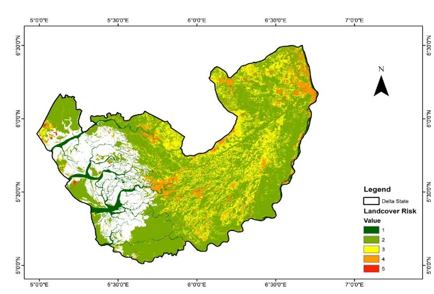
Third-party interference (TPI) is a threat to petroleum pipeline integrity in Nigeria’s Niger Delta, yet existing protection approaches are largely reactive and lack spatial predictive capability. This study develops a GIS-based Multi-Criteria Decision Analysis framework, integrating the Analytical Hierarchy Process, to assess and map the spatial variability of TPI risk along selected pipeline corridors. The analysis incorporates environmental, infrastructural, and socioeconomic factors, including land-use, population density, proximity to roads and waterways, and terrain characteristics. Results indicate that 22% of the pipeline corridor falls within high to very high-risk categories, with risk hotspots concentrated in areas characterized by high accessibility and dense human activity. Accessibility-related variables is 55% to the composite risk index, highlighting their dominant influence. Socioeconomic factors such as poverty and unemployment show spatial association with high-risk zones, their role appears complementary rather than primary. The findings demonstrate the utility of geospatial modelling in identifying spatial patterns of vulnerability and supporting targeted intervention strategies. The study provides a scalable decision-support tool for prioritizing surveillance, infrastructure protection, and community-based interventions. The study recommend the use of automated sensors, remote sensing, and routine field inspections, for pipeline segments classified as high and extremely high risk in the Spatial Risk Index. This study contributes to the growing application of GIS-MCDA approaches in infrastructure risk assessment and offers a foundation for more predictive and evidence-based pipeline security management in complex socio-environmental settings. The study concluded that TPI risk is spatially heterogeneous and strongly influenced by accessibility and human activity in the study area.
References
Adekola, O., Mitchell, G., Oduwaye, L. (2021). Oil spills, livelihoods and vulnerability in the Niger Delta. Environmental Science & Policy, 122, 30–39.
Adewumi, J. R., Salami, A. W., & Olatunji, O. A. (2022). Spatial assessment of oil pipeline incidents in Nigeria. Journal of Environmental Management, 305, 114357.
Adewumi, J. R., Agbasi, O. E., Etuk, S. E., & Robert, U. W. (2023). An industry perception and assessment of oil and gas pipeline third-party interference. Journal of International Environmental Application & Science, 18(1), 17–32.
Ahmed, J. Y., Umar, N. Y., Yahaya, I., Daki, M. M., & Musa, U. (2025). Geospatial techniques in Nigeria’s oil and gas sector: Applications and impacts. Fane-Fane International Multidisciplinary Journal, 9(2), 294–311
Anejionu, O. C. D., Blackburn, G. A., & Whyatt, J. D. (2023). Geospatial analysis of oil spills and pipeline interference in the Niger Delta. Applied Geography, 153, 102910.
Ebegbulem, J. C. (2021). Oil pipeline vandalism in the Niger Delta: Beyond the security lens. African Security Review, 30(3), 315-332.
Edoumiekumo, S. G. (2017). Regional development and oil-related economic dynamics in the Niger Delta region of Nigeria. International Journal of Social Sciences and Management Research, 3(2), 45–58
Eke, S. J., & Nwankwo, C. I. (2021). Pipeline vandalism and security challenges in Nigeria. Energy Policy, 156, 112443.
Kadafa, A. A. (2021). Environmental impacts of oil exploitation in the Niger Delta. Journal of Cleaner Production, 280,
Li, X., Zhang, Y., & Chen, Z. (2024). Spatial risk assessment of linear energy infrastructure. Reliability Engineering & System Safety, 242,
National Oil Spill Detection and Response Agency. (2021). National Oil Spill Monitor Report. National Oil Spill Detection and Response Agency.
Nigerian National Petroleum Corporation. (2022). Annual Statistical Bulletin. Nigerian National Petroleum Company Limited.
Obida, C. B., Blackburn, G. A., & Whyatt, J. D. (2020). Spatial drivers of oil pipeline vandalism. Applied Geography, 117, 102185.
Okoli, A. C. (2013). Oil theft and pipeline vandalism in Nigeria’s Niger Delta: The socio-economic and environmental implications. Journal of Energy Technologies and Policy, 3(4), 1–10
Onuoha, F. C., & Oyewole, S. (2022). Oil theft and insecurity in the Niger Delta. African Security Review, 31(2), 162–178.
Orinya, O. A. (2015). Pipeline vandalism and environmental degradation in the Niger Delta region of Nigeria. Journal of Environmental Science, Toxicology and Food Technology, 9(5), 1–8
Ozor, V. O., Erameh, A. A., & Aravie, G. O. (2025). Mitigating the effects of third-party interference on crude oil pipeline networks in South-South Nigeria using differential interferometric synthetic aperture radar analysis. Nigerian. Journal of Engineering Science Research, 8 (2), 57–70.
Saaty, T. L. (2008). Decision making with the analytic hierarchy process. International Journal of Services Sciences, 1(1), 83–98.
United Nations Development Programme. (2023). Nigeria Human Development Report. United Nations Development Programme.
United Nations Environment Programme {UNEP}. (2020). Environmental Assessment of Ogoniland. United Nations Environment Programme.
Yildirim, E., Gul, M., & Guneri, A. F. (2021). GIS-based infrastructure risk assessment. Safety Science, 141,
Downloads
Published
Issue
Section
Categories
License
Copyright (c) 2026 Saidu Hussaini, Ahmad Muhammad Aliyu, Musa Isa Muhammad, Zanuwa Mu’azu Audu

This work is licensed under a Creative Commons Attribution 4.0 International License.