
MULTIVARIATE ANALYSIS OF SECTORAL INFLUENCES ON HOUSEHOLD FOOD CONSUMPTION EXPENDITURE USING PRINCIPAL COMPONENT AND REGRESSION MODELING
DOI:
https://doi.org/10.33003/fjs-2026-1004-4805Keywords:
Household Consumption Expenditure, Principal Component Analysis, Food Security, Sectoral Interdependence, ModelingAbstract
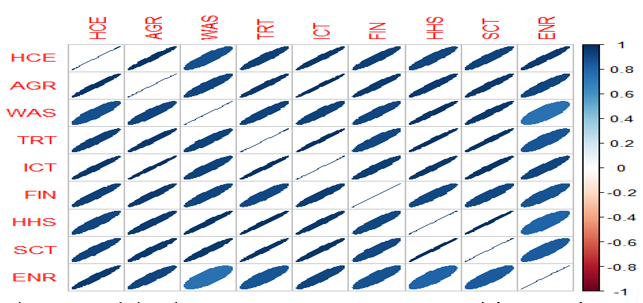
In this study, the principal component analysis (PCA) and multiple regression were adopted to examine the sectoral determinants of household food consumption expenditure (as proxy to food security) in Nigeria. Annual data from the Central Bank of Nigeria Statistical Bulletin spanning 1996 to 2021 were used. The results showed that the correlation analysis revealed strong positive relationships among the sectoral variables, implying the presence of multi-collinearity. The outcomes of PCA indicate that the first principal component (PC1) represents 93.58% of the total variance, whereas the second and third components are 3.96 and 1.56, and this fact confirms the fact that the data is characterized by only one underlying economic structure. The PCA loadings show that all sectors have a positive contribution to PC1 with average contribution of approximately 13%, which implies that sectors have a balanced and interconnected influence in household’s consumption. Nevertheless, the energy sector pushes the second major element by nearly 60%, which shows a structural role. The individuals plot also indicates three different clusters, showing the difference in time on sectoral performance. The regression findings demonstrate that the relationship between agriculture and household consumption expenditure is positive and statistically significant ( = 0.5886, p < 0.05) and water supply and ICT are not significant. The model describes 94.98% of the change in household consumption expenditure ( = 0.9498), which shows a great fit in the model. This result shows the sectoral interactions, especially agriculture, strongly influence household consumption, supporting policies that enhance welfare and food security.
References
Abolade, A. P., Lawal, I. O., Akanbi, K. L., & Salami, A. O. (2025). Unlocking the future of food security through access to finance for sustainable agribusiness performance. Management and Entrepreneurship: Trends of Development, 5(1), 45–60. doi:10.26661/2522-1566/2025-1/05
Adams, S. O., & Bamanga, M. A. (2018). Principal component analysis of Nigerian economy from 2006 – 2017. Journal of Statistical Studies, 12(2), 45–58.
Awe, F., Azeez, F. A., & Kabir, G. B. (2021). Determinants of food security status among rural households in Okunland of Kogi State, Nigeria. Journal of Agricultural Development Studies, 15(1), 78–90.
Bello, L. O. (2025). Rural non-agricultural employment and food security in Nigeria. Frontiers in Sustainable Food Systems, 9, 1691586. doi:10.3389/fsufs.2025.1691586
Bizimana, J., Karuaihe, S., Fitawek, W., & Jourdain, D. (2025). An empirical analysis of the determinants of food insecurity among smallholder farmers in Eastern Rwanda. Agriculture & Food Security, 14, 37.
Danmaigoro, A., & Gona, A. (2022). Determinants of food security status and coping strategies among rice farmers in Kebbi State, Nigeria. African Journal of Agricultural Economics, 8(3), 112–124.
Dardeer, M., & Shaheen, R. (2022). Structural determinants of food price inflation and food security implications: Evidence from GCC panel data. Economic Research Journal, 35(4), 567–589.
Habib, S. B. (2024). Determinants of food security among households in Kano State, Nigeria. International Journal of Agricultural Economics and Statistics, 10(5), 67 – 79.
Islam, B., Ibrahim, T., Wang, T., Wu, M., & Qin, J. (2025). Current trends in household food insecurity, dietary diversity, and stunting among children under five in Asia. Journal of Global Health.
Israel, K. E., & Charity, G. (2024). Food inflation and the Nigerian economy: An empirical investigation. International Journal of Research and Innovation in Social Science, 8(4), 1023–1035. doi:10.47772/IJRISS.2024.8041023
Jambor, A., & Elias, B. A. (2022). Determinants of food security across East, South, and Southeast Asia. Food Policy, 109, 102118.
Kegode, H., Karuaihe, S., Fitawek, W., & Jourdain, D. (2025). Determinants of food insecurity among smallholder farmers in Eastern Rwanda. Agriculture & Food Security.
Mafolasire, S., Mephors, J. O., Mbah, J. J., Henry, M. U., Mikaeel, F. H., Ayorinde, J. O., & Nnaji, A. H. (2023). Determinants of food price inflation in Nigeria: Evidence from PCA and ANOVA. Nigerian Journal of Economic Analysis, 9(1), 101 – 115.
Maisule, S. A., Fadiji, T. O., Barnabas, T. M., Aluko, O., & Sennuga, S. O. (2023). Insurgency and food security in Borno State, Nigeria. Journal of Rural Development Studies, 14(2), 34 – 49.
Omenka, L. C., Osabuohien, E. S., & Urhie, E. (2025). Climate dynamics and food security in Nigeria. Discover Sustainability, 6(1), 118. doi:10.1007/s43621-025-01518-w
Umeh, J. C., & Mensah-Bonsu, A. (2025). Infrastructure and food security in Nigeria. Review of Agricultural and Applied Economics, 28(1), 35–50. doi:10.15414/raae.2025.28.01.35-50
Vysochyna, A., Stoyanets, N., Mentel, G., & Olejarz, T. (2020). Environmental determinants of a country’s food security in short-term and long-term perspectives. Sustainability, 12(10), 4098.
Downloads
Published
Issue
Section
Categories
License
Copyright (c) 2026 Olugbenga Ojo, Omotola Oluwatobi; Oluwadamilola Ojenike

This work is licensed under a Creative Commons Attribution 4.0 International License.