
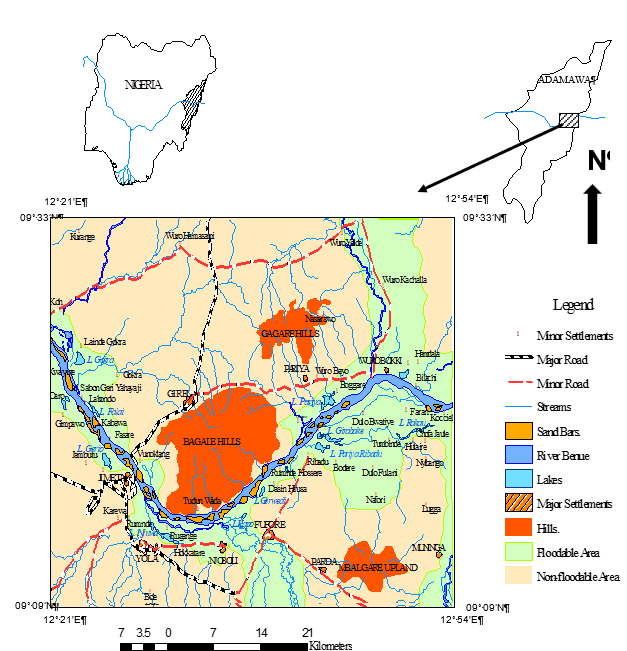
STUDY ON PHYSICOCHEMICAL PARAMETERS AND PLANKTON COMPOSITION OF LAKE RIBADU IN FUFORE LOCAL GOVERNMENT AREA OF ADAMAWA STATE, NIGERIA
DOI:
https://doi.org/10.33003/fjs-2026-1003-4774Keywords:
Physicochemical parameters, plankton composition, phytoplankton, zooplankton, water qualityAbstract
This study assessed the physicochemical parameters and plankton composition of Lake Ribadu in Fufore Local Government Area of Adamawa State, Nigeria, to determine the influence of water quality on plankton distribution and its abundance. Water samples were collected monthly from three sampling stations (A, B, and C) between July and December 2025. Physicochemical parameters including temperature, turbidity, conductivity, dissolved oxygen (DO), biochemical oxygen demand (BOD), pH, total dissolved solids (TDS), and ammonia were analyzed using standard laboratory procedures. Plankton samples were collected using a 55 µm mesh net, preserved with Lugol’s iodine solution, and identified microscopically using standard identification keys. The Data was analyzed using one-way analysis of variance (ANOVA) to determine spatial variations among stations. The Results showed that temperature ranged from 22.00 to 29.04°C, turbidity from 38.00 to 66.00 cm, conductivity from 100 to 159 µS/cm, and dissolved oxygen from 3.7 to 6.6 mg/L. The pH ranged from 6.53 to 7.80, BOD from 5.0 to 7.6 mg/L, TDS from 100.60 to 106.86 mg/L, and ammonia from 0.03 to 0.08 mg/L. A total of 21 phytoplankton species belonging to four taxa (Bacillariophyceae, Chlorophyceae, Myxophyceae, and Chrysophyceae) with a total abundance of 433,677 cells/L were recorded. Bacillariophyceae was the dominant group (37.8%), followed by Chlorophyceae (35.12%), Myxophyceae (25.82%), and Chrysophyceae (1.53%). Zooplankton comprised 21 species (125,416 individuals/L), with Copepoda being most abundant (38.18%). The findings indicate that water quality conditions were within acceptable limits and supported diverse plankton communities, with seasonal variations influencing their distribution and abundance patterns.
References
Abolude, D. S. (2007). Water Quality and Metal Concentrations in Sediments and Fish from Ahmadu Bello University Reservoir, Zaria, Nigeria, Ph.D. Thesis Ahmadu Bello University,Zaria.
Abolude, D. S., Davies, O. A., & Chia, A. M. (2012). Distribution and abundance of phytoplankton in relation to physicochemical conditions of water bodies. Journal of Environmental Biology, 33(2), 273–281.
Abubakar, M. M. (2014). Climatic influence on water temperature and aquatic productivity in arid zone reservoirs. Nigerian Journal of Fisheries, 11(2), 45–52.
Anago, I. J., Esenowo, I. K., & Ugwumba, A. A. A. (2011). The physico-chemical characteristics and plankton diversity of Awba Reservoir, Ibadan, Nigeria. Research Journal of Environmental and Earth Sciences, 3(1), 58–65.
Antakil, A., & Umaru, H. (2025). Seasonal variation of zooplankton as indicators of water quality in Kawo Dam, Niger State, Nigeria. African Journal of Aquatic Science, 50(1), 65–74.
Atobatele, O. E., & Ugwumba, A. A. A. (2008). Seasonal variation in the physicochemistry of a small tropical reservoir (Aiba Reservoir, Iwo, Nigeria). African Journal of Biotechnology, 7(12), 1962–1971.
Ayoade, A. A., Fagade, S. O., & Adebisi, A. A. (2006). Dynamics of limnological features and plankton populations in a tropical reservoir. African Journal of Biotechnology, 5(7), 601–608.
Charles, K. (2003). Freshwater ecology: Concepts and environmental applications. Academic Press.
Curtis, T. P., & Sloan, W. T. (2004). Prokaryotic diversity and its limits: Microbial community structure in natural environments. Nature Reviews Microbiology, 2, 719–726.
Dike, N. I., & Adedolapo, A. A. (2012). Seasonal dynamics of plankton abundance and diversity in a freshwater ecosystem in Nigeria. Journal of Aquatic Sciences, 27(1), 45–54.
Etuk, U. S., Ekpo, I. E., & Essien, N. B. (2023). Seasonal variation of biochemical oxygen demand and nutrient dynamics in Niger Delta rivers. Environmental Monitoring and Assessment, 195(3), 211–223.
FEPA (Federal Environmental Protection Agency). (1991). National guidelines and standards for water quality in Nigeria. Lagos: Federal Environmental Protection Agency.
Fusi, M., Bianchi, C. N., & Morri, C. (2023). Oxygen dynamics in aquatic ecosystems are under changing environmental conditions. Aquatic Sciences, 85(2), 112–125.
Idowu, E. O., Ugwumba, A. A. A., & Ugwumba, O. A. (2004). Physico-chemical studies of a tropical reservoir in relation to plankton productivity. Journal of Aquatic Sciences, 19(1), 1–9.
Ja’afaru, A. K., Ibrahim, S., & Mohammed, I. (2013). Physicochemical characteristics of Lake Alau, Borno State, Nigeria. International Journal of Fisheries and Aquatic Studies, 1(2), 30–35.
Jerling, H. L., & Wooldridge, T. H. (1995). Plankton distribution and abundance in estuarine ecosystems. Estuarine, Coastal and Shelf Science, 41, 145–160.
Jonah, S. O. (2025). Seasonal variation in physicochemical characteristics of Nigerian freshwater ecosystems. Nigerian Journal of Limnology, 18(1), 33–46.
Kiourt, C., Dimitriou, E., & Karaouzas, I. (2023). Conductivity classification and ecological implications in freshwater ecosystems. Water Research, 235, 119867.
Kolo, R. J., Oladimeji, A. A., & Umaru, H. (2010). Plankton diversity and abundance in a tropical reservoir in Northern Nigeria. Journal of Environmental Biology, 31(5), 787–794.
Kramer, K. J. M., & Botterweg, J. (1991). Aquatic biological monitoring of rivers and lakes. Hydrobiologia, 226, 141–148.
Lewis, W. M. (2000). Basis for the protection and management of tropical lakes. Ecological Applications, 10(1), 20–30.
McNeely, R. N., Neimanis, V. P., & Dwyer, L. (1979). Water quality sourcebook: A guide to water quality parameters. Ottawa: Inland Waters Directorate.
Mohammed, A. S., Ibrahim, S., & Abubakar, M. M. (2009). Plankton diversity and abundance in coastal waters of India and Nigeria. International Journal of Environmental Studies, 66(3), 345–356.
Mohammed, S. D., Abdullahi, M., & Sani, M. (2023). Environmental factors influencing zooplankton distribution in Lapai-Gwari stream, Niger State. Nigerian Journal of Aquatic Sciences, 38(1), 54–62.
Okere, O. O., Nwankwo, D. I., & Akin-Oriola, G. A. (2020). Seasonal variation of phytoplankton in Lagos Lagoon, Nigeria. African Journal of Aquatic Science, 45(2), 173–182.
Philips, D. J. H. (1985). Determination of ammonia in freshwater samples using the phenol-hypochlorite method. Water Research, 19(3), 341–345.
Singh, R., Kumar, P., & Sharma, V. (2025). Dissolved oxygen dynamics in freshwater ecosystems under climate variability. Environmental Research, 235, 117–128.
Ubani, C. N., Okafor, P. C., & Eze, J. N. (2024). Assessment of ammonia pollution in urban rivers of Enugu State, Nigeria. Environmental Monitoring and Assessment, 196(1), 102–115.
USEPA (United States Environmental Protection Agency). (2002). Methods for evaluating aquatic macroinvertebrates as indicators of water quality. Washington, DC: USEPA.
Wetzel, R. G. (1983). Limnology (2nd ed.). Philadelphia: Saunders College Publishing.
WHO (World Health Organization). (2006). Guidelines for drinking-water quality (3rd ed.). Geneva: World Health Organization.
Xu, Y., Zhang, L., & Chen, H. (2025). Seasonal dynamics of phytoplankton communities in tropical estuarine ecosystems. Marine Ecolo
Downloads
Published
Issue
Section
License
Copyright (c) 2026 Emmanuel Hassan Inuwa, Abasiryu Apagu, Bamaiyi Chaka, Mshelia B. Mbilari, Musa Mohammed, Ngati Filibus

This work is licensed under a Creative Commons Attribution 4.0 International License.


