
ENHANCEMENT OF THE PHYSICOCHEMICAL PROPERTIES OF BIDA CLAY THROUGH ADDITIVE MODIFICATION FOR INDUSTRIAL APPLICATIONS
DOI:
https://doi.org/10.33003/fjs-2026-1004-4763Keywords:
Bida Clay, Additive Modification, Physicochemical Properties, Industrial ApplicationsAbstract
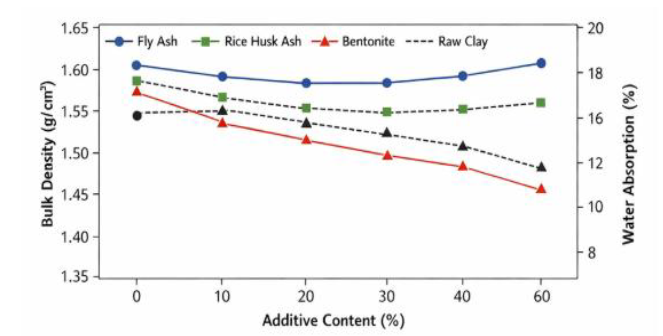
This study investigates the effect of additive modification on the physicochemical and thermal properties of Bida clay for enhanced engineering applications. Fly ash, rice husk ash (RHA), and bentonite were incorporated at 0–20 wt. % and evaluated using standard physicochemical tests, X-ray fluorescence (XRF), X-ray diffraction (XRD), scanning electron microscopy (SEM), and Fourier-transform infrared spectroscopy (FTIR). One-way ANOVA was used to assess statistical significance. Results showed that fly ash and RHA significantly improved clay performance. The plasticity index decreased from 32% in raw clay to 18% at 20 wt. % fly ash, while linear shrinkage reduced from 7.5% to 4.2%, indicating improved dimensional stability. Bulk density increased, and water absorption decreased, reflecting enhanced densification and reduced porosity. Thermal stability improved, with lower weight loss at 1000 °C, attributed to better sintering and formation of stable aluminosilicate phases. XRF analysis revealed increased SiO₂ and Al₂O₃ content, while XRD confirmed retention of primary clay minerals with minor formation of high-temperature phases. SEM images showed a transition from a porous to a dense microstructure, and FTIR indicated structural rearrangement within the aluminosilicate framework. ANOVA confirmed that all properties were significantly affected by additive content (p < 0.05), with fly ash and RHA at 15–20 wt. % showing the best performance, while bentonite had limited effectiveness. The findings demonstrate that modified Bida clay is suitable for structural, ceramic, and refractory applications, offering a sustainable approach to utilizing industrial and agricultural wastes.
References
Abdulrahman, S. M., Al Kindi, G. Y., & Ihsan, E. A. (2024). Sustainable stabilization of clay soil with rice husk ash. Journal of Engineering and Technology Sciences.
Ademola, K. O., & Akinwumi, I. I. (2020). Evaluation of agricultural waste ash as stabilizing additives for clay soils. Construction and Building Materials, 235, 117–126. https://doi.org/10.1016/j.conbuildmat.2019.117126
Adeoye, M. O., Akinola, A. F., & Yusuf, K. A. (2023). Assessment of clay modification using agricultural and industrial waste additives for sustainable ceramics. Materials Today: Proceedings, 72(3), 144–153. https://doi.org/10.1016/j.matpr.2023.01.011
Ajayi, B. O., & Hassan, A. M. (2021). Engineering properties of clay modified withindustrial waste materials. Journal of Materials in Civil Engineering, 33(7), 04021172. https://doi.org/10.1061/(ASCE)MT.1943-5533.0003740
Almuaythir, S., Zaini, M. S. I., Hasan, M., & Abdullah, M. (2025). Stabilization ofexpansive clay soil using shells based agricultural waste ash. Scientific Reports, 15, 10186. https://doi.org/10.1038/s41598-025-94980-5
ASTM D4318-17. (2017). Standard test methods for liquid limit, plastic limit, and plasticity index of soils. ASTM International.
ASTM C20-00. (2020). Standard test methods for apparent porosity, water absorption,apparent specific gravity, and bulk density of burned refractory brick. ASTM International.
Ayodele, A. L., Ajibola, I. K., & Fajobi, A. B. (2022). Impact of rice husk ash based geopolymer on geotechnical properties of tropical soils. Nigerian Journal of Technological Development, 19(3), 92–101.
Chen, Y., Zhang, Y., & Li, H. (2021). Mechanical and microstructural properties of clay stabilized with industrial by products. Construction and Building Materials, 287,123014. https://doi.org/10.1016/j.conbuildmat.2021.123014
Horpibulsuk, S., Rachan, R., Suddeepong, A., & Liu, M. D. (2020). Strength development in cement stabilized clay soils. Construction and Building Materials, 24(10), 2011–2021.
Noaman, M. F. (2022). A review on the effect of fly ash on the geotechnical properties of clay soils. Journal of Materials and Geotechnics.
Obafemi, A. A., Eludoyin, A. O., & Adeyemi, O. O. (2019). Influence of industrial byproducts on the stabilization of clay soils for engineering applications. International Journal of Geotechnical Engineering, 13(6), 543–551.
Ologunye, O. A., Akinlabi, E. T., & Adetunji, A. R. (2023). Evaluation of clay materialsfor structural and ceramic applications in Nigeria. Materials Today: Proceedings, 72, 144–153. https://doi.org/10.1016/j.matpr.2023.01.011
Olusola, E. O. (2023). Characterization and Industrial Applications of Wushishi Clay Deposit International Journal of Latest Technology in Engineering, Management& Applied Science IJLTEMAS vol.12 issue 12, December 2023, pp.37-44
Olusola E. O. & Ajao, M. O. (2024). Evaluation of Refractory Characteristics of Badeggi Clay with Varied Ratios of Graphite and Asbestos Additives. International Journal for Research Trends and Innovation, 9(7), 342–349.https://doi.org/10.5281/zenodo.12817789
Olusola, E.O. (2024). “Analyzing the Impact of Rice Husk on the Insulative Qualities of Badeggi Clay” International Journal of Novel Research and Development, 9(6), 352- 359
Onyia, T. M., & Idenyi, N. E. (2024). Effects of rice husk ash addition on the refractory properties of clay. Indian Journal of Agriculture Engineering (IJAE).
Phanikumar, B. R., & Nagaraju, V. (2018). Effect of fly ash and rice husk ash on index and engineering properties of expansive clays. Journal of Geotechnical and Geological Engineering.
Rinma, M. A., Abdullahi, M., & Mohammed, A. (2022). Physicochemicalcharacterization of clay deposits in North Central Nigeria for industrial applications. Nigerian Journal of Materials Science and Engineering, 13(1), 45-53.
Sultana, M. S. (2014). Influence of rice husk ash and fly ash on properties of red clay.Journal of Scientific Research, 6(2), 275–283.
Temitope, S. J., Joshua, A. G., Moyosiore, A. A., & Oluwasesan, O. T. (2025). Influenceof agro waste additives on the microstructural view, bulk density, apparentporosity and firing shrinkage properties of locally produced refractory bricks.International Journal of Research and Innovation in Applied Science, 10(4), 1286–1293. https://doi.org/10.51584/IJRIAS.2025.10040103
Ugwu, K. C., Nwoye, C. I., & Okafor, F. O. (2020). Assessment of clay modificationusing agricultural wastes for ceramic production. Ceramics International, 46(12), 19127–19134. https://doi.org/10.1016/j.ceramint.2020.04.219
Uthman, H. and Danjuma D. A. (2025). Development of Filler From Lokoja Bentonite Clay forApplication In The Production Of Plaster Of Paris (POP) FUDMA Journal of Sciences (FJS)9 ( 6), 1 – 9 DOI: https://doi.org/10.33003/f js-2025-0906-2979
Utilisation of Fly Ash and Rice Husk in Soil Stabilization. (2024). International Journal of Soil Improvement.
Wang, L., Li, Q., & Chen, J. (2020). Microstructural analysis of clay stabilized with industrial waste materials. Materials Research Express, 7(11), 115503.
William, T. E., Alege, T. S., Jimoh, A. O. and Musa, O. K. (2024). GeotechnicalAssessment of Residual Clay in Zariagi, Lokoja, North-Central Nigeria:Implication for Industrial Applications. FUDMA Journal of Sciences (FJS) 8(5), 17 – 24 DOI: https://doi.org/10.33003/fjs-2024-0805
Yusuf, K. A., Adeoye, M. O., & Akinola, A. F. (2023). Characterization of clay materials for sustainable construction applications. Materials Today: Proceedings, 72, 154.161. https://doi.org/10.1016/j.matpr.2023.01.015
Zaini, M. S. I., Hasan, M., Almuaythir, S., & Abdullah, M. (2024). Stabilization ofexpansive clay soil using agricultural waste ash. Scientific Reports, 14, 10186.https://doi.org/10.1038/s41598-024-61854-1
Zhang, Y., Li, H., & Wang, J. (2021). Mechanical performance of clay stabilized withindustrial waste materials. Construction and Building Materials, 287, 123014.
Zündüz, Z. G., Dağdeviren, U., & Avsar, E. (2020). Influence of additives on theplasticity properties of clayey soils. Selçuk University Journal of EngineeringSciences, 19(2), 95–103.
Downloads
Published
Issue
Section
Categories
License
Copyright (c) 2026 Emmanuel Omowumi Olusola

This work is licensed under a Creative Commons Attribution 4.0 International License.


