
EXAMINATION OF FINGERNAIL CONTENTS FOR THE PRESENCE OF OVA/CYSTS OF INTESTINAL PARASITES FROM PUPILS ATTENDING PLATEAU STATE POLYTECHNIC BARKIN LADI HEIPANG CAMPUS STAFF PRIMARY SCHOOL
DOI:
https://doi.org/10.33003/fjs-2026-1003-4722Keywords:
Parasite, Cyst/ova, Finger Nails, Pupil, SoilAbstract
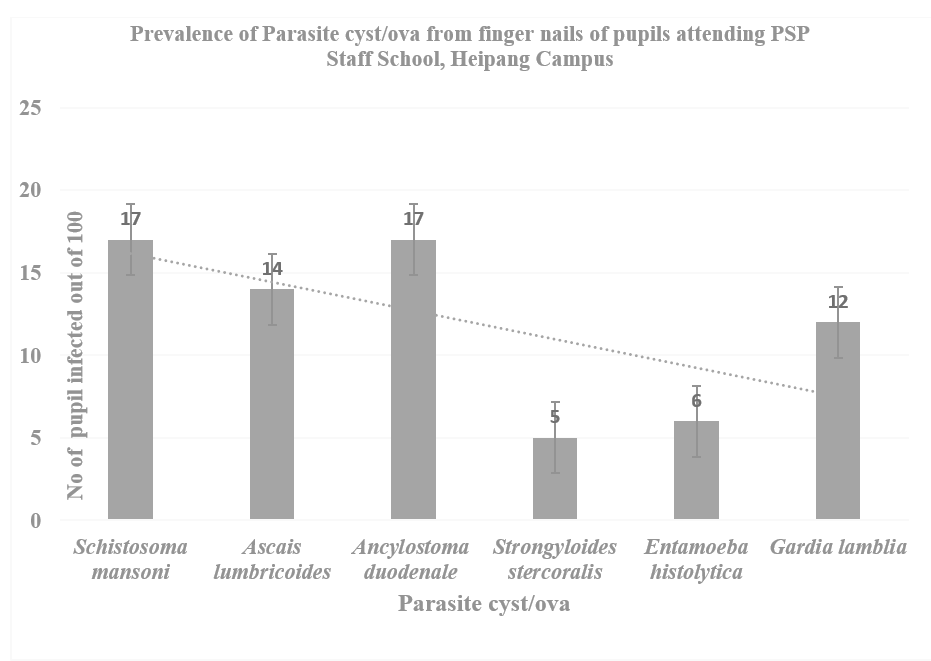
Intestinal parasitic infections among primary school-age children in developing countries, including Nigeria, are an escalating public health issue. These parasites, often transmitted via the oral-faecal route, are a leading cause of diarrhoea. This study focused on examining the fingernail contents of students at Plateau State Polytechnic (PSP) Staff School in Heipang, Barkin Ladi, Plateau State, Nigeria. A total of 100 fingernail samples were analyzed microscopically for the presence of parasite ova/cysts. The investigation revealed that 71% of the pupils harboured at least one type of parasite cyst/ova, resulting in a 98.69% prevalence rate. The most commonly detected parasites were Schistosoma mansoni and Ancylostoma duodenale, each found in 17% of the samples. This was followed by Ascaris lumbricoides, detected in 14% of the cases. Gender analysis showed that 78% of male children tested positive for various parasite cysts/ova, while 64% of female pupils were affected. Age-related analysis indicated that children aged 11-15 had an 80% prevalence rate, those aged 1-5 had a 66.67% prevalence, and children aged 6-10 had a 64.30% prevalence rate. The presence of fingernail parasites in primary school children can lead to chronic infections, negatively impacting their health, nutrition, cognitive development, and educational success. Regular cleaning and trimming of fingernails, along with consistent hand hygiene practices, are essential measures to reduce the risk of parasitic transmission among primary school pupils.
References
Centers for Disease Control and Prevention, Nail Hygiene. (2020). Available from https://www.cdc.gov/healthywater/hygiene/hand/nail_hygiene.html. Accessed: Dec 7, 2024.
Chirdan, O. O., Akosu, J. T. & Adah, S. O. (2010). Intestinal Parasites in Children Attending Day Care Centers in Jos, Central Nigeria. Nign Jnl of Med, 19: 2,219-222.
Gupta, R., Binod, R., Samendra, P., Sherchan, G. R., Reena, K. M., Binod, K. & Shiba, K. R. (2020). Prevalence of intestinal parasitosis and associated risk factors among school
Children of Saptari district, Nepal: a cross sectional. Tropical Medicine and Health, 48:73, 2-9 https://doi.org/10.1186/s41182-020-00261-4.
Hosea, Z.Y., Liamngee, K. & Oga, O. P. (2019). Prevalence of Intestinal Parasitic Helminths from the Fingernails of Primary School Pupils in Makurdi Benue State. Asian Journal of Research in Zoology, 2:4, 1-6.
Jameel, A. Y., Issa, A. R., Amidy, K. S., Mero, W. M. S., Sabri, M. A., & Khdihir, M. A. (2017). Prevalence of Intestinal Parasites under Fingernails of Primary School Children in Zakho, Kurdistan Region. Sc. Jnl of University of Zakho, 5:1, 25–27.
Khanna, V. Alur, S., Khanna, R. & Verma, S. (2024). A Comprehensive Review and Analysis of Intestinal Parasitic Infections in School Children from South India. Archives of Medicine and Health Sciences. DOI: 10.4103/amhs.amhs_125_23.
Klohe, K., Koudou. B.G., Fenwick, A., Fleming, F., Garba, A., Gouvras, A. (2021). A systematic literature review of schistosomiasis in urban and peri-urban settings. PLoS Negl Trop Dis 15:2, 1-19. e0008995. https://doi.org/10.1371/journal. pntd.0008995.
Mahmud, A. M., Mark, Sp., Afework, M. B., Geert‑Jan, D. & Roman, B. V. (2020). Associations between intestinal parasitic infections, anaemia, and diarrhoea
Among School aged Children, and the impact of hand‑washing and nail clipping. BMC Res Notes13:1, 1-6.
Michael E, Abah A, Marcus P. (2017) Intestinal parasite infection among primary school children in Port-Harcourt City Local Government Area of Nigeria: A review for school- based intervention. Adv.-Tech Clin Microbiol.; 1:4, 19-28.
Mengist, A., Aschale, Y. & Reta, A. (2018). Bacterial and Parasitic Assessment from Fingernails in Debre Markos, Northwest Ethiopia. Canadian Jnl of Inf Diseases and Med Microbio.1; 1, 1-2.
Tadesse, M, Dobo, B. & Birmeka, M. (2019). Prevalence and associated risk factors of intestinal parasitic infections among school children in Bamo no. 2 primary school, Adele town, East Arsi, Ethiopia. Sub-Saharan Afr J Med; 6:77-85.
Yadav, S. N. & Mahato, S. (2017). Study on intestinal helminth parasites in school children of Rangeli Municipality of Morang District in Eastern Nepal. Am J Health Res.; 5:2, 50–3.
Yahaya, J. & Tuku, Z. (2017). Incidence of Intestinal Parasites under the Fingernails of Pupils in some Selected Primary Schools in Katsina Metropolis. Dutse Jnl of Pure and Appld Scs (DUJOPAS). 3, 1.272-278.
WHO (2022). Prevention and control of intestinal parasitic infections: WHO Technical Report Series NO 749.
Wu, A. G. & Lipner, S. R. A. (2020). Potential hidden reservoir: The role of nail hygiene in preventing transmission of COVID-19. J Am Acad Dermatol. 83:3, 45-46.
Downloads
Published
Issue
Section
Categories
License
Copyright (c) 2026 George Dasat Shwamyil, Kum Folakemi Olusola, Maryam Garba

This work is licensed under a Creative Commons Attribution 4.0 International License.