
A COORDINATED, NETWORK-AWARE GUARD CHANNEL SCHEME WITH INTER-CELL COMMUNICATION
DOI:
https://doi.org/10.33003/fjs-2026-1004-4649Keywords:
Guard Channel Scheme, Handoff Management, Inter-Cell Communication, Resource Allocation, Quality of Service (QoS)Abstract
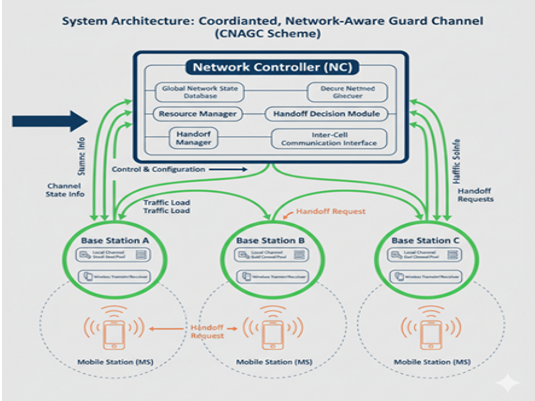
The bane of traditional guard channel schemes is its reliance on static allocation which makes it lack broader network awareness. This has resulted to improper utilization of available spectrum and increase in call-dropping rates in unstable traffic conditions. This paper suggests the Coordinated, Network-Aware Guard Channel (CNAGC) scheme. In the methodology, a centralized Network Controller (NC) is integrated with real-time inter-cell communication links. A mathematical model and an optimization algorithm were developed to dynamically adjust guard channel thresholds based on a Global Network State Database, predicted mobility patterns, and neighbouring cell loads. Contrary to conventional strategies, the CNAGC scheme does not prevent neighbouring cells from accepting handoffs when local resources have been used up because it allows base stations to coordinate directly. It was discovered from simulation results that the CNAGC scheme has the best performance when compared with traditional Fixed Guard Channel (FGC) and local Dynamic Guard Channel (DGC) schemes. The handoff dropping probability for CNAGC is 2.5%, compared to 6.8% and 5.5% for FGC and DGC respectively during handoff heavy scenarios. Also, the scheme has the least new call blocking rate of 4.8% and the best channel utilization of 82% compared to 75% utilization of the traditional fixed models. In dense cellular environments, the CNAGC scheme offers a versatile approach for managing resources. The suitability of the scheme for next-generation wireless networks is enhanced by its ability to capitalize on global network intelligence and local inter-cell coordination which brings about optimum spectrum efficiency and a seamless user experience.
References
[1] Kanaga, S. R. and Bamila, V. L. (2021). A review of call admission control schemes in wireless cellular networks. Wireless Personal Communications. 120(2021): 3369-3388.
[2] Fauzia, I, Mudassar, A., Zubdah, M., Farhan, Q, and Joel J. P. C. (2020). Coordinated multi-point transmission in 5G and Beyond Heterogeneous Networks. In the Proceedings of 2020 IEEE 23rd International Multitopic Conference (INMIC), Bahawalpur, Pakistan, pp. 1-6, doi: 10.1109/INMIC50486.2020.9318091.
[3] Itoro, J. A., Simeon, O. and Constance, K. (2020). Development Of a Guard Channel-Based Prioritized Handoff Scheme with Channel Borrowing Mechanism for Cellular Networks. Journal of Multidisciplinary Engineering Science and Technology. 7(2): 11624–11634. http://www.jmest.org/wp-content/uploads/july2020/JMESTN42353758.pdf.
[4] Solomon, O. Y., Abdulhakeem, A., Maniru, M. U., Aminu, M., and Zaharadeen, Y. Y. (2019). A Survey on Call Admission Control Schemes in LTE. International Journal of Computer Science & Engineering Survey 10(5): 1-12. DOI: 10.5121/ijcses.2019.10501.
[5] Mahmoud, M., Ashraf, D.E, Gamal, M.A.H., and Amr, M. A. (2020) Dynamic Channel Allocation Scheme for Handover Calls in Cellular Networks. In the Proceedings of 2020 3rd International Conference on Information and Computer Technologies (ICICT), pp:457–461. DOI: 10.1109/ICICT50521.2020.00079
[6] Ojesanmi, O.A., Lawal, O.A., Ibharalu, F.T. and Adejumobi, I.A. (2021). The Performance Evaluation of Adaptive Guard Channel Scheme in Wireless Network. Nigerian Journal of Technology (NIJOTECH), 40(1):109-114.
[7] Yingjie, W. (2024). Enhancing Urban Traffic Flow Through Fuzzy Logic-Based Signal Light Control Optimization. International Journal of e-Collaboration. 20(1):1-13. DOI: 10.4018/IJeC.358746
[8] Zeina, A., Ola, Z., and Abdel-Mehsen, A. (2025). Cross-Layer Security for 5G/6G Network Slices: An SDN, NFV, and AI-Based Hybrid Framework. Sensors. 25(3335):1-20 https://doi.org/10.3390/s25113335
[9] Siddiqui, M. U. A., Qamar, F., Ahmed, F., Nguyen, Q. N., & Hassan, R. (2021). Interference management in 5G and beyond network: Requirements, challenges and future directions. IEEE Access, 9, 68932–68965. https://doi.org/10.1109/ACCESS.2021.3073543
[10] Liaq, M., Sharif, S., Zeadally, S., & Ejaz, W. (2025). Utilization of machine learning in future wireless networks for resource optimization: A survey. Ad Hoc Networks, 178, Article 103983. https://doi.org/10.1016/j.adhoc.2024.103983
[11] Wang, J., Mu, W., Liu, Y., Guo, L., Zhang, S., & Gui, G. (2021). Deep reinforcement learning-based satellite handover scheme for satellite communications. 2021 13th International Conference on Wireless Communications and Signal Processing (WCSP), 1–6. https://doi.org/10.1109/WCSP52459.2021.9613583
[12] Poongodi, C., Deepa, D. and Muthumanickam, D. (2021). Coordinated Multipoint Transmission and Reception in Downlink and Uplink LTE Systems. doi:10.1088/1757-899X/1084/1/012128
[13] Saoud, B., Shayea, I., Alnakhli, M. A., & Mohamad, H. (2025). Mobility and handover management in 5G/6G networks: Challenges, innovations, and sustainable solutions. Technologies, 13(8), 352. https://doi.org/10.3390/technologies13080352
[14] Yasir, U, Mardeni, R., Sufian, M.M., Muhammad, S., Farman, A, Khursheed, A.,
Downloads
Published
Issue
Section
Categories
License
Copyright (c) 2026 Oyedele Oluwasanya; Emmanuel Akinola Kayode, Ayodele Aina Daniel

This work is licensed under a Creative Commons Attribution 4.0 International License.


