
COMPARATIVE ANALYSIS OF PROFITABILITY OF PARTICIPATING AND NON-PARTICIPATING RAINFED RICE FARMERS IN THE ANCHOR BORROWERS’ PROGRAMME IN SELECTED LGAS OF KADUNA STATE, NIGERIA
DOI:
https://doi.org/10.33003/fjs-2026-1004-4628Keywords:
Anchor Borrowers’ Programme, Production, Profitability, Rice, Rainfed Rice, Smallholder FarmersAbstract
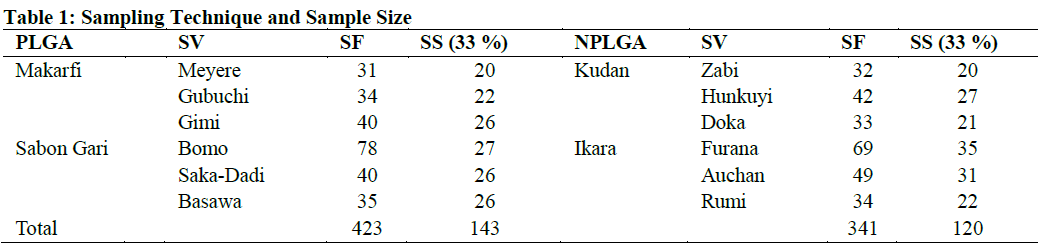
Rice remains a critical staple food in Nigeria, supporting both national food security and rural livelihoods. Despite its importance, productivity among smallholder rice farmers remains low, primarily due to limited access to improved inputs, credit, and extension services. To address these challenges, the Anchor Borrowers’ Programme (ABP) was introduced in Kaduna State in 2017. This study assessed the profitability of rainfed rice farmers who participated in the ABP compared to non-participants. A total of 263 farmers (143 participants and 120 non-participants) were selected using a multistage sampling technique across four Local Government Areas in Kaduna State. Primary data were collected using structured questionnaires and analyzed using descriptive statistics, gross margin analysis, and t-tests. Findings revealed significant differences in age, household size, farming experience, education level, and cooperative membership between the two groups. ABP participants recorded higher mean yields (3174.1 kg/ha), lower production costs (₦210,400/ha), and significantly greater gross margins (₦1,440,132) compared to non-participants. Return on investment was also higher for participants (6.84) than for non-participants (3.27), indicating enhanced profitability due to ABP support. Key constraints identified include inadequate access to capital, poor credit facilities, weak extension service delivery, and infrastructural challenges such as transportation and storage facilities. The study concludes that participation in the ABP has a positive impact on productivity and profitability. It recommends scaling up the program to include more farmers, improving access to credit, strengthening cooperatives, and enhancing extension services to sustain growth in rice production.
References
Ahmed, B., Echekwu, C. A., Mohammed, S. G., Ojiewo, C., Ajeigbe, H., Vabi, M. B., Affognon, H., Lokossou, J. and Nwahia, O. C. (2020). Analysis of Adoption of Improved Groundnut Varieties in the Tropical Legume Project (TL III) States in Nigeria. Agricultural Sciences, 11:143-156.
Biswas, S., Ali, M. S., Setu, M. W. A., Sikder, S. and Nure-Alam, S. M. (2020). Adoption of Bari Groundnut Varieties by the Farmers of Faridpur District. Direct Research Journal of Agriculture and food science, 8(11):417-423.
Bitrus, A., Yakubu, H., Patrick, T. and Stephen, S. F. (2021). Economics of Rice Production among Beneficiaries of Anchor Borrowers Programme in Gerie Local Government Area of Adamawa State, Nigeria. Asian Journal of Agricultural Extension, Economics and Sociology, 39(1):82-95.
Food and Agricultural Organisation of the United Nations, Statistics Division/FAOSTAT (2021). Retrieved May 13, 2021 from http://www.fao.org/faostat/en/#data/QC
John, K. S., & Balogun, B. I. (2025). Assessment on the Challenges of Zaria Local Government Farmers on Agricultural Information Use and Practices for Sustainable Development in Kaduna State.
Kaka, Y., Gindi, A. A. and Khalid, A. B. (2020). Towards Rice Self-sufficiency in Nigeria: An Analysis of Technical Efficiency of Irrigated Rice Farms in Kebbi State, Direct Research Journal of Agriculture and Food Science, 8(4):103-110.
National Agricultural Extension and Research Liaison Services (2020). Agricultural Performance Survey Report of 2020 Wet Season in Nigeria, NAERLS, Ahmadu Bello University Zaria Press.
National Population Commission/NPC (2006). Human Population Figures of 2006 Census in Nigeria
Obianefo, C. A., Ng’ombe, J. N., Mzyece, A., Masasi, B., Obiekwe, N. J., Anumudu, O. O. (2021). Technical Efficiency and Technological Gaps of Rice Production in Anambra State, Nigeria. Agriculture science, 11:1-13.
Subedi, S., Ghimire, Y. N., Kharel, M., Sharma, B., Shrestha and Sapkota (2020). Profitability and Resource Use Efficiency of Rice Production in Jhapa District of Nepal. International Journal of Social Science and Management, 7(4):1-15.
Tsado J. H., Ojo M. A. and Ajayi O. J. (2014). Impact of Training the Trainers’ Programme on Rice Farmers’ Income and Welfare in North Central, Nigeria Journal of Advanced Agricultural Technologies, 1(2):157-160
United States Department of Agriculture, Foreign Agricultural Service (2018): World Agricultural Production. Circular Series, 4-18.
Downloads
Published
Issue
Section
Categories
License
Copyright (c) 2026 Aliyu Magaji Abdullahi, Auwalu Shu’aibu Abdullah, Maryam Bala Adamu, Suleiman Suleiman, Nazifi Rabiu

This work is licensed under a Creative Commons Attribution 4.0 International License.


