
PREVALENCE OF GASTROINTESTINAL PARASITES IN STRAW-COLORED FRUIT BATS IN MAKURDI, BENUE STATE NIGERIA
DOI:
https://doi.org/10.33003/fjs-2026-1003-4627Keywords:
Fruit Bats, Gastrointestinal, Parasites, Prevalence, MakurdiAbstract
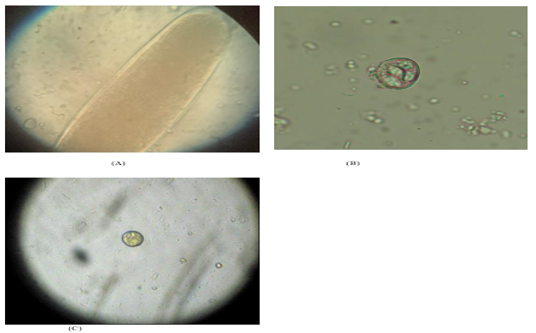
Fruit bats often referred to as flying foxes belonging to the family Pteropodidae, are ecologically significant mammals that play vital roles in pollination, seed dispersal, and maintaining ecosystem balance. Gastrointestinal parasites are organisms that live inside the digestive system of their host and feed on nutrients meant for the host. The presence of gastrointestinal parasite of fruit bat is profound and infected bats may exhibit reduced foraging activity and altered movement patterns. This research investigates the presence of gastrointestinal parasites in fruit bats within Makurdi metropolis; it aims to elucidate potential public health risks and implications in relation to fruit bat species. To achieve this, 449 fecal samples were obtained from bat roost sites in Makurdi. Fecal flotation and sedimentation techniques were carried out to check for the presence of gastrointestinal parasite ova and oocytes. The results showed a prevalence of 3.79% of gastrointestinal parasites circulating in fruit bat species in Makurdi. Three parasite types were identified: Eimeria spp, Strongyle-type nematodes, and Cryptosporidium spp. From this study, the prevalence obtained indicates that fruit bats in Makurdi metropolis are infected with gastrointestinal parasites, though with a low parasitic burden. However, the detection of Cryptosporidium spp, a known zoonotic organism, underscores the potential risk of disease transmission especially in areas where close human contact occurs. The findings from this study provide useful baseline data on the gastrointestinal parasites of fruit bat species in Makurdi and emphasize the importance of continued surveillance and public health awareness to mitigate potential public health threats.
References
Adhikari, R., Maharjan, M., and Ghimire, T. (2020). Prevalence of Gastrointestinal Parasites in the Frugivorous and the Insectivorous Bats in Southcentral Nepal. Journal of Parasitology Research, 2020. https://doi.org/10.1155/2020/8880033.
Afonso, E., Baurand, P. E., Tournant, P., and Capelli, N. (2014). First amplification of Eimeria hessei DNA from the lesser horseshoe bat (Rhinolophus hipposideros) and its phylogenetic relationships with Eimeria species from other bats and rodents. Experimental Parasitology, 139, 58–62.
Aliyu A. A., Sesugh, G. K., Ayuba, S. O., Ashigar, M. A., Ombugadu, A., Ahmed, H. O., Aimankhu, O. P., Maikenti, J. I., Odey, S. A., Ezuluebo, V. C., Dogo, K. S., and Idris, A. M. (2025). Ecto and endoparasites of bats in selected areas of Lafia Metropolis, Nasarawa State, Nigeria. FUDMA Journal of Sciences, 9(7), 96–101. https://doi.org/10.33003/fjs-2025-0907-3517
Ameh, V. O., Chirima, G. J., Quan, M., and Sabeta, C. (2022). Public health awareness on bat rabies among bat handlers and persons residing near bat roosts in Makurdi, Nigeria. Pathogens, 11(9), 975. https://doi.org/10.3390/pathogens11090975
American Society of Mammalogists. (2019). Mammal Diversity Database: Taxon summary statistics. https://mammaldiversity.org/summary
Anderson, S., and Ruxton, G. (2020). The evolution of flight in bats: a novel hypothesis. Mammal Review, 50, 426-439. https://doi.org/10.1111/mam.12211.
Barbosa, A. D., Egan, S., Feng, Y., and Xiao, L. (2023). How significant are bats as potential carriers of zoonotic Cryptosporidium and Giardia? Current Research in Parasitology & Vector-Borne Diseases, 4, 100155. https://doi.org/10.1016/j.crpvbd.2023.100155
Burton, S. A., and& Lalande, J. (2021). Fecal flotation. In Clinical Veterinary Diagnostic Laboratory. LibreTexts. https://med.libretexts.org
Carlson, C., Albery, G., Merow, C., Trisos, C., Zipfel, C., Eskew, E., Olival, K., Ross, N., & Bansal, S. (2022). Climate change increases cross-species viral transmission risk. Nature, 607, 555 - 562. https://doi.org/10.1038/s41586-022-04788-w.
Caspeta-Mandujano, J. M., Peralta-Rodríguez, J. L., Galindo-García, M. G., and Jiménez, F. A. (2015). A new species of Torresstrongylus (Trichostrongylidae, Anoplostrongylinae) from Macrotus waterhousii (Chiroptera: Phyllostomidae) in Central Mexico. Parasite, 22(29), 28–29.
Diniz, U., Lima, S., and Machado, I. (2019). Short-distance pollen dispersal by bats in an urban setting: monitoring the movement of a vertebrate pollinator through fluorescent dyes. Urban Ecosystems, 22, 281-291. https://doi.org/10.1007/s11252-019-0825-7.
Eby, P., Peel, A., Hoegh, A., Madden, W., Giles, J., Hudson, P., and Plowright, R. (2022). Pathogen spillover driven by rapid changes in bat ecology. Nature, 613, 340 - 344. https://doi.org/10.1038/s41586-022-05506-2.
Falconaro, A. C., Vega, R. M., and Viozzi, G. P. (2018). Helminth communities of two populations of Myotis chiloensis (Chiroptera: Vespertilionidae) from Argentinean Patagonia. International Journal for Parasitology: Parasites and Wildlife, 7(1), 21–55.
Fenton, M. B., and Fleming, T. H. (1976). Ecological interactions between bats and nocturnal birds. Biotropica, 8(2), 104–110.
Genov, T., Stoykova-Hajinikolova, R., and Mészáros, F. (1992). Molinostrongylus spp. (Nematoda: Molineidae) from bats in Bulgaria, with a review of European species. Parasitologia Hungarica, 25, 53–68.
Hiller, T., Brändel, S., Honner, B., Page, R., and Tschapka, M. (2020). Parasitization of bats by bat flies (Streblidae) in fragmented habitats. Biotropica, 52, 488 - 501. https://doi.org/10.1111/btp.12757.
Horvat, Z., Čabrilo, B., Paunović, M., Karapandža, B., Jovanović, J., Budinski, I., and Čabrilo, O. (2016). The helminth fauna of the greater horseshoe bat (Rhinolophus ferrumequinum) (Chiroptera: Rhinolophidae) on the territory of Serbia, 37.
JATO Dynamics. (2006). [Report on market tribes and seasonal patterns]. JATO Dynamics. https://www.jato.com
Jones, D. L., Williams, T., and Taylor, M. (2021). Public health risks of bat-borne parasites in urban environments. Emerging Infectious Diseases, 27(4), 543–556.
Jones, K. E., and Patel, N. (2020). Bats and biodiversity: Their role in maintaining ecosystem health. Biodiversity and Conservation, 27(4), 315–330.
Junker, K., Bain, O., and Boomker, J. (2008). Helminth parasites of Natal long-fingered bats, Miniopterus natalensis (Chiroptera: Miniopteridae), South Africa. Onderstepoort Journal of Veterinary Research, 75(3), 261–265.
Lim, Y. A.-L., Tanalgo, K. C., Heaney, L. R., Xu, L., Fukuda, Y., Murakoshi, F., Alviola, P. A., Masangkay, J., Recuenco, F., Shehata, A., Omatsu, T., Bando, H., Fujii, H., Une, Y., and Kato, K. (2025). Molecular characterization and zoonotic risk assessment of Cryptosporidium spp. in Philippine bats. Food and Waterborne Parasitology, 38, e00249. https://doi.org/10.1016/j.fawpar.2024.00249
Lord, J. S., Parker, S., Parker, F., and Brooks, D. R. (2012). Gastrointestinal helminths of pipistrelle bats (Pipistrellus pipistrellus/Pipistrellus pygmaeus) of England. Parasitology, 159(5), 300–304.
Mickleburgh, S. P., Waylen, K., and Racey, P. A. (2009). Bats as bushmeat: A global review. Oryx, 43(2), 217–234. https://doi.org/10.1017/S0030605308000938
Moreno, K., Weinberg, M., Harten, L., Ramos, V., M., H., Czirják, G., and Yovel, Y. (2021). Sick bats stay home alone: fruit bats practice social distancing when faced with an immunological challenge. Annals of the New York Academy of Sciences, 1505, 178 - 190. https://doi.org/10.1111/nyas.14600.
Murakoshi, F., Koyama, K., Akasaka, T., Horiuchi, N., and Kato, K. (2018). Molecular and histopathological characterization of Cryptosporidium and Eimeria species in bats in Japan. Journal of Veterinary Medical Science, 80(9), 1395–1399.
Nguyen, T. H., Zhao, L., and Patel, R. (2020). Cestode infestations in fruit bats: Host–parasite interactions and epidemiology. International Journal of Parasitology, 50(9), 789–803.
Nunes, H., Rocha, F., & Cordeiro-Estrela, P. (2016). Bats in urban areas of Brazil: roosts, food resources and parasites in disturbed environments. Urban Ecosystems, 20, 953 - 969. https://doi.org/10.1007/s11252-016-0632-3.
Ochieng, J. R., Wambua, L., Kisaka, S., and Okumu, F. O. (2025a). Gastrointestinal parasites of zoonotic importance detected in bats using molecular screening in Kenya. medRxiv. https://doi.org/10.1101/2025.04.10.25325607
Ochieng, J., Kato, C., Kisakye, J. (2025b). Gastrointestinal Parasites of Zoonotic Importance Detected in Bats in the Conservation Area of Semuliki National Park, Western Uganda. Journal of Parasitology Research, 2025. https://doi.org/10.1155/japr/9972163.
Okafor, F. C., Igbinosa, I., and Ezenwaji, H. (2004). Helminth fauna of Tadarida (Chaeraphon) nigeriae (Chiroptera: Molossidae). Animal Research International, 1, 1–6.
Prothero, D. R. (2016). The Princeton field guide to prehistoric mammals (Princeton Field Guides, Vol. 112). Princeton University Press.
Rulli, M., D’Odorico, P., Galli, N., and Hayman, D. (2021). Land-use change and the livestock revolution increase the risk of zoonotic coronavirus transmission from rhinolophid bats. Nature Food, 2, 409 - 416. https://doi.org/10.1038/s43016-021-00285-x.
Santos, C. P., and Gibson, D. I. (2015). Checklist of the helminth parasites of South American bats. Zootaxa, 3937(3), 471–499.
Schwab, I., and Pettigrew, J. (2005). A choroidal sleight of hand. British Journal of Ophthalmology, 89(11), 1398.
Simões, R. de O., Fraga-Neto, S., Vilar, E. M., Júnior, A. M., and Val Vilela, R. (2019). A new species of Bidigiticauda (Nematoda: Strongylida) from the bat Artibeus planirostris and a molecular phylogeny of molineid bat parasites. Journal of Parasitology, 105(5), 783–792.
Whitaker, J. O., Jr. (2004). Chitinase in insectivorous bats. Journal of Mammalogy, 85(1), 15–18.
Downloads
Published
Issue
Section
Categories
License
Copyright (c) 2026 Veronica Odinya Ameh, Mercy-Grace Mhuunu Akura, Philomena Mde Ikye-Tor

This work is licensed under a Creative Commons Attribution 4.0 International License.


