
ISOLATION AND IDENTIFICATION OF FUNGAL SPECIES FROM SPOILED FRUITS IN UTAKO MARKET, ABUJA, NIGERIA
DOI:
https://doi.org/10.33003/fjs-2026-1006-4610Keywords:
Abuja, Isolates, Fungi, UtakoAbstract
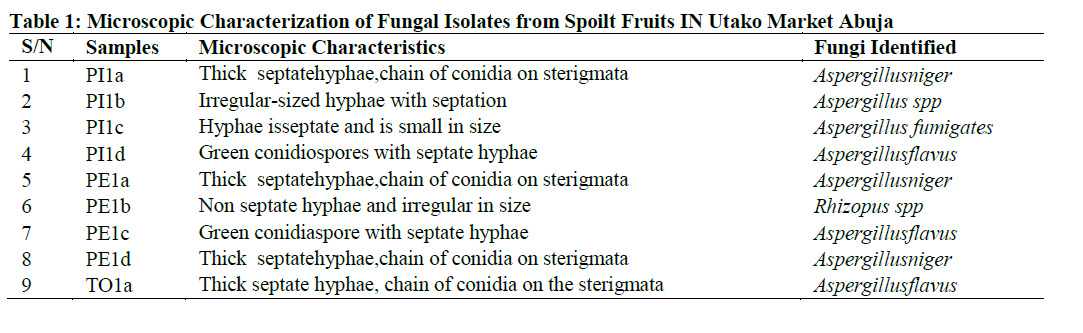
Fruits inherently harbor a diverse range of microorganisms, including various pathogens like fungi. Food spoilage is a complex process, and excessive amounts of food are lost due to microbial spoilage, even with modern-day preservation techniques. This research investigated the different types of fungal species associated with fruit spoilage at the Utako market in Abuja, Nigeria. A total of one hundred fruits—seventy spoiled and thirty healthy—were collected from the market and brought to the lab. A sterile blade was used to cut thin slices of the rotting fruits, which were then inoculated onto PDA media and incubated for five days at 27 oC. Aspergillus niger, A. flavus, A. fumigatus, Aspergillus spp., Rhizopus spp., Mucor spp., and Alternaria spp. were the seven distinct fungal species found in the results. Alternaria is the least common species, whereas Aspergillus niger is the most common species. However, Alternaria has the lowest pathogenicity, whereas Rhizopus spp. have the highest. Some of these fungal species have strains that are known to produce toxins and have the potential to cause serious food poisoning.
References
1. Akinmusire, O. O. (2011). Fungal species associated with the spoilage of some edible fruits in Maiduguri, North-Eastern Nigeria. Advances in Environmental Biology, 5(1):157-161.
2. Akinro, E. B., Adetuberu, I. A., Efunwole, O. O., & Olakunle, T. P. (2015). Isolation and identification of fungal species associated with the spoilage of some selected edible fruits in Iree town of Boripe Local Government, Osun State, Nigeria. Journal of Research in Pharmaceutical Science, 2(7), 07-10.
3. Alegbeleye, O., Odeyemi, O. A., Strateva, M., & Stratev, D. (2022). Microbial spoilage of vegetables, fruits and cereals. Applied Food Research, 2(1), 100122.
4. Baiyewu, R.A, Amusa, N.A, Ayoola,O.A,,and Babalola, O.O. (2007). Survey of the postharvest diseases and aflatoxin contamination of marketed Pawpaw fruit (Carica papaya L.) in South Western Nigeria. Afr. J. Agric. Res, 2(4):178–181.
5. Balali, G.R., Naete, S.M., Scott, E.S., Whisson, D.L., and Wicks, T.J. (1995). Anastomosisgroup and pathogenicity of isolates of Rhizoctonia solani from potato crops in South Australia. Plant Pathol. 44: 10501057
6. Bali, R.V., Bindu, M.G., Chenga, R.V., and Reddy, K. (2008). Post harvest fungal spoilage in sweet orange (Citrus sinensis) and acid lime (Citrus aurentifoliaSwingla) at different stages of marketing. Agric. Sci. Digest, 2008;28:265–267.
7. Barnett, H. L. and Hunter, B. (1972). Illustrated Genera of Imperfect Fungi. Burgress PublishingCompany, Minneapolis, 241pp.
8. Barth, M., Hankison, T.R., Zhuang, H., and Breidt, F. (2009).Microbiological spoilage of fruits and vegetables. In: Sperber W.H, Doyle M.P, editors. Compendium of the Microbiological Spoilage of Foods and Beverages, Food Microbiology and Food Safety. New York: C Springer Science Business Media, LLC; 2009. pp. 135–183.
9. Bukar, A., Mukhtar, M.D., and Adamu, S. (2009). Isolation and identification of postharvest
10. Chukwuka, K.S., Okonko, I.O., and Adekunle, A.A. (2010). Microbial ecology of organisms causing pawpaw (Carica papaya L.) fruit decay in Oyo State, Nigeria. Am. Eurasian J. Toxicol. Sci., 2(1):43–50.
11. Dashwood, E. P., Fox, R. A. and Perry, D. A. (1992): Effects of inoculation source on roots andtubers infection by potato blemish disease fungi. Journal of Plant Pathology, 41: 215 – 223.
development of Aspergillus flavus rot of mango fruit. Sci. Technol., 3:48–49.
12. Droby S. (2006). Improving the quality and safety of fresh fruits and vegetables after harvest by the use of biocontrol agents and natural materials. Acta Hortic, 709:45–51.
13. Ewekeye,T.S., Oke,O.A.,Quadri,A.I., Isikalu,A.O., Umenwaniri,M.O., and Durosinmi,M.L. (2013). Studies on Post Harvest Deterioration of Some Fruits and Vegetables in Selected Markets in Lagos State, Nigeria. American Journal of Research Communication, 1(10):209-223.
14. Fawole, M.O. and Oso, B.A. (1995). Laboratory Manual of Microbiology. 1st Edition. Spectrum Books Ltd, Ibadan, Nigeria Pp. 34 - 35.
fruits. Int. J. F. Microbiol., 105: 11-17.
15. Gadgile, D.P., and Chavan, A.M. (2010). Impact of temperature and relative humidity on
identification of fungi associated with spoiled fruits vended in Gwagwalada market, Abuja, Nigeria. VetWorld, 10(4): 393-397.
16. Mailafia, S., Okoh, G.R., Hamza, O. Olabode, K., and Osanupin, R. (2017). Isolation and
17. Mukhtar, M. R. (2023). Fungal Species Isolation And Characterization From Spoiled Fruits: A Study At Utako Market, Abuja, Nigeria. American Journal Of Applied Science And Technology, 3(06), 34-38.
18. Okereke, V.C., Godwin-Egein, M.I., and Arinze, A.E. (2010). Assessment of postharvest rot of mango at different stages of market in Port Harcourt, Nigeria. Int. J. Curr. Res, 11:6–10.
19. Oyeleke, A., and Manga, S.B. (2008).Essentials of Laboratory Practice. 3rd ed. Minna, Niger state, Nigeria: Tobest Publisher, 12–29 pp.
20. Rawat, S. (2015). Food Spoilage: Microorganisms and their prevention. Asian journal of plant science and Research, 5(4), 47-56.
21. Snyder, A. B., & Worobo, R. W. (2018). Fungal spoilage in food processing. Journal of Food Protection, 81(6), 1035-1040.
spoilage fungi associated with sweet oranges (Citrus sinensis) traded in Kano metropolis. BAJOPAS, 2(1):122-124.
22. Tournas VH, Katsoudas E (2005). Mould and yeast flora in fresh berries, grapes and citrus
23. Zhao, P., Ndayambaje, J. P., Liu, X., & Xia, X. (2022). Microbial spoilage of fruits: A review on causes and prevention methods. Food Reviews International, 38(sup1), 225-246.
Downloads
Published
Issue
Section
Categories
License
Copyright (c) 2026 Fatima Mukhtar Mairami, Samira Abdulmudallib Abdullahi

This work is licensed under a Creative Commons Attribution 4.0 International License.


