
ESTIMATION OF ENTRANCE SKIN DOSE IN ANALOGUE X-RAY FACILITIES OF SOUTHERN DELTA STATE, NIGERIA: A MATHEMATICAL APPROACH TO RADIOLOGICAL PROTECTION
DOI:
https://doi.org/10.33003/fjs-2026-1003-4574Keywords:
Effective dose, X-ray machines, Radiation safety, ESD, ExaminationAbstract
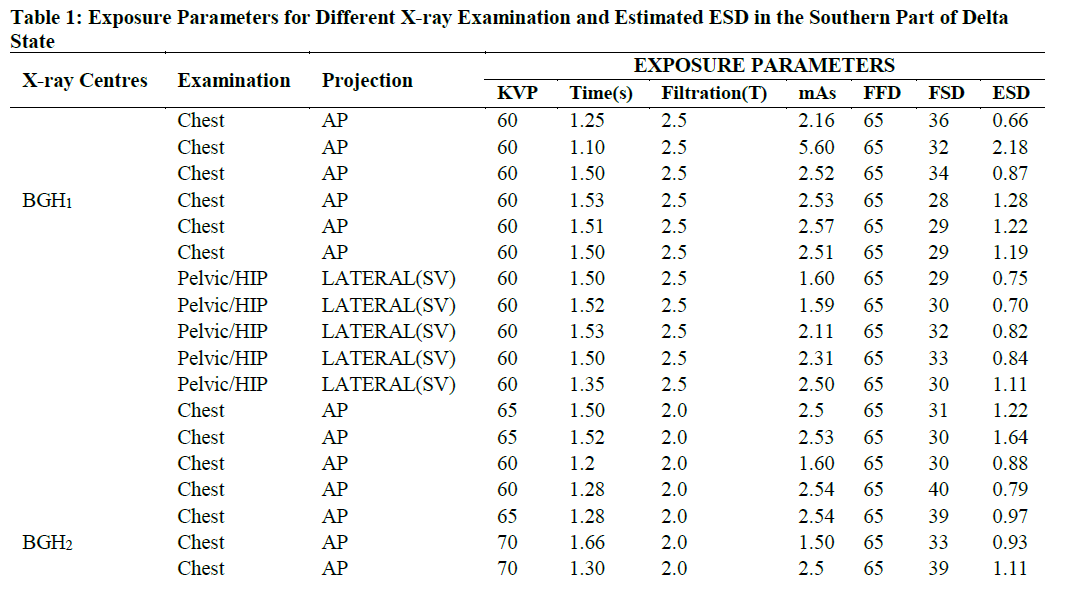
Radiation dose optimisation in diagnostic radiography is essential for patient safety and adherence to international standards. In many developing regions, analogue X-ray systems remain in use, raising concerns about elevated exposure levels. This study evaluated entrance skin dose (ESD) and effective dose in four government-owned hospitals in southern Delta State, Nigeria, all operating analogue X-ray equipment. Patient examinations included three routine projections: chest (AP), pelvis (SV), and abdomen (LS). The mean ESD values obtained were BGH1 (1.04 mGy), BGH2 (0.94 mGy), DEXC1 (1.78 mGy), and DEXC2 (0.87 mGy). These values exceeded the international diagnostic reference level of 0.4 mGy, though they were lower than those reported in several previous studies and marginally higher than results published by the same authors elsewhere. The elevated doses may reflect suboptimal operator techniques and inadequate equipment maintenance. Although quality control assessments are mandated quarterly, inconsistent compliance likely contributes to the observed deviations. The findings emphasize the need for stricter enforcement of quality assurance protocols and enhanced operator training to reduce patient radiation exposure. While the recorded doses remain within diagnostic ranges, optimization of radiographic practice is imperative to align with international benchmarks and safeguard patient health.
References
Adelayi, M. O., & Ajayi, O. S. (2023). Evaluation of entrance skin dose from paediatric diagnostic X ray examination. Open Journal of Radiology, 13, 26–33. https://doi.org/10.4236/ojrad.2023.131003
Alghoul, A., Abdalla, M. M., & Abubaker, H. M. (2017). Mathematical evaluation of entrance surface dose (ESD) for patients examined by diagnostic X-rays. Open Access Journal of Science, 1(1), 8–11. https://doi.org/10.15406/oajs.2017.01.00003
Asogwa, C. O., Chiegwu, H. U., Omojola, A. D., & Onwughalu, E. M. (2021). Assessment of radiation dose to pediatric patients during routine digital chest X ray procedure in a government medical centre in Asaba, Nigeria. Medical Science and Discovery. https://doi.org/10.36677/msd.21486832
Ciraj, O., Marković, S., & Koštitics, D. (2005). First results on patient dose measurements from conventional diagnostic radiology procedures in Serbia and Montenegro. Radiation Protection Dosimetry, 113(3), 330–335.
Davies, M., Jones, A., Smith, R., & Taylor, P. (1999). Patient dose audit in diagnostic radiography using custom designed software. Radiography, 3(1), 17–25. https://doi.org/10.1016/S1078-8174(99)80005-6
Egbe, N. O., Inyang, S. O., Ibeagwa, O. B., & Chiaghanam, N. O. (2009). A baseline study of entrance dose and image quality for lumbar spine radiography in Calabar, Nigeria. Radiography, 15(4), 306–312. https://doi.org/10.1016/j.radi.2008.09.004
Eseka, K., Molua, O. C., Morka, J. C., & Ukpene, A. O. (2022). Chest X ray ESD and ESAK assessment in a few diagnostic radiological facilities in Delta State. Journal of Healthcare Treatment Development, 2(6). https://doi.org/10.55529/jhtd.26.17.29
Esu, E. O., Chiegwu, H. U., Omojola, A. D., & Eze, E. M. (2021). Estimation of entrance skin dose and effective dose from abdomen radiography in two diagnostic facilities in Aba, Abia State, South-East Nigeria. World Scientific News, 161, 143–156
European Commission; EC (1996). European guidelines on quality criteria for diagnostic radiographic images. EUR 16260 EN Brussels
Fataftah, J., Tayyem, R., Al-Dwairy, S., Al Manasra, A. R., Ibrahim, A., Al Ryalat, R., Alwreikat, M., Al-Shraah, H., Alharbi, R., & Alharbi, B. (2024). Awareness of radiation hazards and knowledge of radioprotective measures among radiologists and non-radiology staff: A cross-sectional survey. Egyptian Journal of Radiology and Nuclear Medicine, 55, Article 128. https://doi.org/10.1186/s43055-024-01300-4
Faulkner, K., Broadhead, D. A., & Harrison, R. M. (1999). Patient dosimetry measurement methods. Applied Radiation and Isotopes, 50(1), 113–122. https://doi.org/10.1016/S0969-8043(98)00160-7
Gnowe, G., Ekobena, H. P. F., Mbo, J., & Neossi, M. G. (2019). Exposure levels of adult patients during radiographic examinations: Sinuses and coastal grill cases at the Ngaoundere Regional Hospital, Cameroon. Radiology Research and Practice, 2019, Article 5452149. https://doi.org/10.1155/2019/5452149
Gyan, E., Inkoom, S., & Amoako, G. (2020). Entrance skin dose assessment of selected computed radiography facilities in Ghana. International Journal of Radiation Research, 18(4), 817–823.
Maaruf, A., Gide, B. M., & Rufai, A. U. (2023). Determination of entrance surface dose for patients undergoing conventional chest X ray examination at Radiology Department, Federal Teaching Hospital (FTH) Katsina. UMYU Scientifica, 2(1), 69–77. https://doi.org/10.56919/usci.1222.009
Mohammadain, K. E. M., da Rosa, L. A. R., Azevedo, A. C. P., Guebel, M. R. N., Boechat, M. C. B., & Habani, F. (2004). Dose evaluation for paediatric chest X-ray examinations in Brazil and Sudan: Low doses and reliable examinations can be achieved in developing countries. Physics in Medicine and Biology, 49(6), 1017–1031. https://doi.org/10.1088/0031-9155/49/6/012
Nigeria Basic Ionizing Radiation Regulation (2003). NBIRR report, pariso T. C. (2008). The Dicom standard. The international journal of cardiac imaging. 11:171
Ofori, K., Gordon, S. W., Akrobortu, E., Ampene, A. A., & Darko, E. O. (2014). Estimation of adult patient doses for selected X ray diagnostic examinations. Journal of Radiation Research and Applied Sciences, 7(4), 459–462. https://doi.org/10.1016/j.jrras.2014.08.003
Omojola, A. D., Agboje, A. A., Uche, K. B., Esu, E. O., Omojola, F. R., Anizor, M. I., & Robinson, E. D. (2021). Assessment of the impact of chest radiography on the breast of female patients in a medical facility in Asaba, Delta State: An evaluation of the lifetime cancer risk. Journal of Radiological Studies, 6(4), 20–30.
Omojola, A. D., Akpochafor, M. O., Adeneye, S. O., Akala, I. O., & Agboje, A. A. (2021). Estimation of dose and cancer risk to newborn from chest X-ray in South-South Nigeria: A call for protocol optimization. Egyptian Journal of Radiology and Nuclear Medicine, 52, Article 69. https://doi.org/10.1186/s43055-021-00445-w
Rasuli, B., Mahmoud-Pashazadeh, A., Ghorbani, M., Juybari, R. T., & Naserpour, M. (2016). Patient dose measurement in common medical X-ray examinations in Iran. Journal of Applied Clinical Medical Physics, 17(1), 374–386. https://doi.org/10.1120/jacmp.v17i1.5860.
Rubai, S. S., Rahman, M. S., Purohit, S., Patwary, M. K. A., Meaze, A. K. M. H., & Mamun, A. A. (2018). Measurements of entrance surface dose and effective dose of patients in diagnostic radiography. Biomedical Journal of Scientific and Technical Research, 12(1), 1–5. https://doi.org/10.26717/BJSTR.2018.12.002186
Usikalu, M. R., Orosun, M. M., Akinpelu, A., Babarimisa, I. O., Arijaje, T. E., & Mohammed, A. U. (2024). Environmental radioactivity monitoring and radiological impact assessment of Agbara Industrial Area, Ogun State, Nigeria. Polytechnica, 7, Article 9. https://doi.org/10.1007/s41050-024-00052-4
Vatsa, M. A., Bello, I. A., Onuh, E., Garba, N. N., Kado, S., Ahmad, A. A., & Aminu, M. A. (2022). Assessment of entrance surface dose (ESD) in some routine X ray examinations at the Faculty of Veterinary Medicine, Ahmadu Bello University, Zaria. Bayero Journal of Pure and Applied Sciences, 13(1), 87–91.
Wall, B. F., & Hart, D. (1997). Revised radiation doses for typical X-ray examinations: Report on a recent review of doses to patients from medical X-ray examinations in the UK by the NRPB. British Journal of Radiology, 70, 437–439.
Yacoob, H. Y., & Mohammed, H. A. (2017). Assessment of patients’ X-ray doses at three government hospitals in Duhok City lacking requirements of effective quality control. Journal of Radiation Research and Applied Sciences, 10(3), 183–187. https://doi.org/10.1016/j.jrras.2017.04.005
Liu, X., Su, Q., Zhang, J., Chen, Y., Li, F., Xie, C., He, L., Liu, S., & Lv, Y. (2025). Low-dose radiation exposure and health outcomes among healthcare workers: A multi-center prospective cohort study. Journal of Health, Population and Nutrition, 44, Article 414. https://doi.org/10.1186/s41043-025-01133-5.
Najjar, R. (2023). Radiology’s Ionising Radiation Paradox: Weighing the Indispensable Against the Detrimental in Medical Imaging. Cureus, 15(7), e41623.
John, M., & Mina, J. A. R. (2024). Medical Physics in Cancer Treatment: A Comprehensive Review of Innovations, Challenges, and Future Directions. Radiation Science and Technology, 10(2), 26–36.
Dudhe, S. S., Mishra, G., Parihar, P., Nimodia, D., & Kumari, A. (2024). Radiation dose optimization in radiology: A comprehensive review of safeguarding patients and preserving image fidelity. Cureus, 16(5), e60846. https://doi.org/10.7759/cureus.60846
Hassan, A., & Mraity, H. (2024). Patients’ dosimetry during lumbar radiographic examination (Lat) in certain hospitals at Dhi Qar governorate, Iraq. Journal of Kufa-Physics, 16(1), 56–67. https://doi.org/10.31257/2018/JKP/2024/v16.i01.14419
Huang, S.-H., Huang, S.-R., & Chou, M.-C. (2024). Investigation of the relationship between body parameters and current–time product in kidney–ureter–bladder digital radiography. Journal of Radiological Science, 49(1), 39–44. https://doi.org/10.4103/jradiolsci.JRADIOLSCI-D-23-00035
Haider, U. H., Hussain, B., Shaheen, W., Iqbal, M., Sandhu, M. A., & Fatima, N. (2024). Comparison of directly and indirectly estimated entrance skin dose (ESD) for diagnostic radiation qualities (RQR, RQA and RQT) using water phantom and shadow-free diagnostic chamber (SFD). Egyptian Journal of Radiology and Nuclear Medicine, 55, 164. https://doi.org/10.1186/s43055-024-01337-5
Alomairy, N., Hadi, D., Al-Zaid, A., Fasikh, R., Arif, R., Al-Hazmi, R., Kharizy, A., Alyami, A., Hummdy, A., & Shubayr, N. (2023). Evaluation of the entrance surface doses (ESD) for common diagnostic X-ray examinations. Journal of Radiation Research and Applied Sciences, 16(4), 100754. https://doi.org/10.1016/j.jrras.2023.100754
Sidi, M., England, A., Mansur, U., Muhammad, Z., Garba, I., Zira, D., Abubakar, U., Abubakar, A. A., Ya’u, A., & Luntsi, G. (2024). Radiation protection measures of the radiological facilities in Kano metropolis, Nigeria. West African Journal of Radiology, 29(2), 118–124. https://doi.org/10.82235/wajr.vol29no2.49
Bamanga, A., Umaru, A., Musa, H. M., Mohammed, Y. M., Ali, A. M., Muhammed, I., Lawal, A., & Imam, Z. M. (2024). Radiographers’ knowledge, practice, and compliance with radiation protection measures in the radiology department. Annals of Basic and Medical Sciences, 4, 377–382. https://doi.org/10.51658/ABMS.202331.6
Shamsi, K., Shabestani Monfared, A., Deevband, M. R., Mohsenzadeh, B., Ghorbani, M., Ebrahimnejad Gorji, K., & Niksirat, F. (2020). Evaluation of effective dose and entrance skin dose in digital radiology. Polish Journal of Medical Physics and Engineering, 26(2), 119–125. https://doi.org/10.2478/pjmpe-2020-0013
Downloads
Published
Issue
Section
Categories
License
Copyright (c) 2026 Anita F. Akpolile, Amanda A. Ukerun-Akpesiri, Crownbirth E. Eki, Francisca E. Abdul

This work is licensed under a Creative Commons Attribution 4.0 International License.


